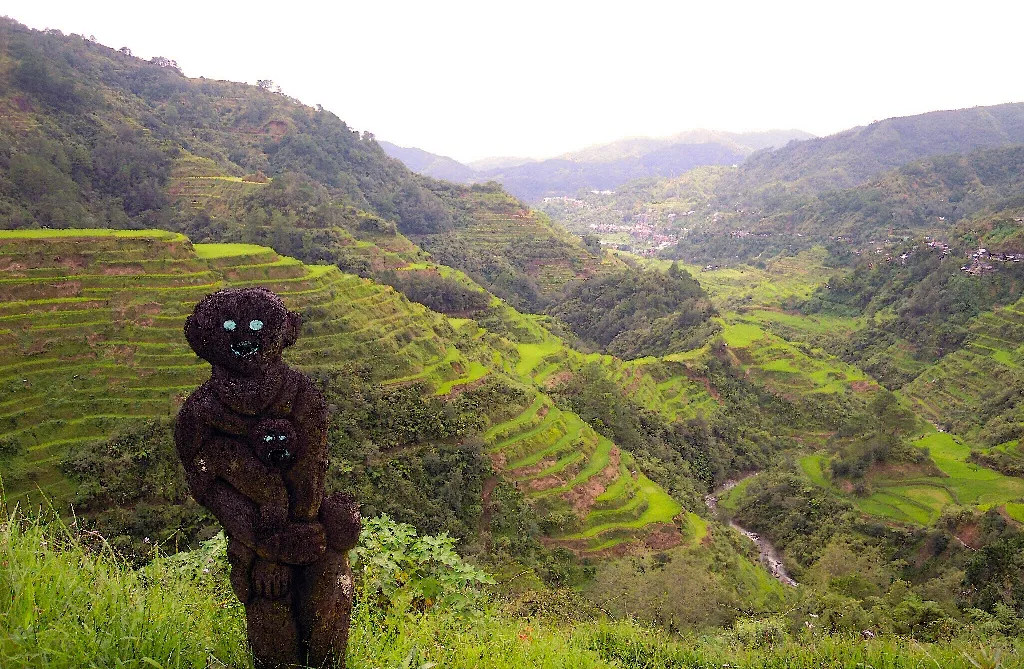
The Banaue Rice Terraces are often called the Eighth Wonder of the World, and when you stand at the viewpoint on a clear morning and see the green steps climbing up the sides of the Cordillera mountains, it is easy to understand why. Carved into the slopes by the Ifugao people over a period of roughly 2,000 years, these terraces are not ruins or a monument. They are a living agricultural system, still planted with rice and vegetables by the communities that maintain them. They are also a UNESCO World Heritage Site, recognized for their cultural significance and their remarkable engineering.
Banaue Rice Terraces: Walking the 2,000-Year-Old Stairways to Heaven
Trip.com
Search on Trip.comHotels in Banaue
Compare live prices via Travelpayouts — targeted for this guide.
The History of the Banaue Rice Terraces
The rice terraces of the Philippine Cordillera were built by hand, without machinery, over many generations. The Ifugao people carved the mountainsides into narrow, stepped fields, each one supported by a stone and mud wall. Water from mountain streams and rainfall was channeled through an irrigation system of bamboo pipes and canals that still functions today. The terraces were designed to grow rice at altitudes of 700 to 1,500 meters above sea level, which is unusual for rice cultivation.
UNESCO inscribed the Rice Terraces of the Philippine Cordillera on the World Heritage List in 1995. The inscription covers five clusters: Batad, Bangaan, Mayoyao, Hungduan, and Nagacadan. These are spread across four municipalities in Ifugao province. The Banaue Rice Terraces, which are the most famous and most photographed, are actually not part of the UNESCO inscription. They are a separate set of terraces visible from the main viewpoint in Banaue town. However, they are protected as a National Cultural Treasure under Philippine law and are the gateway to the UNESCO clusters.
The terraces are a testament to the Ifugao people's deep knowledge of their environment. The walls are built to withstand earthquakes and heavy rain. The irrigation system uses gravity to distribute water evenly across thousands of small fields. The rice varieties grown here are traditional upland strains that are adapted to the cool climate and the high altitude.
Trip.com
See all tours in Banaue on Trip.comHiking tour in Banaue
Hand-picked experiences in Banaue — book on Trip.com with instant confirmation.
How to Get to Banaue
Banaue is a municipality in Ifugao province in the Cordillera Administrative Region of northern Luzon. It is about 350 kilometers north of Manila, a drive of 8 to 10 hours by bus on mountain roads. The most common way to get there is by overnight bus. Ohayami Trans and Coda Lines operate direct buses from Manila to Banaue. Ohayami departs from its terminal in Sampaloc, Manila, and the fare is PHP 900 to PHP 1,100 one way for a semi-reclining seat. The bus leaves Manila in the evening and arrives in Banaue at around 5:00 to 6:00 AM. Coda Lines departs from Quezon City and offers similar fares.
If you prefer to drive, the route goes through the NLEX, SCTEX, and TPLEX highways to Baguio or via the Nueva Vizcaya route through Dalton Pass. The drive takes about 8 hours in good conditions. A private van with driver from Manila costs PHP 8,000 to PHP 12,000 for a round trip.
From Banaue town, the UNESCO terraces at Batad are about 19 kilometers away by road, followed by a 30 to 45-minute downhill hike. Bangaan is about 14 kilometers from Banaue. Tricycles and jeepneys can take you to the trailheads for PHP 150 to PHP 300 per person.
The Main Viewpoints and Terraces
The most famous view of the Banaue Rice Terraces is from the roadside viewpoint about 4 kilometers from the town center on the road to Batad. This is where the iconic postcard image comes from. The viewpoint is free to visit, though there is a small environmental fee of PHP 50 for visitors to Banaue that is usually collected at the tourism office or by your accommodation.
The Batad Rice Terraces are the most spectacular of the UNESCO clusters. They form an amphitheater of terraces that curves around a small valley. The village of Batad sits in the middle, accessible only on foot. The hike down to Batad takes about 45 minutes from the saddle (the point where the road ends). Once in the village, you can walk among the terraces, visit the traditional Ifugao houses, and hike to Tappiya Waterfall, a 30-minute walk from the village center. The waterfall has a deep pool where you can swim after the hike.
The Bangaan Rice Terraces are less visited than Batad and offer a quieter experience. They are a smaller cluster but equally beautiful, with a traditional village at the base. The hike down takes about 30 minutes. Bangaan is a good option if you want to see a UNESCO terrace cluster without the crowds that Batad can attract.
Hiking the Terraces: Routes and Difficulty
There are several hiking options depending on your time and fitness level. The most popular is the Batad day hike. From Banaue town, take a tricycle or jeepney to the Batad saddle (about 45 minutes), then hike down to the village (45 minutes), explore the terraces and hike to Tappiya Waterfall (30 minutes each way), then hike back up to the saddle (1 hour). The total hiking time is about 3 to 4 hours. The trail is steep in sections, with stone steps and dirt paths. It is rated moderate to challenging depending on your fitness.
For a longer experience, you can do a 2-day trek from Banaue to Batad to Bangaan, staying overnight in a homestay in Batad. This costs about PHP 1,500 to PHP 2,500 per person including guide, homestay, and meals. A local guide is strongly recommended for any trek that goes beyond the main viewpoints. Guide fees are PHP 800 to PHP 1,200 per day.
If you want to see all five UNESCO clusters, a 3 to 4-day trek connecting Batad, Bangaan, Mayoyao, Hungduan, and Nagacadan is possible but requires advance planning and a guide. This is a serious trek through remote mountain areas and should only be attempted by experienced hikers.
When to Visit the Banaue Rice Terraces
The appearance of the terraces changes dramatically with the rice growing cycle, so when you visit affects what you see. The planting season begins in December and January, when the terraces are flooded with water and look like giant mirrors reflecting the sky. This is one of the most beautiful times to visit. The rice grows from February to June, turning the terraces progressively greener. The harvest happens in June and July, when the terraces turn golden yellow. From August to November, the terraces are dry and brown as they are prepared for the next planting cycle.
The best weather is during the dry season from December to May. March and April offer clear skies and warm days. The rainy season from June to October can make the trails slippery and the views cloudy, though the terraces are still impressive. If you want to see the harvest, plan for late June to early July.
Where to Stay in Banaue
Banaue town has a range of accommodations, from budget homestays to mid-range lodges. A basic room with a shared bathroom costs PHP 400 to PHP 700 per night. A double room with a private bathroom in a guesthouse runs PHP 800 to PHP 1,500. Mid-range lodges with hot water and terrace views start at PHP 1,500 to PHP 3,000. The Banaue Hotel and Youth Hostel, a government-run property, offers rooms from PHP 1,200 and has a restaurant and a viewpoint.
In Batad, accommodation is limited to homestays and small guesthouses. A homestay with meals costs PHP 500 to PHP 800 per person per night. Conditions are basic, with shared bathrooms and limited electricity (some homes have solar power or generator electricity for a few hours in the evening). Staying overnight in Batad is worth it for the quiet and the chance to see the terraces at sunrise and sunset without the day-trip crowds.
Visiting the Terraces Respectfully
The rice terraces are not a museum. They are working farms and the homes of the Ifugao people. When you visit, remember that you are walking through someone's livelihood. Stay on the paths and do not walk on the terrace walls, which can collapse under weight. Do not pick the rice or the vegetables. Ask permission before taking photos of people, and respect their privacy if they decline.
The terraces face real threats. Many are deteriorating because younger generations are leaving the mountains for cities, and the maintenance of the walls and irrigation systems requires constant labor. Parts of some terraces have been converted to vegetable farming, which can damage the ancient walls. Tourism, when done responsibly, is one of the ways the local community can afford to maintain the terraces. Pay the environmental fees, hire local guides, and buy local products and handicrafts.
Frequently Asked Questions
Are the Banaue Rice Terraces a UNESCO World Heritage Site?
The Banaue Rice Terraces visible from the main viewpoint are not part of the UNESCO inscription. The UNESCO World Heritage Site covers five clusters in Ifugao: Batad, Bangaan, Mayoyao, Hungduan, and Nagacadan. However, the Banaue terraces are a National Cultural Treasure and are the most accessible starting point for visiting the UNESCO clusters.
How old are the Banaue Rice Terraces?
The terraces are estimated to be 2,000 to 3,000 years old, built by the Ifugao people over many generations. They are among the oldest continuously used agricultural systems in the world.
How do I get to Batad from Banaue?
Take a tricycle or jeepney from Banaue town to the Batad saddle, about 19 kilometers and 45 minutes by road. From the saddle, hike down to the village of Batad, which takes 30 to 45 minutes. The road to the saddle costs PHP 150 to PHP 300 per person by tricycle.
Can I walk on the rice terraces?
You can walk along the paths between the terraces, but you should not walk on the terrace walls themselves. The walls are made of stone and mud and can be damaged by foot traffic. Always follow your guide's instructions and stay on designated paths.
What is the best time to see the Banaue Rice Terraces?
For mirror-like flooded terraces, visit December to February. For green terraces, visit March to June. For golden harvest colors, visit late June to early July. The dry season from December to May has the best weather for hiking.
Plan Your Banaue Trip With PANA
Ready to walk the stairways to heaven? PANA.PH has everything you need. Explore our destinations for more Cordillera spots, book a tour with local Ifugao guides, find a hotel in Banaue or Batad, and read more from our blog for hiking and cultural travel guides.
Sources and References
Sources
Primary references for the figures and rules in this guide. Fees and schedules change — check the source before you travel.

PANA.PH Luzon Desk
Luzon travel logistics — Manila, Baguio and North Luzon
The Luzon Desk of the PANA.PH travel desk: it maintains and re-checks the luzon travel logistics — manila, baguio and north luzon data behind the site's guides — operator price lists, official fee schedules and posted timetables — and publishes what it can verify.
🏡 Real local stays (book direct)
Hand-picked homestays and guesthouses — book direct, no markup.
Browse all local stays →
🌊 Popular activities (book instantly)
Island hopping, canyoneering, whale sharks — real Klook/GetYourGuide options.
View all activities →