The Miagao Church, formally known as the Church of Santo Tomas de Villanueva, is a Roman Catholic parish church in the municipality of Miagao in the province of Iloilo, Panay Island. It is one of four Baroque Churches of the Philippines inscribed on the UNESCO World Heritage List in 1993, and it is widely regarded as the most visually distinctive of the four. Its facade, carved from local sandstone, blends European Baroque design with tropical and indigenous motifs, creating a style that is found nowhere else in the world. The church also functioned as a fortress, its thick walls and strategic position on a hill reflecting the dual purpose of many Spanish colonial churches in the Philippines: to serve as places of worship and as refuges during pirate raids.
Miagao Church: The Baroque Fortress Church of Iloilo (UNESCO)
Hotels in Visayas
Compare live prices via Travelpayouts — targeted for this guide.
This guide covers the history and architecture of Miagao Church, its UNESCO significance, how to get there from Iloilo City, what to see inside and around the church, and how to build a heritage day trip through the towns of southern Iloilo. Whether you are an architecture enthusiast, a heritage traveler, or a pilgrim, Miagao Church is a destination that rewards close attention.
The History of Miagao Church
The town of Miagao was established as a parish by the Augustinian missionaries in 1731, part of the broader effort to Christianize the island of Panay after the Spanish arrival in the 16th century. The original church was built near the coast, but the constant threat of Muslim slave raiders from the south forced the townspeople and the friars to relocate the settlement inland, to a hilltop site that offered better visibility and defensibility. Construction of the present church began in 1787 and was completed in 1797, under the supervision of the Augustinian friar Francisco Maximo Gonzales and with the labor of the local Miagawanon community.
The church was built to serve a dual purpose. On ordinary days, it was a place of worship, the center of the religious life of the town. In times of danger, it was a fortress, its thick walls and elevated position providing a refuge for the population during raids. The walls, made of coral stone and sandstone quarried from nearby hills, are roughly 1.5 meters thick, and the bell towers were designed to serve as watchtowers. This combination of religious and military function is a hallmark of Philippine Baroque architecture, a response to the specific conditions of the colonial era.
City tour in Visayas
Hand-picked experiences in Visayas — book on Trip.com with instant confirmation.


Over the centuries, the church has suffered damage from fire, earthquake, and war. It was burned during the Philippine Revolution at the end of the 19th century, damaged by earthquakes in the early 20th century, and partially destroyed during World War II. Each time, the church was restored, often with modifications. The current structure is the result of multiple rounds of restoration, the most recent of which was carried out by the National Historical Commission of the Philippines (NHCP) in consultation with the UNESCO World Heritage Centre to ensure that the original character of the building was preserved.
The Architecture and the Facade
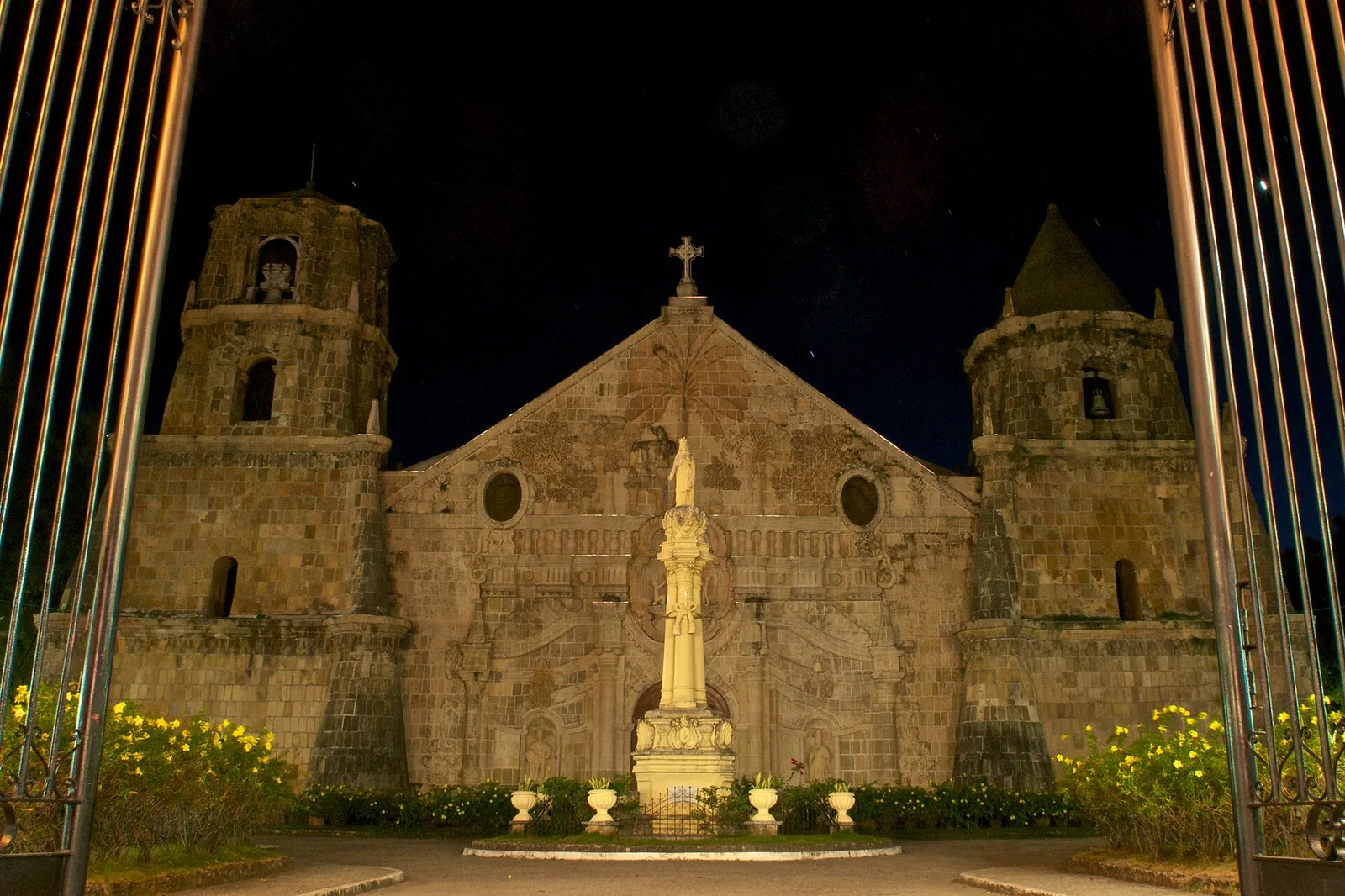
The facade of Miagao Church is its most celebrated feature, and it is what draws most visitors to the site. The facade is made of local sandstone, which gives it a warm ochre color that shifts in tone depending on the time of day and the angle of the sun. The stone was quarried from the hills around Miagao and was cut and carved by local artisans, many of whom were skilled in working with the soft, workable stone of the region.
The design follows the Baroque style, with a central portal flanked by columns and topped by a pediment. But what sets the Miagao facade apart is the carving. The entire surface is covered with relief sculpture, and the motifs are a blend of European Christian imagery and tropical, local elements. The centerpiece of the facade is a large relief of Saint Christopher carrying the Christ child on his shoulder, wading through a stylized tropical landscape filled with coconut trees, papaya, and other local flora. This blending of a European saint with a Philippine landscape is one of the most famous examples of the localization of Baroque art in the country.
Flanking the central portal are columns decorated with vines and rosettes, and above the portal is a niche containing a statue of Saint Thomas of Villanova, the patron saint of the parish, shown in his customary pose of distributing alms to the poor. The pediment, the triangular section at the top of the facade, contains a carved relief of a coconut tree with a stylized heart, a motif that has been interpreted in various ways by scholars but that is generally understood as a symbol of the local community's faith and identity.
The Bell Towers
Two bell towers flank the facade, and they are famously mismatched in design. The left tower, which is slightly lower, has a simpler, more austere design, while the right tower is taller and more ornate. The mismatch is believed to reflect the fact that the two towers were built at different times and possibly under the direction of different friars. The left tower is thought to be the earlier of the two, while the right tower was added or completed later with a more elaborate design.
The towers served as watchtowers during the era of pirate raids, and their elevated position gave a clear view of the coast and the surrounding countryside. Today, they are one of the most photographed features of the church, and their asymmetry has become a beloved characteristic rather than a flaw.
The Interior of the Church
The interior of Miagao Church was largely destroyed by fire and war, and the current interior is a reconstruction dating from the 20th century. The original ceiling, which was reportedly painted with scenes from the life of Saint Thomas of Villanova, was lost. The current ceiling features murals painted in the 1980s by a local artist, depicting biblical scenes and the history of the parish.
The retablo, the decorated screen behind the altar, is a modern reconstruction based on the original design. It follows the Baroque style of the facade, with multiple tiers of niches containing statues of saints. The main altar is dedicated to Saint Thomas of Villanova, and side altars are dedicated to the Virgin Mary and other saints important to the local community.
Despite the losses, the interior retains a sense of solemnity and grandeur. The thick stone walls keep the interior cool even on hot days, and the play of light through the windows creates a contemplative atmosphere. If you visit during a mass, you will experience the church as it was meant to be experienced, as a living place of worship rather than a museum piece.
UNESCO World Heritage Status
Miagao Church was inscribed on the UNESCO World Heritage List in 1993 as one of the Baroque Churches of the Philippines, along with San Agustin Church in Manila, Nuestra Senora de la Asuncion in Santa Maria, Ilocos Sur, and San Agustin Church in Paoay, Ilocos Norte. The inscription recognizes the churches as outstanding examples of the Philippine interpretation of the Baroque style, which adapted European architectural forms to local materials, climate, and cultural context.
The UNESCO citation specifically notes the fusion of European Baroque design with local craftsmanship and tropical motifs, and the fortress-like character of the churches, which reflects the defensive needs of the colonial era. Miagao Church is highlighted for its particularly rich and ornate facade, which is considered the most elaborate example of the localized Baroque style in the country.
World Heritage status brings both recognition and responsibility. The church is maintained under the guidelines of the UNESCO World Heritage Centre and the NHCP, and any restoration or modification must be carried out in consultation with these bodies to ensure that the site's outstanding universal value is preserved.
How to Get to Miagao Church
Miagao is located about 40 kilometers southwest of Iloilo City, the regional capital of Western Visayas. Iloilo City is accessible by air through Iloilo International Airport (ILO), which receives flights from Manila, Cebu, and other major cities. A one-way economy flight from Manila to Iloilo typically costs between PHP 2,000 and PHP 4,000, while flights from Cebu are generally between PHP 1,500 and PHP 2,500.
From Iloilo City, the easiest way to reach Miagao is by jeepney. Jeepneys bound for Miagao and other southern towns depart from the Mohon terminal and from other points in the city. The fare is about PHP 50 to PHP 70 one way, and the trip takes about 1 to 1.5 hours depending on traffic. The jeepney will drop you off at the town proper, and the church is a short walk from the main road.
If you prefer more comfort, you can hire a taxi or a private car from Iloilo City. A one-way taxi ride to Miagao costs about PHP 800 to PHP 1,200, and a chartered car for a half-day heritage tour of southern Iloilo runs about PHP 2,500 to PHP 3,500. Many visitors choose this option because it allows them to visit multiple churches and heritage sites in a single trip.
A Heritage Day Trip Through Southern Iloilo
Miagao Church is the highlight of a heritage route through the towns of southern Iloilo, and it is best visited as part of a day trip that includes several other Spanish-era churches. The route typically starts in Iloilo City and proceeds southwest along the coastal road, passing through the towns of Oton, Tigbauan, Guimbal, and Miagao, with optional extensions to San Joaquin and Anini-y.
In Tigbauan, you can visit the Church of Saint John of Sahagun, which features a Latin inscription on its facade and a distinctive Churrigueresque altar. In Guimbal, the Church of Saint Nicholas of Tolentine has a yellow sandstone facade and four bell towers that also served as watchtowers. In San Joaquin, the Church of Saint Joachim has a facade carved with a relief of the Battle of Tetuan, a scene from the Spanish-Moroccan conflict, which is unique among Philippine churches.
A full-day heritage tour of southern Iloilo, including transportation and a guide, can be arranged through tour operators in Iloilo City for about PHP 2,500 to PHP 4,500 per person, depending on group size and inclusions. If you are doing it independently, a jeepney-hopping trip costs only a few hundred pesos in fares, plus meals.
Practical Tips for Visiting
The church is open daily, and there is no entrance fee, though donations are welcome and help support maintenance. If you want to see the interior, check the mass schedule, as the church is an active parish and access may be limited during services. Sunday mornings are particularly busy with mass attendees.
For photography, the best light on the facade is in the late afternoon, when the sun is low and the ochre sandstone takes on a warm, golden glow. Morning light is also good, but the facade faces west, so afternoon is generally preferred. The bell towers are best photographed from the plaza in front of the church, where you can capture the full asymmetry of the two towers.
Wear modest clothing if you plan to enter the church, as it is a place of worship. Shoulders and knees should be covered. Be respectful during masses and devotions, and avoid using flash photography inside.
Where to Stay in Iloilo
Most visitors to Miagao base themselves in Iloilo City, which has a wide range of accommodations. Budget inns and hostels start at around PHP 600 to PHP 1,000 per night. Mid-range hotels charge PHP 1,500 to PHP 3,000, and higher-end hotels with full amenities range from PHP 3,500 to PHP 6,000. If you prefer to stay closer to Miagao, there are a few guesthouses and resorts in the area, but the selection is more limited.
Frequently Asked Questions
Is Miagao Church a UNESCO World Heritage Site?
Yes. Miagao Church was inscribed on the UNESCO World Heritage List in 1993 as one of the Baroque Churches of the Philippines, recognized for its outstanding example of Philippine Baroque architecture and its fusion of European and local design elements.
What is the best time to photograph the facade?
The late afternoon offers the best light, as the facade faces west and the low sun brings out the warm tones of the sandstone and the details of the carvings.
Is there an entrance fee?
No, there is no entrance fee to visit the church. Donations are welcome and help support the maintenance of the building and the parish.
How do I get to Miagao from Iloilo City?
Jeepneys bound for Miagao depart from Iloilo City and cost about PHP 50 to PHP 70 one way. The trip takes 1 to 1.5 hours. A taxi or private car costs about PHP 800 to PHP 1,200 one way.
Why are the two bell towers different?
The two bell towers are mismatched in design, likely because they were built at different times and possibly under the direction of different friars. The asymmetry has become a beloved and iconic feature of the church.
Plan Your Iloilo Heritage Trip with PANA
Ready to explore the Baroque churches and heritage towns of Iloilo? PANA.PH has you covered. Discover more Visayas heritage sites in our destinations guide, book a church and heritage tour through our tours marketplace, find accommodations in our hotels directory, and read more travel stories on our blog.
Sources and References
Sources
Primary references for the figures and rules in this guide. Fees and schedules change — check the source before you travel.

PANA.PH Visayas Desk
Visayas travel logistics — Cebu, Bohol, Boracay and Siargao
The Visayas Desk of the PANA.PH travel desk: it maintains and re-checks the visayas travel logistics — cebu, bohol, boracay and siargao data behind the site's guides — operator price lists, official fee schedules and posted timetables — and publishes what it can verify.
🏡 Real local stays (book direct)
Hand-picked homestays and guesthouses — book direct, no markup.
Browse all local stays →
🌊 Popular activities (book instantly)
Island hopping, canyoneering, whale sharks — real Klook/GetYourGuide options.
View all activities →