Short answer: Cloud 9 works from August to November, peaking September to November, with the largest faces in November. Siargao sits in PAGASA climate Type II, which has no dry season at all - its wettest stretch is November to February. In 2026 two competitions close the peak: a Qualifying Series event 16-25 October and a Championship Tour stop 31 October to 10 November.
Trip.comHotels in Philippines
Compare live prices via Travelpayouts — targeted for this guide.
Search on Trip.comFor surfers and non-surfing travellers timing a Siargao trip, especially anyone booking around the 2026 competition calendar. Climate classification taken from PAGASA on 30 July 2026; swell descriptions reflect the pattern local surf schools and forecasters report season to season, not a guaranteed forecast.
| Month | Cloud 9 swell | Rain and wind | Who it suits |
|---|
| Jan-Feb | Inconsistent, occasional big days | Wettest window, Amihan wind | Patient surfers, few crowds |
| Mar-May | Small and clean | Driest stretch of a wet climate | Beginners, learners at Jacking Horse |
| Jun-Jul | Building, still modest | Habagat influence, humid | Improvers wanting space |
| Aug | Season opens | Showery, warm | Intermediates ahead of the crowd |
| Sep-Oct | Peak consistency, 4-6 ft faces common | Typhoon risk rises | Confident reef surfers |
| Nov | Biggest of the year, double overhead possible | Wet season deepening | Experienced surfers only |
| Dec | Still powerful, less consistent | Wet, Amihan strengthening | Experienced surfers |
Month by month at Cloud 9, and what the swell actually does
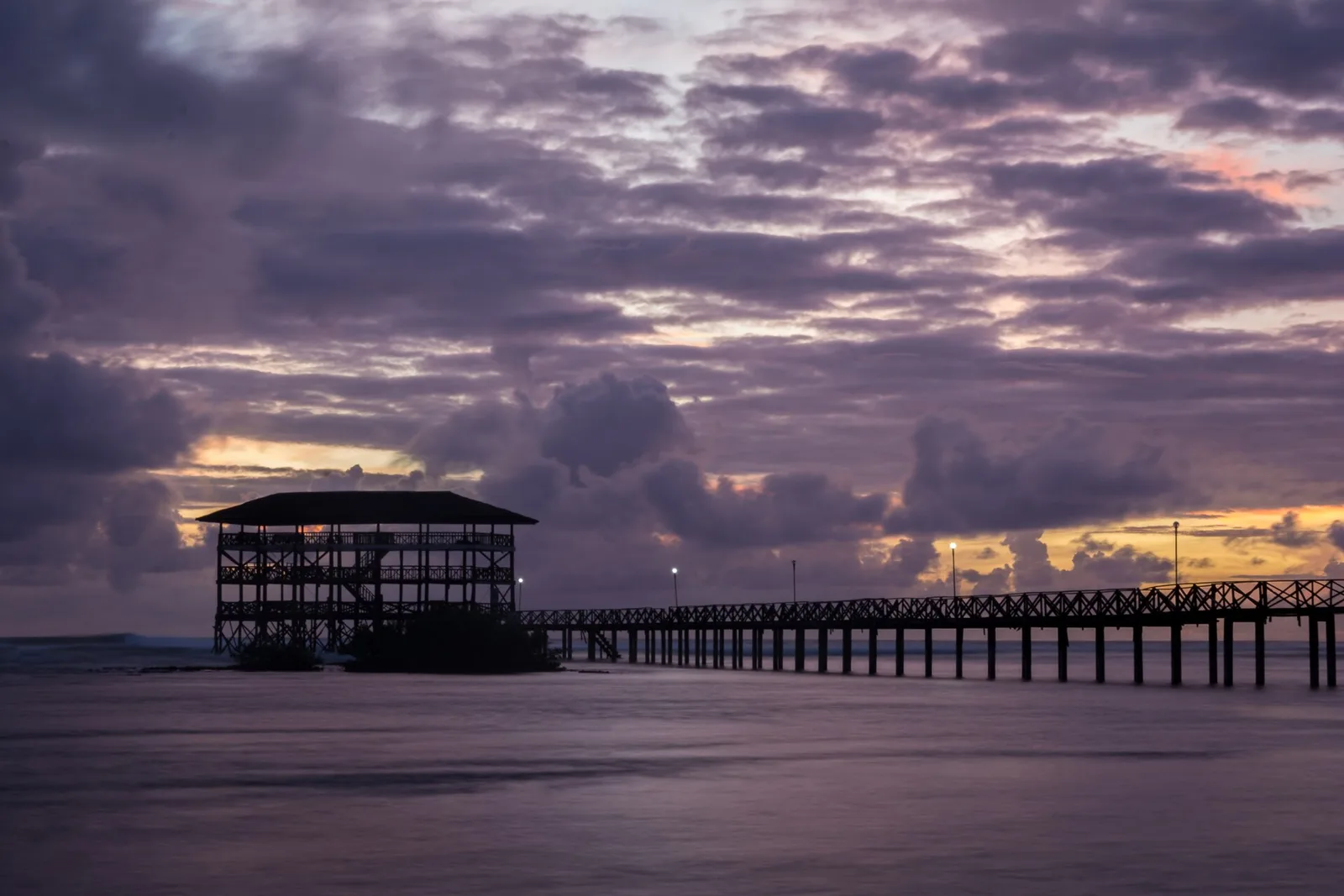
The surf calendar and the tourist calendar disagree in Siargao, which is the single most useful thing to know before booking. The months that photograph best - March to May, blue sky, flat blue water - are the months when Cloud 9 is a shadow of itself. The months that deliver the wave are the months it rains.
From August the swell begins to arrive with some consistency. September and October are the reliable peak, when head-high to overhead faces are routine rather than lucky. November brings the largest surf of the year, and it also brings the most rain, so the trade is real rather than theoretical.
Between March and May the island is at its gentlest. That is the right window for a first surf lesson, and it is why Jacking Horse rather than Cloud 9 is where most learners actually spend their week.
Siargao sits in a climate type with no dry season
PAGASA classifies Philippine climate using the Corona system, four types defined by how rainfall is distributed through the year. Type II has no dry period at all, with a pronounced maximum from November to February. Siargao and the eastern seaboard of Mindanao fall in it.
This matters more than any month-by-month table, because it invalidates the mental model most visitors bring. There is no Philippine dry season here to aim for. There is a wetter half and a less wet half, and the less wet half is also the flat half. Anyone promising you dry weather and big surf in the same week is selling something.
PAGASA's climatological normals are the place to check the underlying 30-year averages rather than relying on a blog's recollection of last year.
Two competition windows close the peak to visiting surfers
Late 2026 is an unusual season. The Siargao International Surfing Cup, a Qualifying Series 6000 event, runs at Cloud 9 from 16 to 25 October. Immediately after it, from 31 October to 10 November, Cloud 9 hosts a World Surf League Championship Tour stop - the first time the elite tour has come to the Philippines.
For a visiting surfer that is close to three consecutive weeks in which the best wave on the island is either in a competition window or on standby for one. Competition periods run on waiting days, so a forecast swell can convert a scheduled rest day into a contest day at short notice.
If you are coming to watch, this is the best fortnight in Siargao's history. If you are coming to surf Cloud 9 yourself, September or early October is the calmer choice, and accommodation in General Luna will be cheaper by a wide margin.
Beginner months are not the same as good-weather months
Cloud 9 is a reef break. The consequence people underestimate is not the wave height, it is the bottom - a shallow, sharp reef that punishes a fall in a way sand does not. A beginner on a peak-season day at Cloud 9 is in the wrong place regardless of how many lessons they have had.
The learning waves are elsewhere. Jacking Horse breaks gently over the same reef system and is where surf schools run their first sessions, and the March-to-May window is when it is most forgiving. Booking a beginner course for November is booking a week of watching.
Non-surfers face a different calculation entirely: the island hopping to Naked, Daku and Guyam, and the Sugba Lagoon trip, all depend on sea state rather than swell, and they cancel far more often in the November-to-February wet maximum.
Booking around the Championship Tour stop
Three practical consequences follow from a Championship Tour event landing on a small island. Accommodation in General Luna prices up and sells out months ahead for the competition window. Domestic flights into Sayak tighten at the same time, and Siargao's air access is thin at the best of times. And the boardwalk at Cloud 9, which is normally the viewing platform for anyone, becomes competition infrastructure.
The workable plan for a surfer is to arrive before mid-October or after mid-November. The workable plan for a spectator is to book flights and a room now, because the local supply will not grow to meet the event.
What most guides get wrong about Siargao's rainy season
Almost every Siargao guide recommends March to May, and almost all of them are answering the wrong question. Those months are the driest and calmest, which makes them right for a beach holiday and wrong for the thing Siargao is famous for. Recommending the flat season to someone who came to surf is a failure of the guide, not of the island.
The second error is applying the Philippine dry season to Siargao at all. Most of the country runs on a November-to-April dry season, which is why so much generic advice repeats it. Siargao is Type II under PAGASA's classification and has no dry season. Copy-pasted national advice is simply inaccurate here.
The third error is treating typhoon risk as a footnote. The peak surf months overlap the period when tropical cyclones cross this part of Mindanao, and Siargao took catastrophic damage from Typhoon Odette in December 2021. Travel insurance that covers weather disruption is not an upsell in November - it is the sensible baseline.
Frequently asked questions
When is the best month to surf Cloud 9?
September and October for consistency, November for size. November produces the largest faces of the year and is also the wettest end of the season, so it suits experienced reef surfers rather than improvers.
Does Siargao have a dry season?
No. PAGASA places it in Corona climate Type II, which has no dry period, with maximum rainfall between November and February. March to May is the least wet stretch, not a dry season.
When is the WSL event at Cloud 9 in 2026?
The Championship Tour stop runs 31 October to 10 November 2026, preceded by the Siargao International Surfing Cup, a Qualifying Series 6000 event, from 16 to 25 October.
Can a complete beginner learn to surf in Siargao?
Yes, but at Jacking Horse rather than Cloud 9, and ideally between March and May. Cloud 9 breaks over shallow, sharp reef and is not a learner wave at any time of year.
Is November too risky because of typhoons?
It carries real risk. The peak surf months overlap cyclone season in eastern Mindanao, and Typhoon Odette devastated Siargao in December 2021. Book flexible fares and insurance that covers weather disruption.
Book tours, hotels & stays in Siargao
Top tours