Short answer: Five terrace clusters are inscribed on the UNESCO list - Nagacadan, Hungduan, Central Mayoyao, Bangaan and Batad - and the famous Banaue viewpoint is not one of them. It was left out because of modern structures in the area. There are more than 48 terrace clusters in the Cordilleras, and only those five carry World Heritage status.
Trip.comHotels in Philippines
Compare live prices via Travelpayouts — targeted for this guide.
Search on Trip.comFor travellers planning two to four days in Ifugao who want to see the terraces that are actually protected, and for anyone budgeting Banaue and Sagada as a single trip. Inscription details last checked 30 July 2026 against the UNESCO World Heritage Centre record.
| Inscribed cluster | Municipality | What distinguishes it |
|---|
| Batad | Banaue | Amphitheatre form with the village at its base |
| Bangaan | Banaue | Terraces framing a traditional Ifugao village |
| Central Mayoyao | Mayoyao | Terraces interspersed with bale houses and alang granaries |
| Hungduan | Hungduan | Spider-web pattern formed by the terrace walls |
| Nagacadan | Kiangan | Two distinct terrace fields split by a river |
| Banaue viewpoint cluster | Banaue | Not inscribed - modern structures in the area |
Mistake one: assuming the Banaue viewpoint is the World Heritage site
The terraces on the thousand-peso note, the ones every tour van stops at above Banaue town, are not part of the inscribed property. The Rice Terraces of the Philippine Cordilleras comprises five clusters, and the Banaue viewpoint cluster was excluded, primarily because of the number of modern structures within the area.
This is not a technicality that only matters to heritage bureaucrats. It explains the experience gap travellers report - arriving at the famous viewpoint, finding souvenir stalls and concrete, and wondering why the photographs looked different. The photographs were taken somewhere else.
The fix: treat the Banaue viewpoint as a ten-minute stop on the way in, and plan your actual time around Batad or Bangaan. If you have one full day, spend it in Batad.
Mistake two: treating Batad as a day trip from Banaue
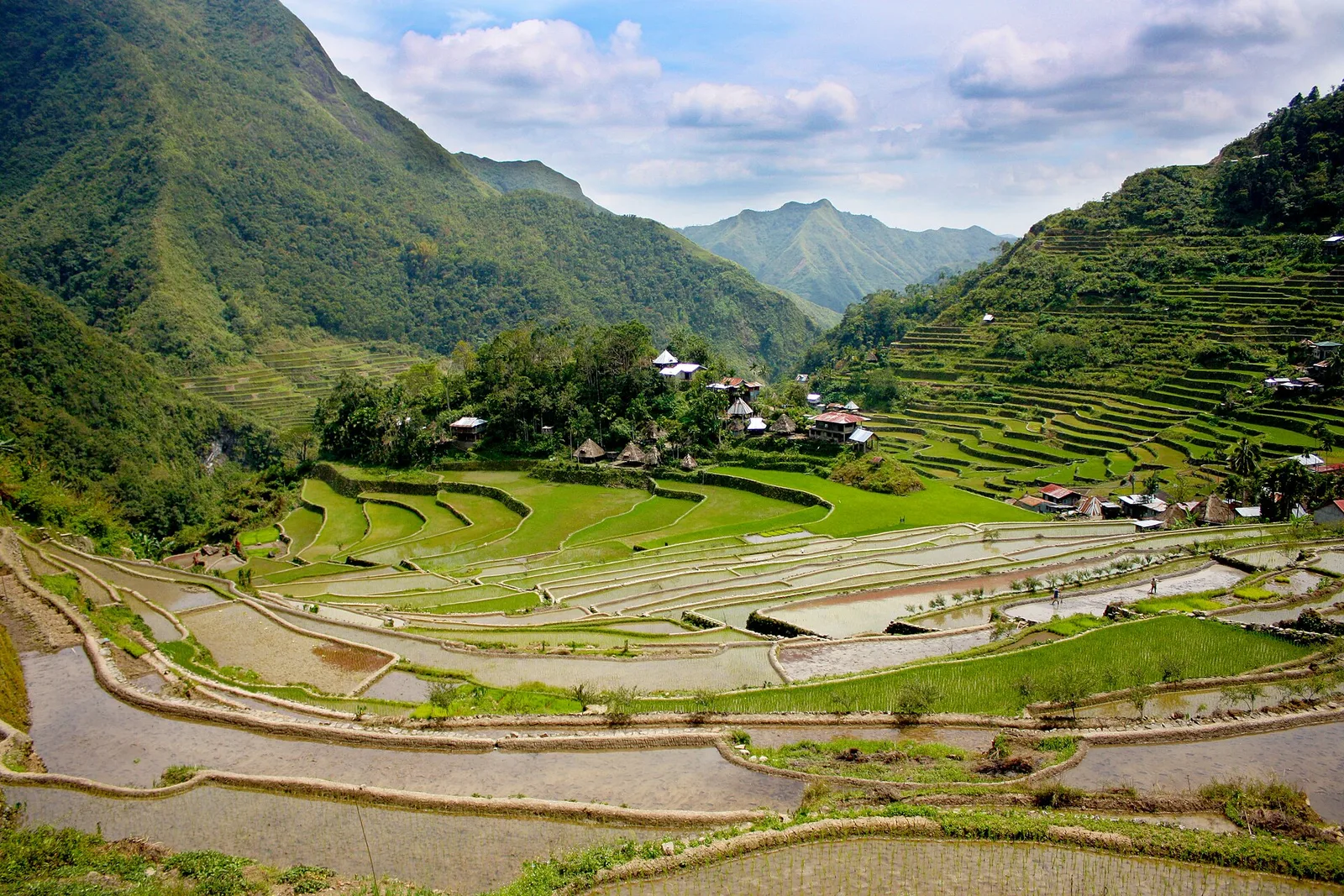
Batad is the cluster most people mean when they picture the terraces - an amphitheatre of stone-walled fields with a village at the bottom. It is also not reachable by simply driving there. The road ends at a saddle point and the village is a walk down, which means the walk back up is how your day ends.
Compressed into a day trip, Batad becomes a rushed descent, twenty minutes at the bottom and a hard climb out. The terraces reward the opposite: staying the night in the village, seeing the light change, and walking to Tappiya Falls without watching a clock.
The fix: book a night in Batad. Accommodation is simple guesthouses rather than hotels, and one night converts the single most strenuous day of a Cordillera trip into the best one.
Mistake three: arriving in the wrong month for green terraces
The terraces are a working agricultural system, not a static landscape, and they look completely different through the cycle. Newly planted fields are water mirrors. Growing rice is the vivid green of the postcards. After harvest the terraces are brown stubble and stone.
Travellers routinely book the Cordilleras for the driest, most convenient travel months and arrive to find the fields harvested. The green window is tied to the planting cycle, not to the tourist calendar, and it varies between clusters at different altitudes.
The fix: if the green terraces are the point of the trip, ask locally about the cycle in the specific cluster you are visiting before fixing dates. Roughly speaking the growing season delivers the green, and the months either side of harvest do not.
Mistake four: hiring no guide in a living cultural landscape
The terraces are farmed by Ifugao communities who live in them, and the paths between fields are working infrastructure - the walls are field boundaries and irrigation, not trails. Walking them without a guide is how visitors end up on private terraces, damaging walls that are maintained by hand.
A local guide is also the only practical way to understand what you are looking at. The distinction between bale houses and alang granaries, the irrigation logic that moves water across a mountainside without pumps, and the muyong forest system above the terraces that feeds them are not self-evident from a viewpoint.
The fix: hire a guide through the tourism office in Banaue or Batad. It is a modest cost, it is the mechanism by which tourism money reaches the communities maintaining the site, and it is expected rather than optional. The provincial government of Ifugao is the reference point for accredited guiding.
Mistake five: budgeting Sagada and Banaue as one stop
Sagada and Banaue appear together in almost every Cordillera itinerary, and on a map they look adjacent. The road between them is mountain road, and the journey is a substantial part of a day in each direction rather than a transfer.
They are also different trips. Banaue and Batad are about the terraces and Ifugao culture. Sagada is limestone country - the hanging coffins, Sumaguing cave, a different province and a different people. Compressing both into three days produces two rushed halves.
The fix: allow five days for both, or pick one. If the terraces are the reason you are going north, give Ifugao the time and leave Sagada for another trip.
What most guides get wrong about the rice terraces
Nearly every article about the terraces calls the Banaue viewpoint a UNESCO World Heritage Site. It is the most repeated factual error about any Philippine destination, and it survives because writers copy each other rather than checking the inscription, which names five clusters and does not include it.
The second widespread error is the age claim - the assertion that the terraces are exactly two thousand years old, stated as settled fact. The dating is contested, with archaeological work proposing considerably younger origins, and the confident round number is a tourism-brochure figure rather than a scholarly consensus.
The third is describing the terraces as a scenic viewpoint at all. They were placed on the List of World Heritage in Danger in 2001 and only removed in 2012, and the threats behind that listing - abandonment as young Ifugao leave farming, erosion, and unmanaged development - are ongoing. A guide that presents them purely as a photo stop misses that the landscape exists only as long as people keep farming it.
Frequently asked questions
Is the Banaue rice terraces viewpoint a UNESCO site?
No. The inscribed property covers five clusters - Batad, Bangaan, Central Mayoyao, Hungduan and Nagacadan. The Banaue viewpoint cluster was excluded largely because of modern structures in the area.
Which rice terraces should I actually visit?
Batad, if you visit only one. It is an inscribed cluster, it has the amphitheatre form the terraces are famous for, and staying a night in the village makes it far better than a day trip.
How many rice terrace clusters are there?
More than 48 across the Cordilleras, of which five carry World Heritage inscription. The rest are working terraces without heritage listing, some of them spectacular.
When are the terraces green?
During the growing season, between planting and harvest. Newly planted fields are water mirrors and post-harvest terraces are brown stubble, so check the cycle for your specific cluster before fixing dates.
Do I need a guide?
Yes, in practice. The paths are working field walls and irrigation infrastructure maintained by hand, and guiding is arranged through the tourism office in Banaue or Batad. It is also how tourism money reaches the farming communities.
Can I do Banaue and Sagada in three days?
Badly. The mountain road between them takes a substantial part of a day each way, and they are different landscapes and cultures. Allow five days for both, or choose one.
Book tours, hotels & stays in Banaue Batad Rice Terraces
Top tours
Top hotels
Top stays