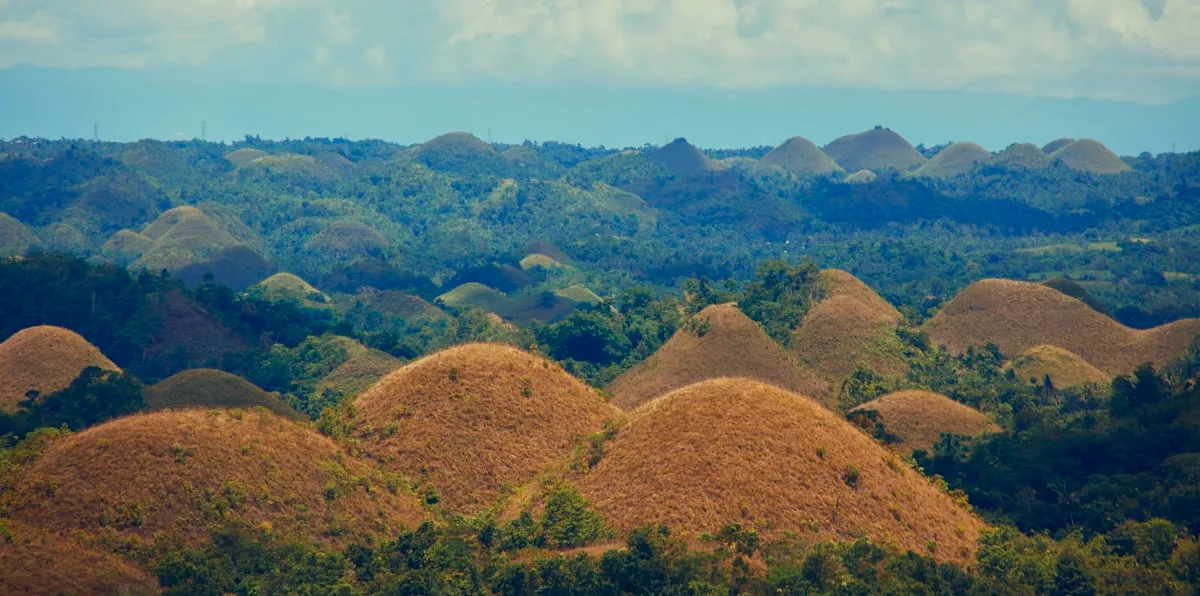
The Chocolate Hills are the most famous landscape in Bohol and one of the most recognizable natural wonders in the Philippines. More than 1,200 symmetrical, dome-shaped hills spread across an area of roughly 50 square kilometers in the towns of Carmen, Batuan, and Sagbayan. During the rainy season they are covered in green grass and look like giant mossy bumps. But when the dry season arrives, the grass dies and the hills turn a deep brown, giving them the appearance of endless rows of chocolate kisses. That color change is where the name comes from, and it is the reason thousands of travelers make the trip to central Bohol every year.
Chocolate Hills of Bohol: Why They Turn Brown
Trip.com
Search on Trip.comHotels in Visayas
Compare live prices via Travelpayouts — targeted for this guide.
How the Chocolate Hills Formed
The origin of the Chocolate Hills is a subject that has attracted both scientists and storytellers. Geologists agree that the hills are what remains of an ancient limestone formation that was once a flat seabed. Over millions of years, tectonic movement lifted the seabed above sea level. Rainwater, which is naturally acidic, then eroded the limestone through a process called karst dissolution. The hills are the parts of the limestone that resisted erosion, while the valleys between them are the parts that were worn away.
There are two main scientific theories about the details. The first says the hills are weathered marine limestone sitting on top of a harder, impermeable clay layer. The second says they are self-organizing landforms, meaning the uniform spacing and shape emerged naturally from the way water flows and erodes the rock. Both theories agree on the core mechanism: rainwater dissolved the limestone over a very long time, and the hills are the leftover mounds.
Local folklore offers a more romantic explanation. One legend says two giants fought by throwing stones and sand at each other for days, then made up and left the island, forgetting to clean up the mess. Another legend says a giant named Arogo fell in love with a mortal woman named Aloya. When she died, he cried for years, and his tears dried into the hills. The scientific explanation is less poetic but far more remarkable when you consider that it took millions of years of rainfall to sculpt this landscape.
Trip.com
See all tours in Visayas on Trip.comChocolate Hills tour in Visayas
Hand-picked experiences in Visayas — book on Trip.com with instant confirmation.
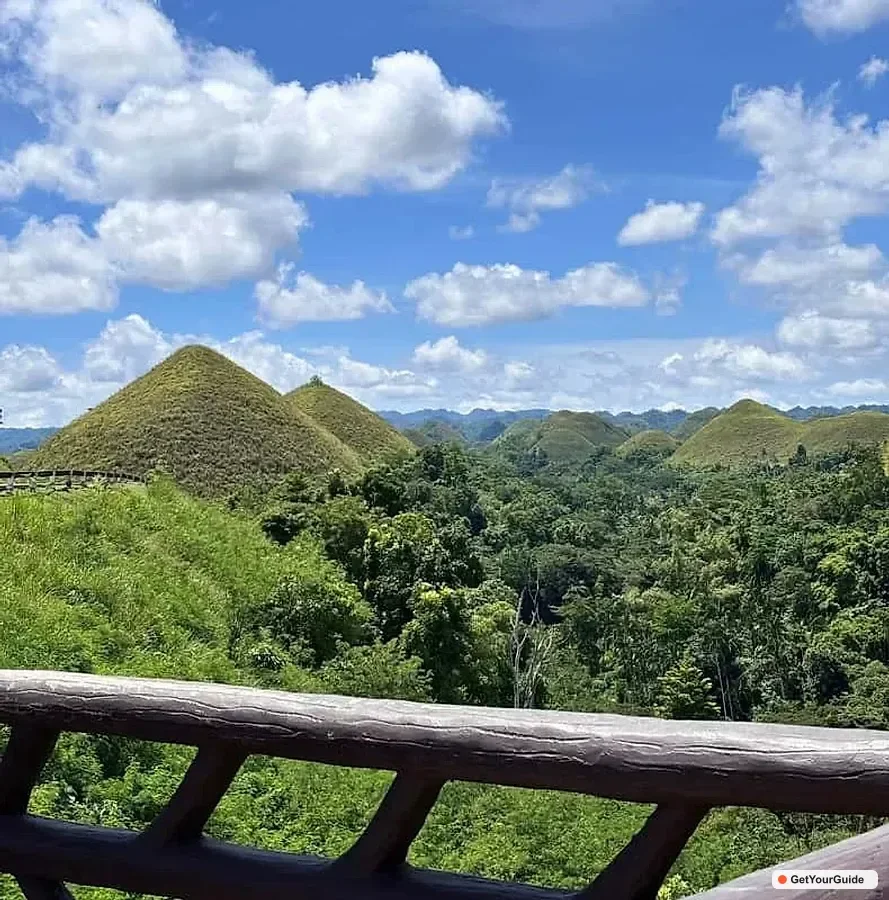
Why the Hills Turn Brown
The color change is purely seasonal. The hills are covered by a species of grass called Imperata cylindrica, commonly known as cogon grass, along with some hardy shrubs. During the wet season from June to November, the grass is green and lush. When the dry season arrives, typically from January to May, the grass dries out and turns brown. The underlying limestone is light gray, but the dead grass on the surface gives each hill its chocolate-brown color.
This means the best time to see the "chocolate" version of the Chocolate Hills is during the dry months, especially March and April. If you visit during the rainy season, you will still see the hills, but they will be green. Both views are impressive, but the brown version is what appears in postcards and tourism campaigns.
How to Get to the Chocolate Hills
Bohol is accessible by air and by sea. The fastest way is to fly into Bohol-Panglao International Airport (TAG), which opened in 2018 and replaced the old Tagbilaran Airport. Direct flights from Manila take about 1 hour and 15 minutes and cost PHP 2,500 to PHP 4,500 one way depending on the season. Cebu Pacific, Philippine Airlines, and AirAsia all serve this route. You can also fly from Cebu to Bohol in about 25 minutes.
The cheaper option is to take a ferry from Cebu City to Tagbilaran. OceanJet and Lite Ferries operate fast craft services that take about 2 hours and cost PHP 800 to PHP 1,200 one way for tourist class. Weesam Express also runs this route. Ferries depart from Pier 1 in Cebu City several times a day.
From Tagbilaran City or Panglao, the Chocolate Hills Complex in Carmen is about 55 kilometers north, a drive of roughly 1 hour and 30 minutes. Most visitors hire a private van or join a countryside tour. A private van with driver for a full day costs PHP 2,500 to PHP 3,500. A joiner tour that includes the Chocolate Hills, the Tarsier Sanctuary, the Man-Made Forest, and a lunch cruise on the Loboc River costs PHP 1,500 to PHP 2,000 per person.
Where to View the Chocolate Hills
There are two main viewing areas. The first and most popular is the Chocolate Hills Complex in Carmen, operated by the provincial government. It has a viewing deck on top of one of the hills, accessible by a 214-step staircase. The entrance fee is PHP 100 for adults and PHP 50 for children. The deck offers a 360-degree panoramic view of the hills and is the standard photo spot.
The second is the Sagbayan Peak in the town of Sagbayan, about 20 minutes from Carmen. Sagbayan Peak has a more relaxed viewing area, a small tarsier enclosure, and a children's playground. The entrance fee is PHP 60 per person. The view here is slightly different because you see the hills from a different angle, and the crowds are usually smaller.
A newer option is the Chocolate Hills Adventure Park in Carmen, which is an eco-adventure park with ziplines, rope courses, and a bike-on-a-wire attraction. Entrance is PHP 100, and individual activities cost extra. This is a good option if you are traveling with children or want more than just a photo stop.
The Best Time to Visit
To see the hills in their signature brown color, plan your visit between late February and early May. March and April are the peak months. The grass is fully dried, the sky is clear, and the contrast between the brown hills and the blue sky is at its strongest. Avoid visiting during or immediately after a heavy rain, even in the dry season, because the hills can briefly turn green again if there is an unusual weather event.
If you prefer fewer crowds, go early in the morning. The Chocolate Hills Complex opens at 7:30 AM. Arriving before 9:00 AM means you will share the viewing deck with only a handful of other visitors. By late morning, tour buses from Tagbilaran begin arriving and the deck gets crowded.
Combining the Chocolate Hills With Other Bohol Attractions
Most travelers visit the Chocolate Hills as part of a full-day countryside tour. The standard itinerary includes the Tarsier Sanctuary in Loboc, where you can see the Philippine tarsier, one of the smallest primates in the world, in a protected forest habitat. The entrance fee is PHP 150. The sanctuary is run by the Philippine Tarsier Foundation and is the ethical place to see tarsiers, as some roadside displays keep the animals in stressful conditions.
The tour also usually includes the Man-Made Forest in Bilar, a 2-kilometer stretch of mahogany trees planted along the road that forms a tunnel of green. It is a free photo stop and takes about 15 minutes.
The Loboc River Cruise is another staple. A floating restaurant takes you up the river for about an hour while you eat a buffet lunch of Filipino dishes. The cruise costs PHP 450 to PHP 550 per person including food. There is usually live music on board and a stop at a small waterfall where you can swim.
Where to Stay in Bohol
Most visitors stay in Panglao Island, which is the beach and resort area of Bohol. Panglao has accommodations from budget hostels at PHP 600 per night to luxury beachfront resorts at PHP 8,000 to PHP 15,000 per night. A solid mid-range resort with a pool and beach access costs PHP 2,500 to PHP 4,000. If your main interest is the countryside and the Chocolate Hills, staying in Tagbilaran City is more practical. Hotels here start at PHP 1,200 for a clean double room.
For a more immersive experience, there are a few eco-resorts in the Carmen and Batuan area near the hills themselves. These are quieter and closer to nature but more expensive, typically PHP 4,000 to PHP 7,000 per night including meals.
Protecting the Chocolate Hills
The Chocolate Hills were declared a National Geological Monument in 1997 and are protected under Philippine law. However, they have faced threats from quarrying and unauthorized development. In 2023, a controversy erupted when a resort was found to have built a pool and structures on top of one of the hills without proper permits. The Department of Environment and Natural Resources (DENR) and the Bohol Provincial Government have since tightened enforcement.
As a visitor, you can help by staying on designated paths, not climbing on the hills outside of the viewing deck areas, and supporting tour operators that follow environmental guidelines. The hills are not just a tourist attraction. They are a geological record of millions of years of natural history.
Frequently Asked Questions
How many Chocolate Hills are there?
There are at least 1,268 confirmed hills, though some estimates put the number closer to 1,776. They are spread across the towns of Carmen, Batuan, Sagbayan, Bilar, and Sierra Bullones in central Bohol.
Why are they called Chocolate Hills?
Because the grass that covers them turns brown during the dry season, making the hills look like giant chocolate mounds. The name was popularized by tourism campaigns in the late 20th century, though locals have long referred to the brown season as the time the hills "change color."
Can you climb the Chocolate Hills?
You cannot climb the hills freely. The viewing decks at the Chocolate Hills Complex in Carmen and at Sagbayan Peak are the designated areas. Climbing on the hills themselves is prohibited to prevent erosion and damage to the grass cover.
Are the Chocolate Hills a UNESCO site?
The Chocolate Hills are not a UNESCO World Heritage Site, but they were declared a National Geological Monument by the Philippine government in 1997 and are included on the country's tentative list for UNESCO nomination.
What is the nearest airport to the Chocolate Hills?
Bohol-Panglao International Airport (TAG) is the nearest airport, about 55 kilometers from the Chocolate Hills Complex in Carmen. The drive takes about 1 hour and 30 minutes by van or car.
Plan Your Bohol Trip With PANA
Want to see the Chocolate Hills for yourself? PANA.PH can help you build the perfect Bohol itinerary. Explore our destinations for more Visayas spots, book a tour with trusted local guides, find a hotel in Panglao or Tagbilaran, and read more from our blog for Bohol travel tips.
Sources and References
Sources
Primary references for the figures and rules in this guide. Fees and schedules change — check the source before you travel.

PANA.PH Visayas Desk
Visayas travel logistics — Cebu, Bohol, Boracay and Siargao
The Visayas Desk of the PANA.PH travel desk: it maintains and re-checks the visayas travel logistics — cebu, bohol, boracay and siargao data behind the site's guides — operator price lists, official fee schedules and posted timetables — and publishes what it can verify.
🏡 Real local stays (book direct)
Hand-picked homestays and guesthouses — book direct, no markup.
Browse all local stays →
🌊 Popular activities (book instantly)
Island hopping, canyoneering, whale sharks — real Klook/GetYourGuide options.
View all activities →