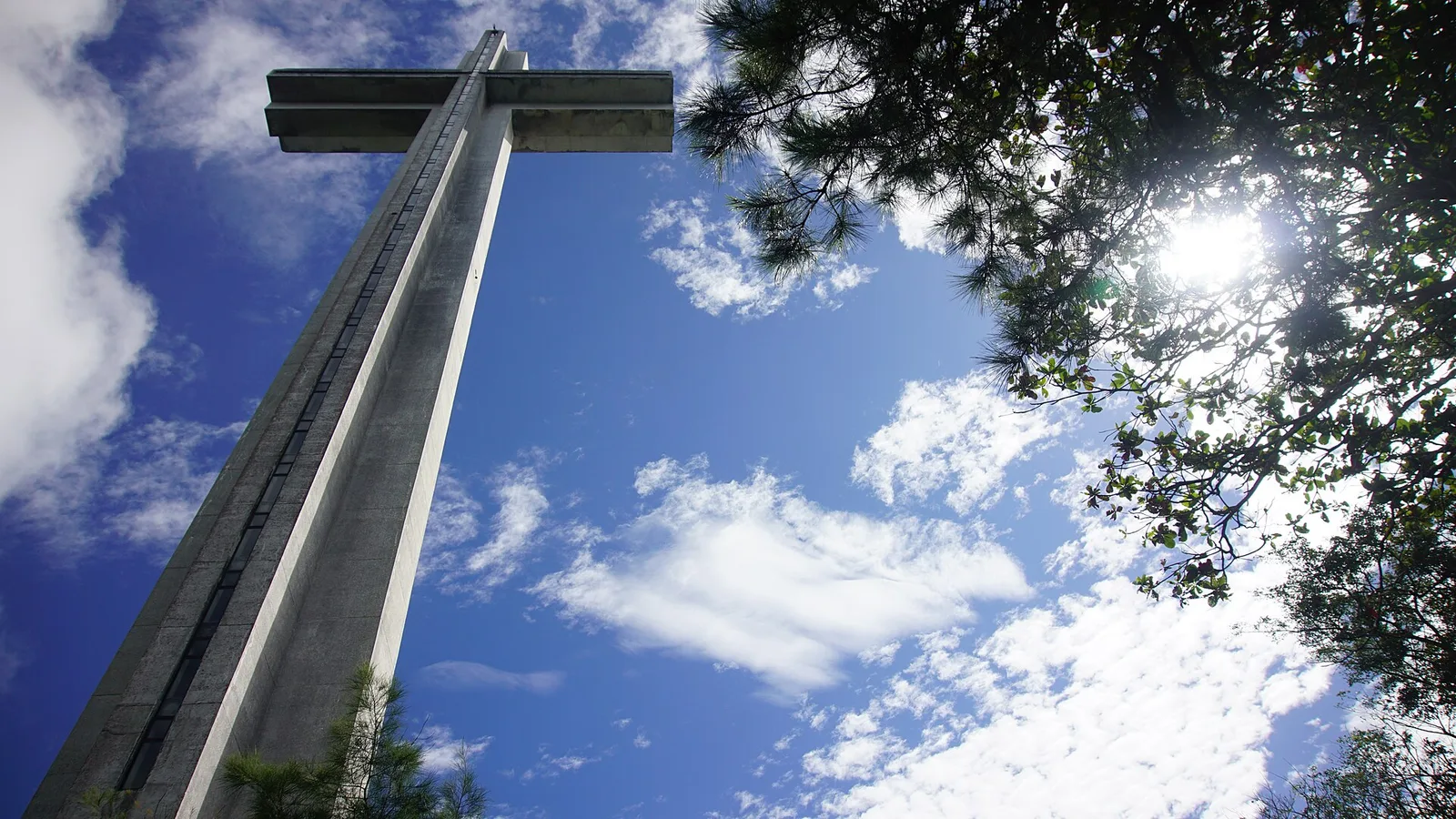
The Mount Samat National Shrine, also known as the Dambana ng Kagitingan (Shrine of Valor), is a war memorial on the summit of Mount Samat in the province of Bataan. It was built to commemorate the courage and sacrifice of the Filipino and American soldiers who fought against the Japanese invasion during the Battle of Bataan in early 1942, and who subsequently endured the Bataan Death March, one of the most notorious atrocities of the Pacific War. The shrine's most visible feature is a 92-meter (302-foot) reinforced concrete cross that can be seen from miles around, standing as a permanent reminder of one of the darkest and most defining chapters of Philippine history.
Mount Samat: The Cross That Commemorates the Bataan Death March
Trip.com
Search on Trip.comHotels in Luzon
Compare live prices via Travelpayouts — targeted for this guide.
This guide covers the history of the shrine, the story it memorializes, the architecture of the memorial complex, how to get there from Manila, what to expect during a visit, and how to combine the trip with other historical sites in Bataan. Whether you are a history enthusiast, a student of World War II, or a traveler looking to understand the Philippines beyond its beaches, Mount Samat is an essential stop.
The Fall of Bataan and the Death March
To understand why Mount Samat matters, you need to understand what happened in Bataan in 1942. After the Japanese attack on Pearl Harbor in December 1941, Japanese forces invaded the Philippines, which was then a commonwealth of the United States. The combined Filipino-American forces under the command of General Douglas MacArthur retreated to the Bataan Peninsula and the island of Corregidor in an attempt to hold out against the advancing Japanese army.
For three months, the defenders of Bataan fought a desperate defensive campaign, enduring disease, starvation, and constant bombardment. They were promised reinforcements from the United States, but those reinforcements never came, as the US government had decided to prioritize the war in Europe. On April 9, 1942, the defending forces, numbering about 75,000 Filipino and American troops, surrendered to the Japanese. It was the largest surrender in American and Filipino military history.
Trip.com
See all tours in Luzon on Trip.comTours & activities in Luzon
Hand-picked experiences in Luzon — book on Trip.com with instant confirmation.

What followed was the Bataan Death March. The prisoners were forced to walk from the southern tip of Bataan to Camp O'Donnell in Capas, Tarlac, a distance of roughly 100 kilometers (60 miles). The march took about a week, during which the prisoners were given little or no food or water, and those who fell behind or could not continue were beaten, bayoneted, or shot. Estimates of the death toll vary, but it is generally accepted that between 5,000 and 10,000 Filipinos and as many as 650 Americans died during the march or in the days immediately following. Those who survived faced further hardship in the prison camps, where disease and malnutrition claimed thousands more lives.
The Fall of Bataan and the Death March became powerful symbols of sacrifice and resistance. April 9 is observed in the Philippines as Araw ng Kagitingan (Day of Valor), a national holiday that honors the memory of those who fought and suffered. The Mount Samat National Shrine is the focal point of the annual commemoration, which is attended by government officials, veterans, and the public.
The Creation of the Mount Samat National Shrine
The idea for a memorial on Mount Samat emerged in the decades after the war. The site was chosen because Mount Samat was one of the last strongholds of the defending forces before the surrender, and its summit offered a commanding view of the peninsula where the battle took place. The shrine was commissioned under the administration of President Ferdinand Marcos, who had served in the Philippine military during the war and who made the commemoration of wartime sacrifice a central theme of his government.
Construction of the shrine began in 1966 and was completed in 1970. The complex was designed by a team of Filipino architects and engineers, and it was formally inaugurated on April 9, 1970, the 28th anniversary of the Fall of Bataan. The shrine was declared a National Shrine by law, placing it under the administration of the National Historical Commission of the Philippines (NHCP), which continues to maintain it today.
The design of the shrine is meant to evoke both the solemnity of a war memorial and the aspiration of a monument to freedom. The central elements are the colonnade and the cross, which are connected by a long flight of stairs and a paved walkway. The overall effect is one of grandeur and restraint, a space that invites reflection rather than celebration.
The Colonnade and the Memorial Wall
The first major structure you encounter when you arrive at the shrine is the colonnade, a rectangular open-air structure supported by rows of columns. The colonnade serves as the main ceremonial area, where the annual Araw ng Kagitingan observance is held. At its center is an altar, and on its walls are inscriptions and murals depicting scenes from the Battle of Bataan and the Death March.
The murals, executed in a style that blends realism with symbolic imagery, show soldiers in combat, civilians aiding the wounded, and prisoners on the march. They are powerful and somber, and they give visitors a visual sense of the events the shrine commemorates. Take time to read the inscriptions, which include excerpts from historical accounts and statements honoring the fallen.
Behind the colonnade is a memorial wall inscribed with the names of battles and units that participated in the defense of Bataan. The wall serves as a record of the military history of the campaign and as a point of reference for descendants of the veterans who visit the shrine to pay their respects.
The Cross of Mount Samat
The most striking feature of the shrine is the towering cross at the summit. The cross stands 92 meters (302 feet) tall, with arms spanning 30 meters (98 feet) from tip to tip. It is made of reinforced concrete and steel, and its surface is finished in white marble and cement. The cross is visible from the lowlands of Bataan and from the sea, and it serves as a navigational landmark for ships passing through Manila Bay.
At the base of the cross is an elevator that takes visitors to a viewing gallery inside the horizontal arm. The gallery has narrow windows on all four sides, offering panoramic views of the Bataan Peninsula, Manila Bay, and the mountains of central Luzon. On a clear day, you can see Corregidor Island and the outline of the Bataan Nuclear Power Plant, another landmark of the region. The elevator can accommodate a limited number of people at a time, so there may be a short wait during peak visiting hours.
The interior of the cross also contains a chapel on the lower level, which is used for religious services and private prayer. The chapel is simple and quiet, and it provides a space for personal reflection away from the open areas of the shrine.
How to Get to Mount Samat from Manila
Mount Samat is located in the municipality of Pilar, Bataan, roughly 130 kilometers northwest of Manila. The most common way to get there is by car or bus. If you are driving, take the North Luzon Expressway (NLEX) and the Subic-Clark-Tarlac Expressway (SCTEX), then exit toward Bataan. The drive takes about 2.5 to 3.5 hours depending on traffic. There is parking at the shrine.
If you are taking public transport, buses to Bataan depart from terminals in Manila, including the Avenida terminal and the Cubao terminal. A one-way bus ticket to Balanga, the capital of Bataan, costs about PHP 200 to PHP 350. From Balanga, you can take a jeepney or a tricycle to the shrine. A jeepney to the town of Pilar costs about PHP 30 to PHP 50, and a tricycle from Pilar to the shrine costs about PHP 150 to PHP 250 one way. Alternatively, you can hire a tricycle directly from Balanga to the shrine for about PHP 300 to PHP 500.
For travelers who prefer a guided experience, there are tour operators in Manila that offer day trips to Bataan that include Mount Samat, the Death March markers, and other historical sites. A full-day guided tour typically costs PHP 2,500 to PHP 4,500 per person, depending on the inclusions and the group size.
What to Expect During Your Visit
A visit to Mount Samat typically takes 2 to 3 hours, including time to explore the colonnade, climb to the cross, and take in the views. There is no entrance fee to the shrine itself, but there may be a small fee for the elevator to the viewing gallery, usually around PHP 10 to PHP 30 per person. Bring small bills.
Wear comfortable walking shoes, as there are stairs and paved walkways between the colonnade and the cross. The walkway is partially shaded, but the area around the cross is exposed to the sun, so bring a hat and water, especially if you are visiting in the middle of the day. The shrine is at an elevation of about 550 meters, so the air is slightly cooler than at sea level, but it can still be warm.
The shrine is open daily, but the best time to visit is in the morning or late afternoon, when the light is good for photography and the temperatures are more comfortable. If you visit on April 9, you will encounter the official Araw ng Kagitingan ceremony, which includes a wreath-laying, a 21-gun salute, and speeches by government officials. It is a solemn and well-attended event, but it also means larger crowds and restricted access to some areas.
Combining Mount Samat with Other Bataan Sites
Bataan is rich in World War II history, and Mount Samat is best visited as part of a broader tour of the province's memorial sites. Along the route of the Death March, you will find kilometer markers that trace the path of the prisoners from Bataan to Tarlac. These markers are maintained by the NHCP and provide a tangible sense of the distance and the suffering.
The Bataan World War II Museum, located near the base of Mount Samat, contains artifacts, photographs, and dioramas related to the battle and the march. It is a good complement to the shrine, as it provides detailed historical context that the shrine, by its nature, does not. The museum charges a small entrance fee, usually around PHP 50 to PHP 100.
Another important site is the Las Casas Filipinas de Acuzar, a heritage resort that features reconstructed Spanish-era houses. While not directly related to the war, it is a popular stop for visitors to Bataan and offers a different perspective on the province's history. Day passes are available for about PHP 1,500 to PHP 2,000 per person.
If you have a full day, a common itinerary is to start at the Death March markers in the morning, visit the museum and Mount Samat at midday, and end the day at a beach resort in Morong or Bagac, on the western coast of Bataan. The beaches of Bataan are not as famous as those of Palawan or Boracay, but they offer a quiet and affordable alternative, with resort rooms starting at around PHP 1,500 to PHP 3,000 per night.
Where to Stay in Bataan
Bataan offers a range of accommodations. In Balanga and Pilar, budget hotels and inns start at around PHP 800 to PHP 1,200 per night. Mid-range hotels in the city center charge PHP 1,800 to PHP 3,000. On the coast, especially in Morong and Bagac, beach resorts range from PHP 2,000 to PHP 5,000 per night, with higher-end options available for PHP 6,000 and above.
Frequently Asked Questions
Is there an entrance fee to the Mount Samat National Shrine?
There is no entrance fee to the shrine grounds. There may be a small fee for the elevator to the viewing gallery inside the cross, usually around PHP 10 to PHP 30 per person.
How tall is the cross at Mount Samat?
The cross stands 92 meters (302 feet) tall, with arms spanning 30 meters (98 feet). It is one of the tallest memorial crosses in the world.
What is Araw ng Kagitingan?
Araw ng Kagitingan (Day of Valor) is a national holiday observed on April 9 to commemorate the Fall of Bataan in 1942 and to honor the Filipino and American soldiers who fought and died in the campaign. The main ceremony is held at Mount Samat.
Can I go inside the cross?
Yes. An elevator at the base of the cross takes visitors to a viewing gallery inside the horizontal arm. The gallery has windows on all sides with panoramic views of Bataan and Manila Bay.
How far is Mount Samat from Manila?
Mount Samat is about 130 kilometers from Manila. The drive takes 2.5 to 3.5 hours by car via NLEX and SCTEX. Buses to Balanga take about 3 to 4 hours, plus a short tricycle or jeepney ride to the shrine.
Plan Your Bataan History Trip with PANA
Ready to walk the grounds of history in Bataan? PANA.PH has everything you need. Explore more Luzon heritage sites in our destinations guide, book a World War II history tour through our tours marketplace, find a place to stay in our hotels directory, and read more stories on our blog.
Sources and References
Sources
Primary references for the figures and rules in this guide. Fees and schedules change — check the source before you travel.

PANA.PH Luzon Desk
Luzon travel logistics — Manila, Baguio and North Luzon
The Luzon Desk of the PANA.PH travel desk: it maintains and re-checks the luzon travel logistics — manila, baguio and north luzon data behind the site's guides — operator price lists, official fee schedules and posted timetables — and publishes what it can verify.
🏡 Real local stays (book direct)
Hand-picked homestays and guesthouses — book direct, no markup.
Browse all local stays →
🌊 Popular activities (book instantly)
Island hopping, canyoneering, whale sharks — real Klook/GetYourGuide options.
View all activities →