Short answer: December to May, with March to May the best of it. The sardine run is not seasonal - unlike the South African event of the same name, this bait ball lives permanently off Panagsama beach - so what the months decide is water clarity, not whether you see it. The dry season gives the visibility that makes both snorkelling and the wall dive worth the trip.
Trip.comHotels in Moalboal
Compare live prices via Travelpayouts — targeted for this guide.
Search on Trip.comA seasonality guide for Moalboal: which months, what changes underwater, and what it costs. Built from 28 bookable trips. Last checked 9 August 2026.
| Period | Conditions | Verdict | Checked |
|---|
| December - February | Cool dry, good visibility | Reliable | 2026-08-09 |
| March - May | Hot dry, best visibility | Best for diving | 2026-08-09 |
| June - September | Wet, reduced clarity | Sardines still present | 2026-08-09 |
| October - November | Wetter, variable | Cheapest | 2026-08-09 |
How this guide was built
Seasons follow PAGASA's official definition rather than a marketing calendar: wet season June to November, dry season December to May, with the dry half splitting into cool-dry (December to February) and hot-dry (March to May).
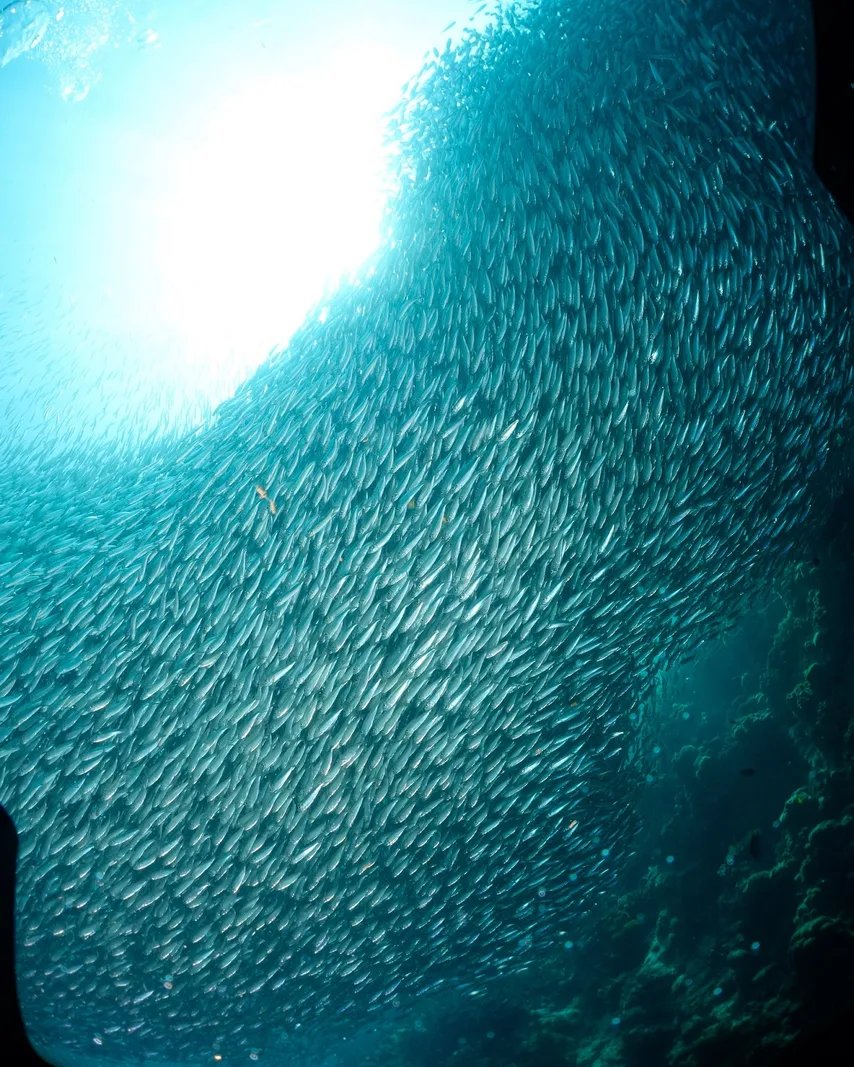
Moalboal's defining product is the sardine run at PHP 800 for two hours - the cheapest marine encounter in our entire Philippine inventory, against PHP 1,000 at Oslob and PHP 1,850 for most snorkelling elsewhere. It sits about 20 metres off Panagsama beach in roughly five metres of water, so it needs no boat, which is why weather affects it far less than a boat-dependent destination.
PAGASA also notes that typhoons generally track north-westward from the Pacific, sparing Mindanao from most direct hits. That single fact is the most useful input when choosing between a northern and a southern destination in the second half of the year.
Why the sardines are a year-round fixture
The bait ball holds position off Panagsama permanently, shifting shape as it moves along the reef edge. That permanence is unusual - most marine spectacles are migratory - and it removes the biggest scheduling worry a diver normally has.
It is also close enough to shore to snorkel to. Free-divers get the best of it, dropping into the middle of the school as it parts around them.
What the season actually changes: visibility
Heavy rain washes sediment off the land and cuts clarity for a day or two afterwards. On a wall dive where the appeal is depth and blue water, that difference is the whole experience.
The dry months from December to May give the most consistent visibility, and March to May the best of it. In the wet season you will still see the sardines; you will simply see less far.
The turtles, and the crowding problem
Green turtles graze the reef edge along the same shore and are seen most days in any month. They are wild rather than fed, so encounters are luck - but the odds here are unusually good.
The rules matter regardless of season: do not touch, do not chase, and never block a turtle surfacing to breathe. A turtle that cannot reach the surface is in real danger, and crowding is the most common mistake snorkellers make here.
Pescador Island and the boat days
Pescador, a short boat ride offshore, is the signature dive - a small limestone island ringed by a sheer wall. That trip does depend on sea state, so it is the part of a Moalboal itinerary that a rough week can remove.
The house reef cannot be cancelled, which is the practical safety net: even on a bad day you can walk in from the beach and see the sardines.
Rough weeks, and the one thing that never cancels
Typhoon season overlaps the wet months and peaks roughly July to October. A direct hit is not an annual event anywhere specific, but a system passing nearby is enough to suspend boats and ground small aircraft.
Check PAGASA bulletins before travelling in the second half of the year. The practical rule is to keep a spare day around any sea crossing or small-airport flight, because that is where a delay turns into a missed connection.
Kawasan canyoneering, 30 minutes south
Badian is half an hour away and canyoneering down the Kawasan gorge is the other thing people combine with Moalboal. It is genuinely rain-sensitive: after heavy rain the river rises and reputable operators cancel.
If canyoneering is part of your plan, weight the dry months more heavily than you would for the sardines alone.
What does not change with the season
The PHP 800 sardine run holds year-round, as does the PHP 3,200 median that reflects the combined south-Cebu day trips to Oslob and the waterfalls rather than local activities.
Panagsama has no real beach in any month - it is a dive village with rock and concrete shore and jetties. White Beach a few kilometres north is where the sand is, in every season.
Timing a trip around water clarity
December-February: cool, dry, good visibility, comfortable. A solid default.
March-May: hottest and clearest. The best diving window of the year.
June-September: wet, with clarity dropping after downpours. The sardines are unaffected.
October-November: wettest and cheapest, with the most variable boat days to Pescador.
The sardine-run myth divers arrive with
The first error is describing the sardine run as seasonal by analogy with South Africa. It is not - the school is resident.
The second is presenting it as a boat trip. It is 20 metres offshore and you can swim to it, which is why weather matters less here than at most dive destinations.
The third is quoting the PHP 3,200 median as the local price. Local activities run PHP 800 to PHP 1,850; the median reflects day trips elsewhere.
Free-diving, and why people come back
Moalboal has become a free-diving base as much as a scuba one, and the reason is geography: the wall is metres from shore, so a training session needs no boat and no fuel cost.
Schools here run courses through the year. The dry months give the clarity that makes depth training pleasant rather than disorienting, which is the one seasonal argument that matters for this particular discipline.
Getting here, and the road in the rain
Moalboal is three to four hours from Cebu City by bus from the South Terminal, then a tricycle down to Panagsama or White Beach. The road is paved and ordinary, and heavy rain slows it rather than blocking it.
Coming from the airport at Mactan means crossing the bridges into the city first, which adds 45 minutes or more in traffic. That is a constant in every season and the reason to leave early whatever the forecast says.
Frequently asked questions
Is the Moalboal sardine run seasonal?
No. The bait ball is resident year-round, unlike the migratory South African run.
What is the best month for diving in Moalboal?
March to May for the clearest water; December to February is also reliable.
Do I need a boat for the sardines?
No, they sit about 20 metres off Panagsama in shallow water. You can snorkel out.
What does rain change?
Visibility, for a day or two after heavy downpours. The sardines are still there.
How much is the sardine run?
PHP 800 for two hours - the cheapest marine encounter we index anywhere.
Should I stay at Panagsama or White Beach?
Panagsama for the diving and the sardines, White Beach for actual sand - in any season.
Book tours, hotels & stays in Moalboal
Top tours
Top hotels
Top stays