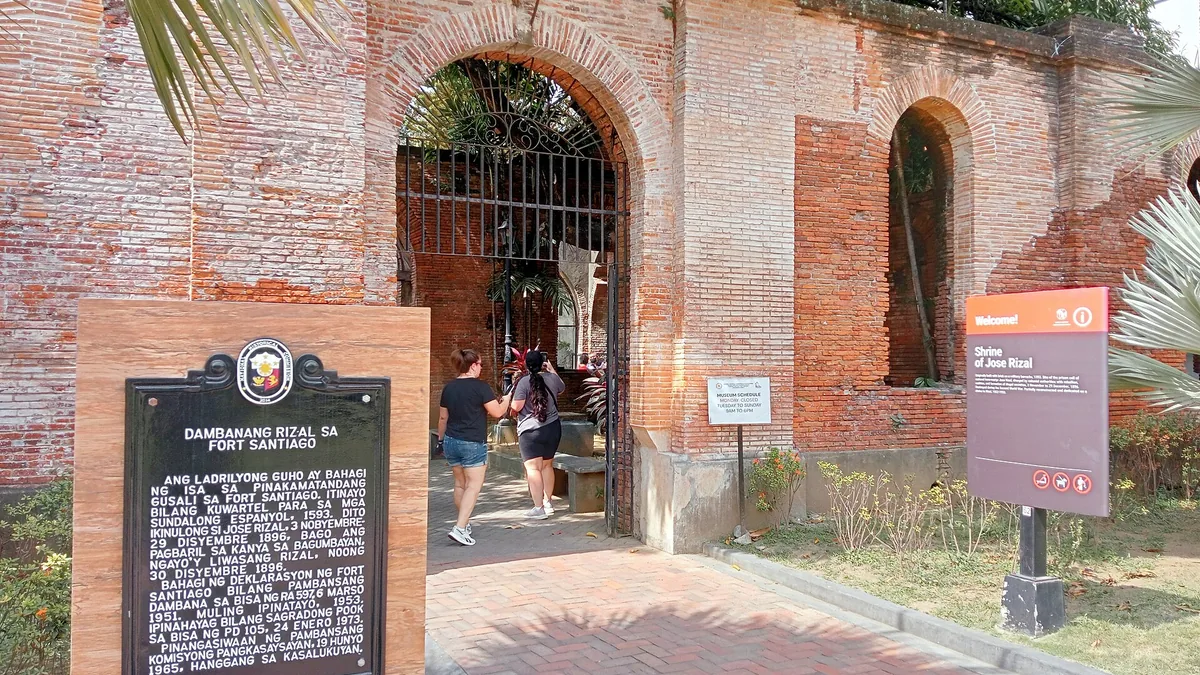
Inside the walls of Intramuros in Manila, a triangular stone fortress points toward the Pasig River like a weathered hand. This is Fort Santiago, the oldest and most important fortification in the Philippines. Built by Spanish colonisers in the late 1500s, expanded over centuries, used by the British, the Americans and the Japanese, and finally restored as a national shrine, the fort carries more layers of Philippine history than almost any other single site in the country.
Fort Santiago: Manila's Stone Witness to 400 Years of History
Trip.com
Search on Trip.comHotels in Philippines
Compare live prices via Travelpayouts — targeted for this guide.
Fort Santiago is not a museum in the usual sense. It is a ruin, a garden, a prison, a shrine and a viewpoint all at once. The walls still show bullet scars from the Second World War. The courtyard where prisoners were executed is now shaded by acacia trees. And at the centre of the grounds, a small memorial marks the final footsteps of Jose Rizal, the national hero, as he walked to his execution in 1896.
The History of Fort Santiago
The site was originally a wooden palisade built by Rajah Sulayman, the Muslim ruler of Manila, before Spanish arrival. Miguel Lopez de Legazpi captured the site in 1570 and began construction of a stone fort named after Saint James. The version that stands today was largely completed in the early 1600s using volcanic tuff from the Mayon region and stones salvaged from the ruins of older buildings.
The fort's strategic importance made it a target repeatedly. The British occupied it during their brief Manila seizure in 1762. The Americans used it as an administrative centre after 1898. The Japanese turned its dungeons into a prison during the Second World War, and at least 600 Filipino and American prisoners of war died there from starvation, suffocation and disease. Post-war restoration began in the 1950s and the site was declared a National Shrine in 1951.
Trip.com
See all tours in Philippines on Trip.comSpa experience in Philippines
Hand-picked experiences in Philippines — book on Trip.com with instant confirmation.

What You Can See Today
The Rizal Shrine
The most emotionally powerful part of the fort is the Rizal Shrine. Jose Rizal was imprisoned here before his execution, and the fort contains a museum dedicated to his life, his writings and his final days. The shrine displays replicas of his prison cell, his writing materials, and personal effects. A bronze set of footprints set into the paving stones traces the path Rizal walked from his cell to the site of his execution at Bagumbayan, now Rizal Park.
The Main Gate
The reconstructed main gate is one of the most photographed parts of Fort Santiago. A stone relief of Saint James the Great on horseback decorates the top of the archway. The gate originally had a drawbridge over a moat. Today the moat is dry and visitors enter through a small visitors' centre where tickets and audio guides are sold.
The Dungeons
The underground chambers near the main entrance were used as prisons and storage vaults. During the Japanese occupation these dungeons held prisoners in appalling conditions - the walls were too thick for sound to escape. A small memorial plaque now lists the names of some who died there. The space is not suitable for young children or anyone uncomfortable with confined areas.
The Gardens and Plazuela
Beyond the military history, Fort Santiago is also a surprisingly peaceful place to walk. The Plazuela de Mella is a landscaped square with benches, fountains and mature trees. Local cats claim the sunny walls at midday. The ramparts give views over the Pasig River and the modern city beyond, a strange contrast between colonial stone and glass towers.
Visitor Information
Opening Hours and Tickets
Fort Santiago is open daily from 8:00am to 6:00pm. The last entry is usually around 5:30pm. The entrance fee for foreign visitors is PHP 75 and for Filipino citizens around PHP 50. Audio guides and guided walking tours are sometimes available at the entrance, though not always in every language. Booking is not usually necessary unless you want a private guide.
How to Get There
The fort is inside the walled city of Intramuros in Manila. The easiest approach is to take a taxi or Grab to the Plaza Moriones entrance, which is the main gate. From there it is a short walk along the walls. Intramuros can be toured on foot, by bamboo bicycle, or by horse-drawn carriage. If you are visiting Fort Santiago, it makes sense to combine it with San Agustin Church, Casa Manila and the Manila Cathedral in the same morning.
Tips for Your Visit
- Go early - Manila's heat peaks after 11:00am and the fort has little shade except in the gardens.
- Wear comfortable shoes - the stone floors are uneven and the ramparts involve stairs.
- Bring water - there are vendors outside the gate but not many inside the fort itself.
- Read Rizal before you go - the museum makes far more sense if you know who he was and why he was executed. His two novels, Noli Me Tangere and El Filibusterismo, explain the context.
- Respect the site - Fort Santiago is a national shrine as well as a tourist attraction. Loud behaviour and climbing on fragile walls are not appropriate.
Why Fort Santiago Matters
For visitors, Fort Santiago is a window into four centuries of Philippine history in one compact site. For Filipinos, it is a place of national memory, particularly for the suffering of the Second World War and the martyrdom of Jose Rizal. The fort does not hide the darker parts of its past - the dungeons are preserved, the bullet holes remain, and the Rizal footprints are deliberately sombre. That honesty is what makes it worth visiting, even for travellers who usually skip historical sites.
Frequently Asked Questions
Is Fort Santiago inside Intramuros?
Yes. Fort Santiago is at the northern end of the walled city of Intramuros. The entrance is near Plaza Moriones. You can walk through Intramuros to reach it from any of the main gates, or enter directly at the fort's main gate.
How long does it take to visit Fort Santiago?
One to one and a half hours is enough for most visitors. If you read every display in the Rizal Shrine and walk the full ramparts, allow two hours. Combine it with other Intramuros sites for a half-day itinerary.
Is Fort Santiago wheelchair accessible?
Partially. The main paths and gardens are flat, but the dungeons, ramparts and some of the older stone stairs are not accessible. The Rizal Shrine museum has a ramp in some areas but not all.
What is the best time of day to visit?
Morning, before 10:00am, is best for cooler weather and softer light for photographs. The fort is open until 6:00pm and late afternoon can also be pleasant, though some indoor exhibits close earlier. Avoid midday in the summer months.
Sources
Sources
Primary references for the figures and rules in this guide. Fees and schedules change — check the source before you travel.

PANA.PH Editorial Team
Philippines travel desk
The PANA.PH travel desk researches, books and re-checks Philippines travel logistics — fares, ferry schedules, government fees and permit rules — and publishes what it can verify.
Ready to go?
Plan your Manila trip with PANA.PH
Turn this guide into a real trip — compare live prices and build a day-by-day itinerary in minutes.
🗺️ Build my itinerary🏡 Real local stays (book direct)
Hand-picked homestays and guesthouses — book direct, no markup.
Browse all local stays →
🌊 Popular activities (book instantly)
Island hopping, canyoneering, whale sharks — real Klook/GetYourGuide options.
View all activities →