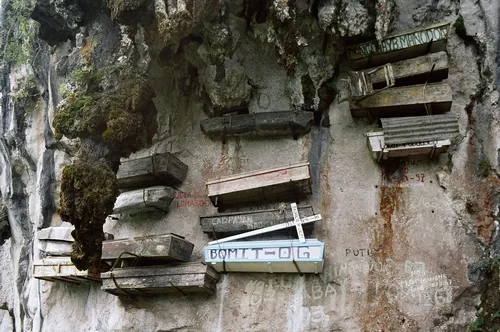
You walk down a dirt path behind the Anglican church in the centre of Sagada, past a gate that asks for silence, and into a valley of limestone cliffs draped in jungle. Your guide stops and points up. There, bolted to the rock face or wedged into natural ledges, are rows of wooden coffins - some weathered grey, some still brown, some stacked two or three high, some hanging from iron brackets driven into the stone. A few have been there for decades. A few have been there for weeks. This is Echo Valley, and the coffins are not an archaeological display. They are an active cemetery.
Sagada Hanging Coffins: Why the Igorot Bury Their Dead on Cliffs
Trip.com
Search on Trip.comHotels in Sagada
Compare live prices via Travelpayouts — targeted for this guide.
The hanging coffins of Sagada are the burial practice of the Igorot people, specifically the Kankanaey and Applai communities of the Mountain Province in the northern Philippines. The practice is not a thing of the past. Elders in Sagada who choose to be buried this way are still placed on the cliffs today, alongside coffins that have been there for generations. Understanding this before you visit changes everything about how you should behave there.
Why the Dead Are Placed on Cliffs
The Igorot believe that the dead should be placed high, closer to the sky and to the spirits of their ancestors, rather than buried in the ground. The limestone cliffs of Sagada provide natural ledges and overhangs that protect the coffins from rain and from animals. The elevation also means the dead can watch over their living relatives and that the living, working in the rice terraces below, can look up and remember them.
There is a practical dimension too. The mountains of the Cordillera are steep, and the soil is thin and rocky. Digging a grave is difficult, and the ground is often too hard or too wet. The cliffs solve this problem. The dry, sheltered ledges preserve the coffins, and some of the oldest visible coffins in Echo Valley are estimated to be over a century old, though most have decayed and been replaced.
Trip.com
See all tours in Sagada on Trip.comHiking tour in Sagada
Hand-picked experiences in Sagada — book on Trip.com with instant confirmation.
Not everyone in Sagada is buried this way. The hanging coffin tradition is reserved for elders who have lived a full life, who have been married, and who have grandchildren. Those who died young, or who died from illness or accident, are typically buried in the ground. The decision to be placed on the cliff is made by the individual before death, or by the family in accordance with tradition.
How the Burial Works
The process is complex and involves the entire community. When an elder dies, the body is placed in a sangadil, a coffin carved from a single pine or narra log. The coffin is shaped to the body of the deceased - the person is measured while alive, and the coffin is sometimes pre-made and stored in the house for years before death. The body is placed in a fetal position, with the knees drawn to the chest, because the Igorot believe that a person should leave the world in the same position they entered it.
Before the coffin is placed on the cliff, the body may sit in the house for several days while the community gathers, sings dirges, and performs the begnas and other rituals. Animals - typically pigs and chickens - are sacrificed, and the meat is shared among the community. The funeral can last several days and is one of the most important social events in Sagada.
On the day of burial, the coffin is carried to the cliff site by a group of men. The coffin is hoisted or lowered into position using ropes, and it is secured with brackets, wedged into natural ledges, or placed on top of older coffins. The men who do this work are from specific families who have traditionally performed this role. The process is dangerous - the cliffs are steep and the wood is heavy - and injuries are not uncommon.
Visitors do not witness the burial itself. If a funeral is in progress, the cliff area is closed to tourists and you should respect the closure without question.
Visiting Echo Valley
Echo Valley is the main site where hanging coffins are visible to visitors. It is a short walk from the town centre. You must hire a registered guide - this is mandatory and non-negotiable. The Sagada tourism office enforces this rule to protect both the site and the visitors, as the paths are unmarked and the cliffs are dangerous.
The walk from the tourism office to the viewing point takes about 20-30 minutes. You pass through the Anglican cemetery, where you will see a mix of conventional graves and the entrance to Echo Valley. From the viewing point, you can see the coffins on the cliff face across the valley. The name "Echo Valley" comes from the acoustic properties of the limestone walls - if you shout, the echo returns clearly. But do not shout near the coffins. This is a cemetery, not a tourist attraction in the recreational sense.
Your guide will explain the tradition, point out specific coffins, and answer questions. Ask respectfully. Do not ask to be taken closer to the coffins or to touch them. Do not take close-up photos of individual coffins or of any funeral activity. Wide landscape shots from the viewing point are generally acceptable, but when in doubt, ask your guide.
The Cost of Visiting
- Environmental fee / registration: PHP 50-100 per person, paid at the Sagada tourism office. This covers all sites in Sagada for the duration of your stay.
- Guide fee: PHP 500-800 for a small group for the Echo Valley tour (1-2 hours). Guides are assigned at the tourism office and fees are fixed.
- Accommodation: PHP 500-1,500 per night for a guesthouse room. Sagada has no large hotels.
- Meals: PHP 150-300 per meal at local restaurants. Try the Sagada lemon pie and the local coffee.
How to Get to Sagada
Sagada is in the Mountain Province, about 1,500 metres above sea level in the Cordillera Central. There is no airport. The nearest major gateway is Baguio City, which has bus connections to Sagada.
From Manila to Baguio
Buses to Baguio leave from the Victory Liner or Genesis terminals in Manila (Cubao or Pasay). The trip takes 5-6 hours and costs PHP 400-700 one way. An overnight bus saves a night of accommodation.
From Baguio to Sagada
From Baguio, take a GL Lizardo or Cable Tours bus to Sagada (5-6 hours, PHP 200-350). The road is winding and mountainous - if you are prone to motion sickness, take medication before you leave. Buses are limited, usually 2-3 per day, so check the schedule and arrive early.
From Banaue
If you are coming from the Banaue Rice Terraces, there are vans from Banaue to Bontoc (2 hours, PHP 150-200), then a jeepney or van from Bontoc to Sagada (1.5 hours, PHP 50-100). This is the most common route for travellers combining Banaue and Sagada.
Best Time to Visit
The dry season in the Cordillera runs from November to May. The best months are January to March, when the weather is cool (often 12-18 degrees during the day, colder at night) and the trails are dry. Sagada is significantly cooler than lowland Luzon - bring warm clothes.
Avoid the rainy season from June to October. The mountain roads to Sagada are prone to landslides, and the trails in Echo Valley become slippery and dangerous. Travel can be disrupted for days after heavy rain.
Sagada gets busy during Holy Week and the Christmas holidays. Book accommodation well in advance for these periods. For a quieter visit, go in January or February.
Other Things to Do in Sagada
Sagada is worth at least 2-3 days. Beyond Echo Valley:
- Sumaguing Cave: A cave with impressive stalactites, stalagmites and underground pools. The cave tour involves wading through water and scrambling over rocks. PHP 500-800 guide fee for a small group. Wear clothes you do not mind getting dirty.
- Kiltepan Peak: The sunrise viewpoint overlooking rice terraces and valleys. Famous for its sea of clouds at dawn. A 30-minute drive from town. Go at 5:00am.
- Bomod-ok Falls: A tall waterfall reached by a hike through rice terraces. Half-day trip. PHP 500-800 guide fee.
- Rice terraces: Several terrace systems are within walking distance of town, including the Ampacao and Kiltepan terraces.
Respect and Cultural Sensitivity
This is the most important section of this guide. The hanging coffins are a sacred site and an active burial ground. The Igorot community of Sagada has opened their town to visitors, but this openness has limits, and those limits have been tested by tourism in recent years.
- Do not touch the coffins. Ever. For any reason.
- Do not take selfies with the coffins. This has become a problem and is deeply offensive to the community.
- Do not ask your guide to take you closer than the designated viewing point.
- Do not visit if a funeral is in progress. If you see activity near the cliffs or if the path is closed, leave.
- Keep your voice down. Echo Valley is named for its acoustics, but it is still a cemetery.
- Hire a registered guide. This supports the local economy and ensures you understand what you are seeing. Unlicensed guides are not permitted and you may be turned away at the site.
- Do not publish identifying photos of coffins that are clearly recent, out of respect for the families.
The Sagada community has discussed restricting access to Echo Valley in response to disrespectful tourist behaviour. If visitors continue to treat the site as a photo opportunity rather than a sacred place, access may be limited in the future. Visit with the understanding that you are a guest in someone's cemetery.
Frequently Asked Questions
Are the hanging coffins of Sagada still used today?
Yes. The practice is a living tradition, not a historical relic. Elders in Sagada who choose to be buried on the cliffs are still placed there today, alongside coffins that have been there for generations. If you visit, some of the coffins you see may be recent. This is why respectful behaviour is essential.
Why are the dead buried on cliffs instead of in the ground?
The Igorot believe that placing the dead high on cliffs brings them closer to the spirits of their ancestors and allows them to watch over their living relatives. There is also a practical reason: the mountain soil is thin and rocky, making ground burial difficult, while the limestone cliffs provide natural, sheltered ledges that preserve the coffins.
Can I visit the hanging coffins without a guide?
No. A registered guide is mandatory for visiting Echo Valley and the hanging coffin sites. This rule is enforced by the Sagada tourism office. The paths are unmarked and the cliffs are dangerous, so the guide requirement protects both the site and the visitors. Guide fees are fixed and assigned at the tourism office.
Is it okay to take photos of the hanging coffins?
Wide landscape shots from the designated viewing point are generally acceptable, but you should ask your guide before taking any photos. Do not take close-up photos of individual coffins, do not take selfies with the coffins, and do not photograph any funeral activity. If a funeral is in progress, the site is closed and you should leave.
How cold is Sagada?
Sagada is at roughly 1,500 metres elevation and is significantly cooler than lowland Luzon. Daytime temperatures are typically 15-22 degrees, and nights can drop to 10 degrees or lower in the cooler months. Bring a jacket, long trousers and warm layers, especially if you are visiting in December to February.
Sources
Sources
Primary references for the figures and rules in this guide. Fees and schedules change — check the source before you travel.

PANA.PH Luzon Desk
Luzon travel logistics — Manila, Baguio and North Luzon
The Luzon Desk of the PANA.PH travel desk: it maintains and re-checks the luzon travel logistics — manila, baguio and north luzon data behind the site's guides — operator price lists, official fee schedules and posted timetables — and publishes what it can verify.
Ready to go?
Plan your Sagada trip with PANA.PH
Turn this guide into a real trip — compare live prices and build a day-by-day itinerary in minutes.
🗺️ Build my itinerary🏡 Real local stays (book direct)
Hand-picked homestays and guesthouses — book direct, no markup.
Browse all local stays →
🌊 Popular activities (book instantly)
Island hopping, canyoneering, whale sharks — real Klook/GetYourGuide options.
View all activities →