The Philippines has been quietly sitting in Australia's backyard for decades, overshadowed by the annual Bali pilgrimage and the well-worn trail to Thailand. But something has shifted. Australians are discovering what Asian travelers have known for years: the Philippines is closer than you think, cheaper than you expect, and dramatically more diverse than anywhere else in Southeast Asia. Here is everything you need to know to plan a Philippines trip from Australia in 2026.
Philippines from Australia: Flights, Visa & What Aussies Need to Know (2026)
Trip.com
Search on Trip.comHotels in Philippines
Compare live prices via Travelpayouts — targeted for this guide.
How Long Is the Flight from Australia to the Philippines?
The flight times are far more manageable than most Aussies assume. Direct and near-direct options from the three main Australian departure cities:
- Sydney to Manila: Philippine Airlines operates direct flights at around 7 hours 30 minutes. Cebu Pacific also runs the route at similar times. This is genuinely one of the shortest international long-haul flights from Sydney to a tropical destination.
- Melbourne to Manila: Around 8 hours direct on Philippine Airlines. AirAsia connects via Kuala Lumpur at around 10-11 hours total — and the fares are often 30-40% cheaper if you time it right.
- Brisbane to Manila: No consistent direct service as of 2026, but Cebu Pacific and Philippine Airlines connect via Manila with short layovers. Total travel time is typically 9-11 hours. Singapore Airlines via Singapore (SIN) is a premium option at around 10-11 hours and well worth the cost for the service quality.
- Any city to Cebu: If your goal is the Visayas (Bohol, Siargao, Dumaguete), flying into Cebu instead of Manila saves you an internal flight. Cathay Pacific via Hong Kong (HKG) is excellent for this route — roughly 10-12 hours total including the layover, and Cathay's business class on the HKG-Cebu leg is world-class.
Flight prices from Australia in 2026 are running roughly AUD 650-950 return economy from Sydney or Melbourne to Manila on promotional fares. Budget around AUD 1,100-1,500 for last-minute or peak-season bookings. Cathay via Hong Kong and Singapore Airlines via Singapore tend to run AUD 900-1,400 return but offer meaningfully better comfort and reliability.
The AUD to PHP Exchange Rate: How Far Does Your Money Go?
This is where the Philippines genuinely surprises Australians. At current mid-2026 rates, 1 Australian Dollar converts to approximately 38-42 Philippine Pesos, depending on the day and your exchange method. In practical terms:
Trip.com
See all tours in Philippines on Trip.comTours & activities in Philippines
Hand-picked experiences in Philippines — book on Trip.com with instant confirmation.
- Budget guesthouse room: PHP 800-1,500 = AUD 20-38 per night
- Mid-range private hotel room: PHP 2,500-5,000 = AUD 63-125 per night
- Carinderia (local canteen) meal: PHP 80-150 = AUD 2-4
- Restaurant meal at a decent local spot: PHP 300-600 = AUD 8-15
- San Miguel Beer at a bar: PHP 70-120 = AUD 2-3
- Island hopping tour (full day): PHP 1,200-2,500 = AUD 30-63
- PADI Open Water dive course: PHP 18,000-25,000 = AUD 450-625
Compare that to Bali: a Bali villa that feels luxurious at AUD 80/night is easily matched by a Philippines beachfront room at AUD 55. The Philippines consistently delivers better value per dollar than Indonesia, Thailand, or Vietnam for Australian travellers in 2026.
Use a Wise card or Revolut to exchange AUD to PHP — both offer mid-market rates with minimal fees. Avoid airport money changers in Manila (Ninoy Aquino International Airport) which typically offer rates 8-12% worse than the street rate. Metrobank ATMs in the Philippines are recommended for cash withdrawals — they charge lower foreign transaction fees than most other local bank ATMs.
Visa-Free Entry for Australians: What You Need to Know
Australian passport holders receive visa-free entry to the Philippines for up to 30 days on arrival — no application, no fees, no paperwork. You simply present your passport (must be valid for at least six months beyond your entry date), a return or onward ticket, and proof of sufficient funds. The Bureau of Immigration officer may ask about accommodation but rarely digs deep for tourists.
Want to stay longer than 30 days? The visa can be extended at any Bureau of Immigration office in the Philippines. The first extension (another 29 days) costs approximately PHP 3,030 (around AUD 76). You can continue extending in similar increments up to a cumulative 36 months, making the Philippines one of the most flexible long-stay visa destinations in Asia for Australians.
Important: you must hold a confirmed onward or return ticket to board your flight to the Philippines. Philippine immigration is strict about this — airlines will refuse boarding without it, and even if you board, BI officers at the airport may ask to see your ticket out. Book a refundable outbound or use a tool like OnwardTicket to generate a temporary booking if your plans are genuinely open-ended.
DFAT Travel Advice and Safety Overview
The Australian Department of Foreign Affairs and Trade (DFAT) maintains a current travel advisory for the Philippines at smartraveller.gov.au. As of mid-2026, the advisory is "Exercise a high degree of caution" for most of the country, with "Do not travel" for the Sulu Archipelago, the Marawi area, and parts of central and western Mindanao due to ongoing terrorism and kidnapping risks.
The practical reality for typical tourist itineraries — Manila, Palawan, Cebu, Bohol, Siargao, and the Visayas generally — is that these are safe, heavily visited destinations with no material elevated risk beyond the usual urban travel caution you would exercise in any large Asian city. The "high degree of caution" rating for Manila reflects petty crime, scams targeting tourists (particularly in Malate and around the airport), and occasional civil unrest, not terrorism.
Simply avoid the southern Mindanao islands flagged by DFAT, use common sense in Metro Manila, and keep your valuables secured. Millions of Australians travel to the Philippines every year without incident.
Australian Travel Insurance for the Philippines
Do not skip travel insurance. The Philippine healthcare system outside major cities is limited, and medical evacuation to Manila or Australia from a remote island can cost AUD 20,000-80,000 out of pocket. Three reputable Australian providers with solid Philippines coverage:
- Cover-More: Australia's largest travel insurer, widely used by Commonwealth Bank and Westpac customers. Good adventure activity coverage extensions for diving and surfing — check the policy schedule as standard policies exclude scuba diving beyond 10m without the adventure sports addon.
- Allianz Travel Insurance: Comprehensive policies with solid medical evacuation coverage. Their "Comprehensive" tier covers trip cancellation, medical, and emergency evacuation robustly. Available standalone or bundled with some Australian credit cards (ANZ Platinum, for instance, includes Allianz cover).
- 1Cover: Popular with budget-conscious Australian travellers. Their "Essentials" policy is genuinely competitive on price while maintaining strong medical coverage. Good online claims process.
Whichever provider you choose, confirm the policy covers: scuba diving (if applicable), motorbike riding (many policies exclude this — it's relevant in the Philippines where renting a motorbike on islands is common), typhoon-related trip interruption, and emergency medical evacuation.
Plugs, Adapters, and Power
Australia uses the Type I plug (the angled three-pin familiar to every Aussie). The Philippines primarily uses Type A and Type B — the flat two-pin and three-pin American-style sockets. These are incompatible with Australian plugs, so you will need an adapter.
A universal travel adapter (widely available at Kmart, Big W, or Harvey Norman for AUD 12-25 before you leave) covers the Philippines and most of Southeast Asia. Alternatively, most mid-range and upper-end Filipino hotels have universal sockets or provide adapters at reception — but do not count on this in guesthouses and budget spots. Bring your own.
Voltage in the Philippines is 220V/60Hz, matching Australia's 230V/50Hz closely enough that all modern Australian electronics (laptops, phone chargers, cameras) work without a voltage converter — just the plug adapter.
One important note: in some rural areas and island guesthouses, power is only available for certain hours (often 6pm to 6am via generator). Pack a power bank — a 20,000mAh unit will keep your phone going through a full off-grid island day.
Filipino English and Culture: What Aussies Should Know
English is an official language of the Philippines and is used in government, education, business, and daily life. The Philippines has the third-largest English-speaking population in the world. As an Australian, you will almost never face a language barrier in any tourist area, hotel, restaurant, or transport hub. Even in remote island communities, someone nearby will speak enough English to help you.
Filipino culture is warm, service-oriented, and genuinely hospitable — sometimes to a degree that surprises Australians accustomed to more reserved service culture. Filipinos are enthusiastic about Australian tourists and often curious about Australia. Expect conversations, smiles, and genuine interest in where you are from. The phrase "Kamusta?" (How are you?) goes a long way as a greeting even if your Tagalog or Visayan goes no further.
Catholic culture is deeply embedded — Sunday masses are packed, religious festivals are spectacular (Sinulog in Cebu in January is one of Asia's great street festivals), and conservative dress applies in churches and provincial communities. Pack a light sarong or cover-up for inland areas.
Best Activities for Aussie Travellers
Scuba diving: The Philippines sits at the heart of the Coral Triangle, with marine biodiversity that rivals or exceeds the Great Barrier Reef. Tubbataha Reef (accessible March-June via liveaboard from Puerto Princesa) is a UNESCO World Heritage site and a bucket-list dive for any Australian diver who has done the Coral Sea. Coron's WWII Japanese shipwrecks are among the best wreck dives on earth. Malapascua offers thresher shark encounters at dawn.
Surfing: Cloud 9 on Siargao Island is a world-renowned right-hand reef break that hosts international competitions. The waves run June through October — precisely when Australian winter makes you want to escape. Baler (Aurora province, Luzon) and La Union are beginner-friendly surf spots with active communities.
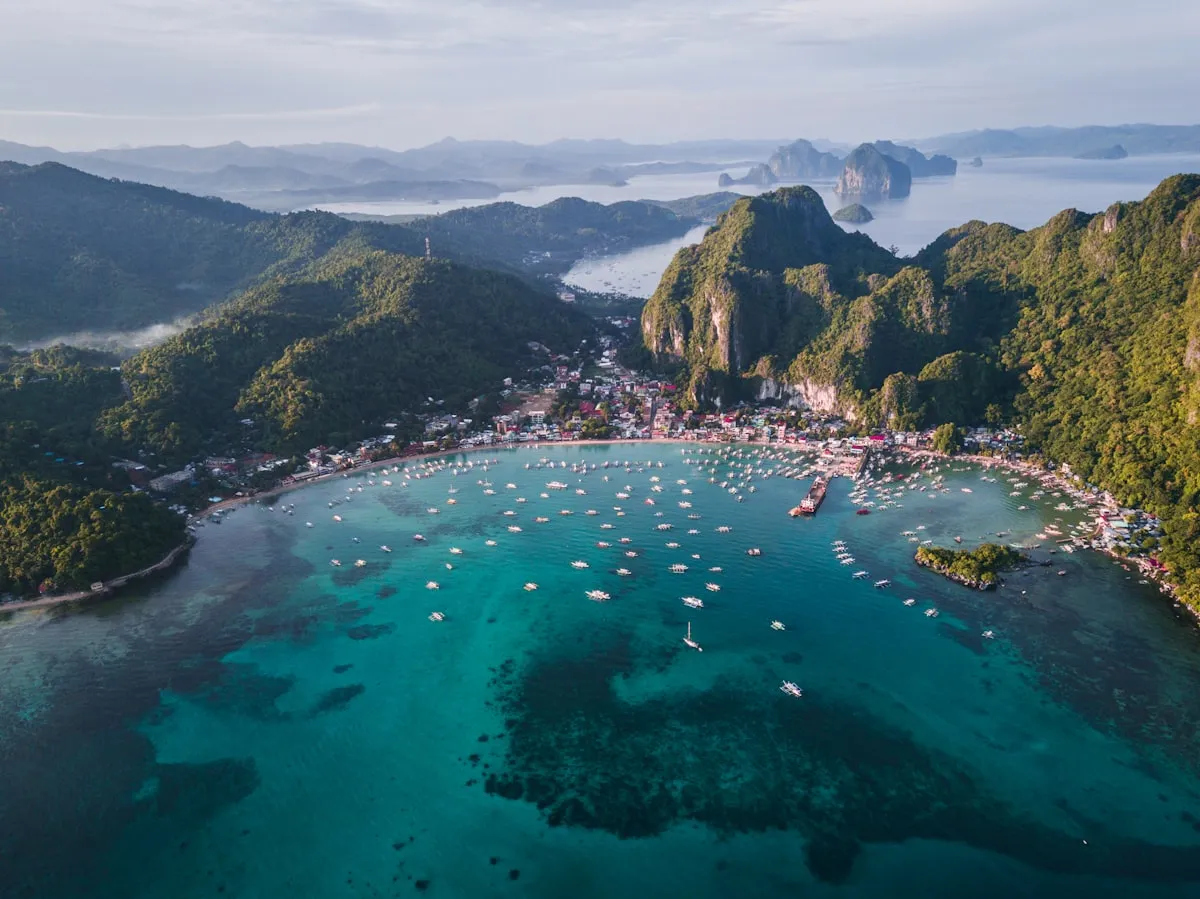
Island hopping: The Philippine archipelago is purpose-built for island hopping. El Nido's lagoons, Honda Bay near Puerto Princesa, the Chocolate Hills of Bohol, the rice terraces of Batad — the diversity is extraordinary. A week-long itinerary barely scratches the surface.
Philippines vs Bali: The Honest Comparison
Every Australian asking about the Philippines has the same question: "Is it better than Bali?" The honest answer: different, and in many ways better.
- Crowds: Bali's Seminyak, Kuta, and Ubud are genuinely overwhelmed. El Nido has crowds in peak season but nothing approaching Bali's Kuta Beach. Most Philippine island destinations still feel relatively undiscovered.
- Value: The Philippines is cheaper than Bali for equivalent accommodation and food quality in most categories.
- English: Far easier in the Philippines — no language barrier whatsoever.
- Diversity: 7,641 islands vs Bali's one island. The Philippines offers beaches, volcanoes, rice terraces, world-class diving, surfing, and colonial history in a single trip.
- Infrastructure: Bali wins here. The Philippines has more variable road quality, more power outage risk in remote areas, and domestic flights that cancel more frequently. Build buffer days into your itinerary.
- Nightlife: Bali's Seminyak is a party machine. Metro Cebu and Manila have excellent nightlife but the Philippines' island destinations are more laid-back by comparison.
Register with Smart Traveller
Before you leave Australia, register your trip at smartraveller.gov.au. It is free, takes five minutes, and means the Australian Embassy in Manila can contact you in an emergency — typhoon, civil unrest, medical evacuation — and your family can reach you through official channels if communication goes down. The Australian Embassy in Manila (at 1 Visa Lane, Taguig) and the Consulate in Cebu are both operational and responsive.
Frequently Asked Questions
Do Australians need a visa for the Philippines?
No. Australian passport holders receive visa-free entry for 30 days on arrival. No pre-application is required. Bring a return or onward ticket, a passport valid for at least six months, and proof of sufficient funds. Extensions are available in-country at Bureau of Immigration offices for approximately AUD 76 per 29-day increment.
What is the best airline to fly from Australia to the Philippines?
For direct flights, Philippine Airlines (Manila) and Cebu Pacific (Manila, Cebu) are the primary options. For one-stop comfort and reliability, Singapore Airlines via Singapore and Cathay Pacific via Hong Kong are both excellent. AirAsia via Kuala Lumpur is the best budget one-stop option. Book 6-10 weeks out for the best fares; last-minute prices spike sharply on this route.
Is the Philippines safe for Australian tourists?
Yes, for the major tourist destinations. Manila, Palawan (El Nido, Coron), Cebu, Bohol, Siargao, and the Visayas generally are safe for travellers exercising normal caution. Avoid the Sulu Archipelago, Marawi, and flagged parts of western Mindanao as per DFAT advice. Register at smartraveller.gov.au and carry travel insurance.
How much money should I budget per day in the Philippines as an Australian?
Budget travellers can manage on AUD 50-70 per day (private guesthouse room, local meals, beer, basic transport). Mid-range travellers comfortable in decent hotels and a mix of local and Western food will spend AUD 120-200/day. Luxury resorts (Amanpulo, El Nido Resorts) run AUD 600-1,500+/night and are genuinely competitive with comparable Maldives or Bali luxury at lower price points.
What plug adapter do I need for the Philippines from Australia?
You need a Type A or Type I-to-Type A adapter. Australia's Type I plug (angled three-pin) is incompatible with the Philippines' Type A (flat two-pin) and Type B (flat three-pin, American style) sockets. A universal travel adapter available at Kmart, Big W, or any Australian electronics retailer covers this. No voltage converter is needed — modern Australian electronics run fine on Philippine 220V power.

PANA.PH Editorial Team
Philippines travel desk
The PANA.PH travel desk researches, books and re-checks Philippines travel logistics — fares, ferry schedules, government fees and permit rules — and publishes what it can verify.
🏡 Real local stays (book direct)
Hand-picked homestays and guesthouses — book direct, no markup.
Browse all local stays →
🌊 Popular activities (book instantly)
Island hopping, canyoneering, whale sharks — real Klook/GetYourGuide options.
View all activities →