Contents
- 1Where you are standing: the river, the bay, and the old city
- 2Stop by stop: inside the walls of Intramuros
- 3Across the river: Binondo, the world's oldest Chinatown
- 4Old Manila: the connective tissue
- 5Practical tips from someone who has walked it many times
- 6Why it stays with you
- 7Good to know before you book
- 8Frequently asked questions
- 9Ready to explore Manila?
There is a particular kind of magic in walking through Manila's oldest streets in the soft light of late afternoon, when the cobblestones of Intramuros catch the gold of a sinking sun and the air carries the mingled scents of incense and freshly fried hopia. This half-day tour stitches together three layers of the same old city: the walled Spanish colonial core of Intramuros, the tight bustling lanes of Binondo, and the faded grandeur of Old Manila that ties them together. It is a walk through nearly five centuries of layered history, and done well, it is one of the most rewarding things you can do in the Philippine capital.
Hotels in Philippines
Compare live prices via Travelpayouts — targeted for this guide.
Most travelers fly into Manila and rush onward to the beaches of Palawan or Cebu. That is a mistake. Manila is where the Philippine story was forged, contested, burned, and rebuilt, and these few square kilometers along the Pasig River hold more genuine history per step than almost anywhere else in the country.
Where you are standing: the river, the bay, and the old city
The geography here explains everything. Manila grew up at the mouth of the Pasig River, the waterway that drains Laguna de Bay, the largest lake in the Philippines, out into Manila Bay. That river mouth was a natural harbor and a strategic chokepoint, which is exactly why a fortified settlement rose here. Intramuros, whose name simply means "within the walls" in Latin, sits on the south bank where the Pasig meets the bay. Binondo sits directly across the river on the north bank.
The Spanish founded Manila as a walled city in 1571 under Miguel Lopez de Legazpi, building on the site of an existing Islamic-influenced settlement ruled by local rulers including Rajah Sulayman. Over the following decades they raised thick stone walls, bastions, and a moat around roughly 64 hectares of ground, using volcanic tuff (a soft local stone called adobe, unrelated to the food) quarried from the surrounding region. Those same walls, much battered and partly reconstructed, are what you walk along today.
Tours & activities in Philippines
Hand-picked experiences in Philippines — book on Trip.com with instant confirmation.


Stop by stop: inside the walls of Intramuros
The tour usually begins inside Intramuros, and the natural anchor point is Fort Santiago, the citadel guarding the river mouth at the northwest corner of the walls. Its dramatic stone gateway, carved with the image of Saint James (Santiago), is one of the most photographed spots in Manila. Inside, leafy gardens and ruined walls tell a sobering story: this fort served as a military prison and place of execution under both Spanish and later Japanese occupation.
Fort Santiago is also the Rizal Shrine. Jose Rizal, the national hero whose novels helped ignite the Philippine Revolution, was imprisoned here in his final days before his execution by firing squad in 1896. Brass footsteps embedded in the ground trace his last walk from his cell to the execution site at what is now Rizal Park (Luneta), just outside the walls. Standing in his preserved cell is a genuinely moving moment.
From the fort, the walk typically continues to:
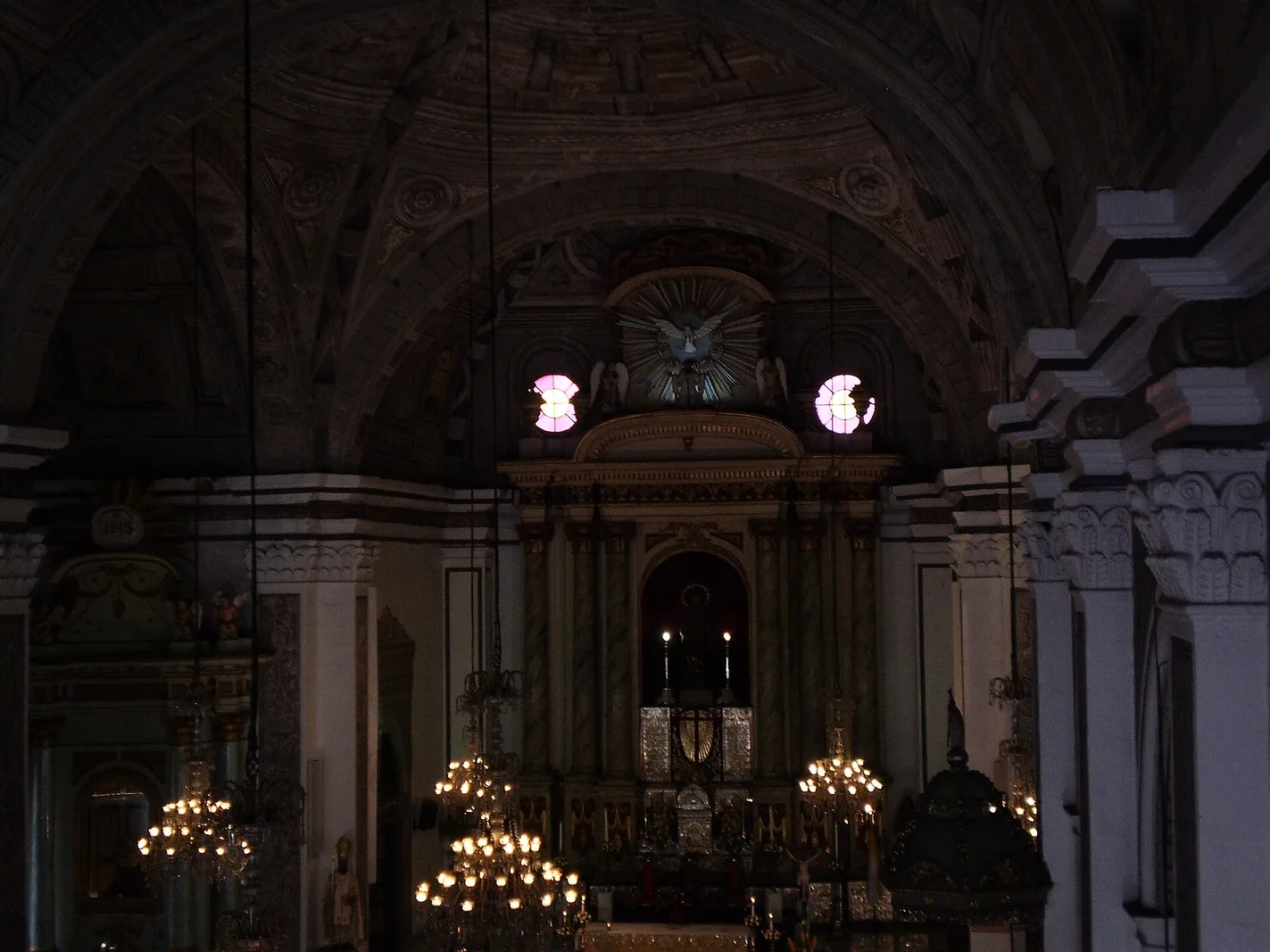
- San Agustin Church - the oldest stone church in the Philippines, completed in 1607, and a UNESCO World Heritage Site as one of the Baroque Churches of the Philippines. It famously survived the bombing and battles that flattened almost everything around it. The trompe-l'oeil ceiling and the carved wooden doors are extraordinary, and the attached monastery houses a rich museum.
- Manila Cathedral - the grand domed seat of the Archbishop of Manila. The current structure is at least the eighth iteration on this site; earthquakes, fires, and the devastation of World War II repeatedly destroyed its predecessors, and it was rebuilt and reopened in the 1950s.
- Casa Manila - a reconstructed colonial-era house museum that recreates an upper-class Filipino-Spanish home, giving you a vivid sense of how the wealthy lived: capiz-shell windows, hardwood floors, and period furniture.
- Plaza Roma and the walls themselves - many tours include a stretch of walking atop or alongside the ramparts, with views over the moat-turned-golf-course and the old gates such as Puerta Real.
A crucial piece of honest history: almost all of Intramuros was destroyed in February 1945 during the Battle of Manila, when the city was caught between Japanese defenders and advancing American forces. Tens of thousands of civilians died and the walled city was reduced to rubble. Much of what you see today is careful postwar reconstruction. Knowing this changes how you look at every restored archway.
Across the river: Binondo, the world's oldest Chinatown
Crossing the Pasig (often via Jones Bridge, itself a handsome restored span) brings you into Binondo, established by the Spanish in 1594 as a settlement for Catholic Chinese residents. It is widely recognized as the oldest Chinatown in the world, predating its more famous counterparts by centuries. The Spanish placed it deliberately within cannon range of Intramuros to keep watch over the large and economically vital Chinese-Filipino community.
Binondo is a feast for the senses and, very often, a feast full stop. Many versions of this tour lean into the food, and rightly so. Highlights commonly include:
- Binondo Church (Minor Basilica of San Lorenzo Ruiz) - dedicated to the first Filipino saint, Lorenzo Ruiz, a Chinese-Filipino from Binondo. Its octagonal bell tower is a Binondo landmark.
- Ongpin Street - the historic main artery, lined with apothecaries selling traditional Chinese medicine, jewelers, and bakeries.
- Hopia and dumpling stops - Binondo is the birthplace of Filipino-Chinese institutions. Expect to sample hopia (flaky bean-filled pastries), fresh lumpia, dumplings, soup, and rich tikoy depending on the season.
- The narrow side lanes - where the real texture of the neighborhood lives, full of small family businesses that have operated for generations.
This is where the "fusion" identity of the Philippines becomes tangible. Chinese-Filipino (Tsinoy) culture shaped Philippine food, commerce, and language profoundly, and Binondo is its beating heart.
Old Manila: the connective tissue
Between and around these two cores lies "Old Manila" proper - the riverside districts, the surviving prewar architecture along Escolta (once the premier commercial street in the country), and the grand civic buildings of the early American period. Walking guides often point out Art Deco facades, the old Manila Post Office building, and the wide ceremonial avenues laid out under American urban planner Daniel Burnham's influence in the early 1900s. It is a layered cityscape: Spanish, then American, then war ruin, then modern Manila, all stacked on top of one another.
Practical tips from someone who has walked it many times
- Duration: Plan for roughly four to five hours on foot, sometimes with short transfers between Intramuros and Binondo.
- How strenuous: Moderate. It is mostly flat walking on uneven cobblestones and busy sidewalks. Reasonable fitness and good walking shoes are essential - leave the sandals at the hotel.
- When to go: The cool dry season (roughly December to February) is most comfortable. For the heat, an early-morning or late-afternoon start beats the brutal midday tropical sun. The rainy season (June to October) brings sudden downpours, so pack a compact umbrella.
- What to bring: Water, sun protection (hat, sunscreen), cash in small denominations for street food and tips, and a hat. Lightweight, breathable clothing is best, but bring something that covers shoulders and knees if you want to enter the churches respectfully.
- What's typically included: A guide is the value here - the history is invisible without one. Many tours include entrance fees to Fort Santiago and San Agustin; food-focused Binondo tours include tastings. Confirm inclusions when booking.
- Responsible travel: These are living neighborhoods and active places of worship and remembrance. Dress modestly in churches, ask before photographing people in Binondo's shops, and support the small family-run food stalls directly. Be mindful that Fort Santiago is, in part, a memorial to enormous wartime suffering.
Why it stays with you
By the end of a half-day here you will have walked from a Spanish citadel where a national hero spent his last hours, across a river into the oldest Chinatown on earth, past the ghosts of a city that was destroyed and rebuilt. Few half-day tours anywhere pack in so much real, consequential history. You arrive thinking of Manila as a place to pass through; you leave understanding it as the place where the Philippines began. Wear good shoes, come hungry, and let the old city tell you its story.
Good to know before you book
- Duration: typically a full day (around 8 to 10 hours including transfers), though half-day and multi-day options exist - check the listing.
- Best for: couples, families and first-time visitors.
- What is included: transport, a guide and the main stops; entrance fees and lunch are sometimes extra.
- Pickup: most tours offer hotel or central pickup; confirm your point and time when booking.
- Book through: the GetYourGuide button on this page, which shows live availability and pricing.
Frequently asked questions
How long does the Intramuros, Chinatown & Old Manila Half-Day Tour take?
Most departures run as a full day - roughly 8 to 10 hours including pickup, travel and the activities themselves - so plan to set aside the whole day. Some operators offer shorter or private versions; the exact timing for your date is shown when you book through the GetYourGuide button on this page.
What is included in the Intramuros, Chinatown & Old Manila Half-Day Tour?
Typically the price covers transport, a guide and the main stops; entrance fees and lunch are sometimes extra. Inclusions vary by operator, so always read the specific listing - it spells out exactly what is provided and what you pay for separately, such as entrance or environmental fees.
What should I bring?
Pack comfortable shoes, sunscreen, a hat, water and small cash for entrance fees and souvenirs. It is also worth carrying some cash for local fees, drinks and tips, plus any personal medication, since card facilities can be limited outside the cities.
Is the Intramuros, Chinatown & Old Manila Half-Day Tour suitable for beginners or families?
It is gentle and family-friendly, suitable for all ages with only light walking involved - a comfortable way to see the highlights. If you have specific concerns about age, fitness or swimming ability, message the operator before booking - they can advise on the best option for your group.
When is the best time to do this tour?
The best conditions are usually the cooler, drier months of November to May. That said, the Philippines is a year-round destination, and many of these experiences run in any season - just expect the occasional shower and check the forecast for the day.
How do I get to Manila?
To reach Manila, fly into Manila (Ninoy Aquino International Airport), then travel by road - most of these day trips depart from Metro Manila. Many tours include transfers from nearby towns or hotels, so confirm your pickup arrangement when you book so the day runs smoothly from the start.
Do I need to book the Intramuros, Chinatown & Old Manila Half-Day Tour in advance?
Yes - booking ahead is strongly recommended, especially in the dry-season peak and on weekends, when popular tours and the best operators sell out. Reserving online also locks in your spot and lets you compare timings and inclusions easily.
How much does the Intramuros, Chinatown & Old Manila Half-Day Tour cost?
Prices vary with the season, group size and exactly what is included, so we do not list a fixed figure here. Tap the GetYourGuide button on this page to see the current, accurate price and availability for your chosen date.
Can I do the Intramuros, Chinatown & Old Manila Half-Day Tour as a private or customised tour?
Many operators offer a private version of this experience for couples, families or small groups who want a flexible pace and a guide to themselves, and some can tailor the route or add stops. If a private or custom option matters to you, check the listing or message the operator before booking, as availability and prices differ from the standard shared tour.
Ready to explore Manila?
From planning to the moment you arrive, the Intramuros, Chinatown & Old Manila Half-Day Tour is one of the most rewarding ways to experience this corner of the Philippines - and booking it is simple. Use the GetYourGuide button on this page to check live availability, compare timings and secure your spot, then turn up and let the local guides handle the rest while you focus on the views, the water and the memories.

Real local stays (book direct)
Hand-picked homestays and guesthouses — book direct, no markup.

Popular activities (book instantly)
Island hopping, canyoneering, whale sharks — real Klook/GetYourGuide options.

Plan your Philippines trip