Bohol Day Tour from Cebu or Mactan (Private) - Guide
A private day trip from Cebu to Bohol packs the Chocolate Hills, tarsiers, Man-Made Forest, Baclayon Church, and a floating river lunch into one extraordin
Bohol sits just a short ferry crossing from Cebu City, yet it feels like a world apart. Where Cebu is urban and coastal, Bohol is an island of ancient churches, misty mahogany corridors, improbable geological wonders, and rivers wide enough to float a kitchen on. A private day tour connecting the two islands packs together many of the Philippines' most singular sights: the Chocolate Hills - one of the country's only UNESCO-listed geological formations - the tiny, saucer-eyed Philippine tarsier, the cathedral-like canopy of the Man-Made Forest in Bilar, and the 16th-century Baclayon Church. Add a slow lunch on the Loboc River and you have a day that unfolds like a greatest-hits record for anyone visiting the Visayas for the first time.
Trip.com
Hotels in Philippines
Compare live prices via Travelpayouts — targeted for this guide.
The journey begins before you even set foot on Bohol. Pickups are available from hotels in Cebu City or on Mactan Island, and guests are transferred to the Pier 1 or Mactan ferry terminal for the crossing to Tagbilaran, Bohol's capital. Fast-craft ferries link the two islands several times daily, and the trip takes roughly two hours on conventional vessels or as little as eighty minutes on the quicker high-speed catamarans. The sea between them is usually calm enough that the crossing itself becomes a gentle warm-up - a chance to settle in, watch the southern Cebu coastline shrink behind you, and spot the occasional fishing banca threading between islands.
In Tagbilaran, a private vehicle and a local guide take over for the rest of the day, giving the trip a relaxed, go-at-your-own-pace quality that shared shuttle tours rarely achieve.
The Chocolate Hills of Carmen
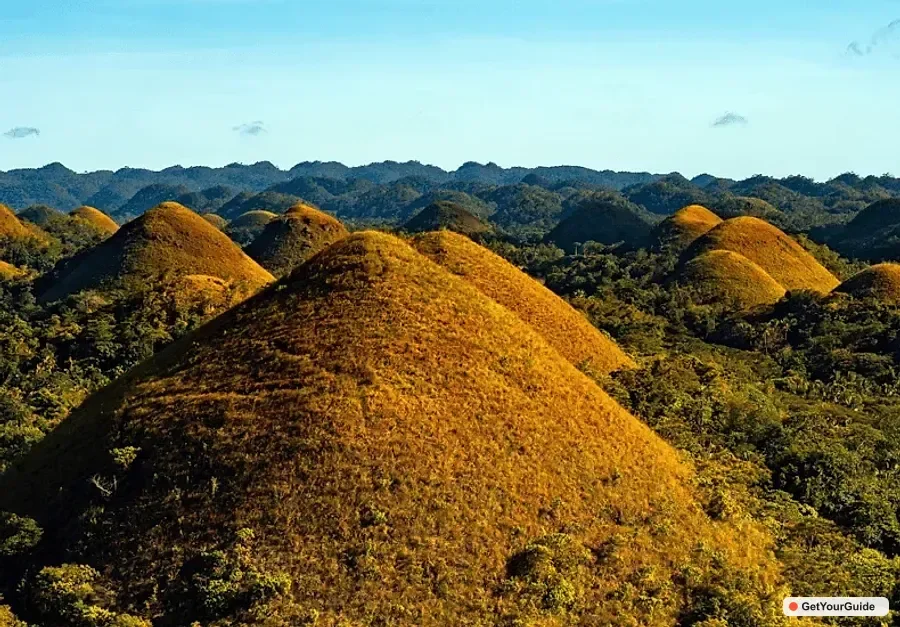
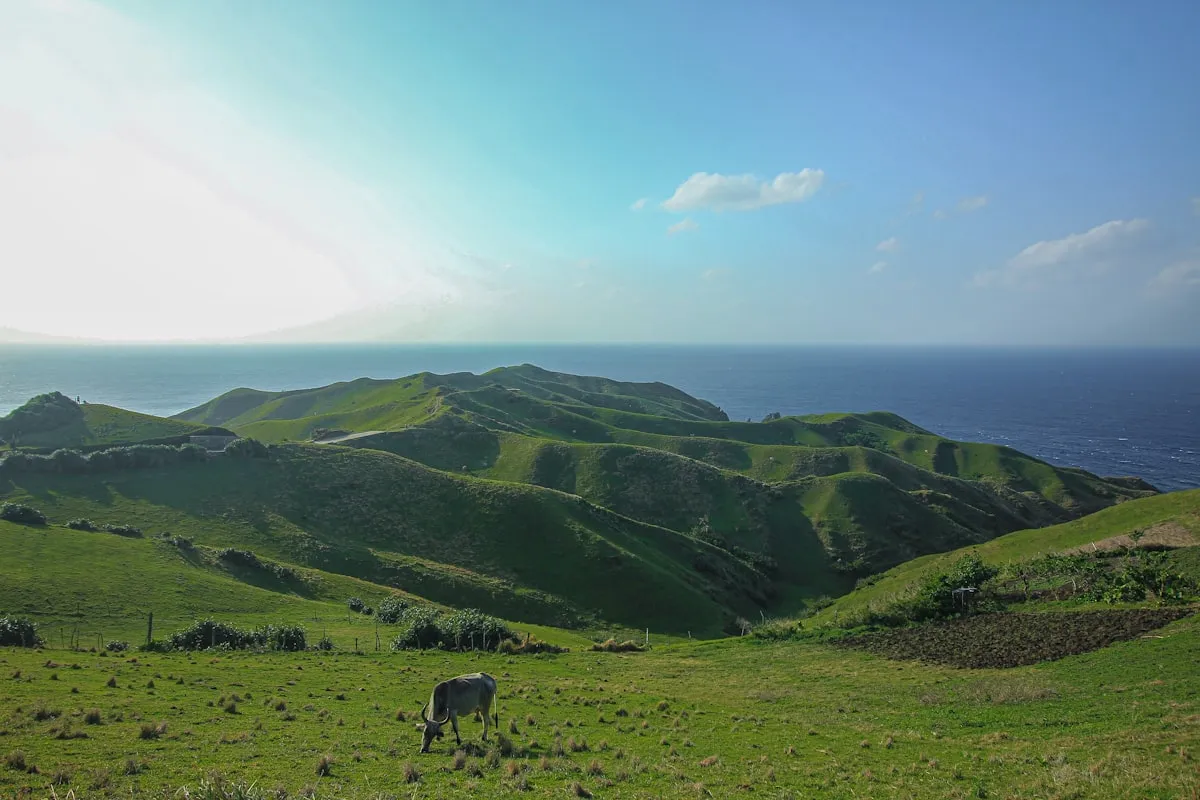
The Chocolate Hills are Bohol's most recognizable landmark and the reason many visitors make the crossing at all. Located in the municipality of Carmen, roughly an hour's drive north of Tagbilaran, the formation consists of more than 1,200 near-perfectly conical mounds rising from a flat valley floor. Scientists believe they are marine limestone deposits left behind when ancient seabeds were pushed upward by tectonic activity, then shaped into their rounded forms by millions of years of rainfall and erosion. During the dry season - roughly November to May - the grass covering them turns a rich coppery brown, giving the hills their edible nickname.
Trip.com
Chocolate Hills tour in Philippines
Hand-picked experiences in Philippines — book on Trip.com with instant confirmation.
The viewing complex sits atop one of the larger hills, reached by a staircase of more than two hundred steps. From the top, the identical-looking cones stretch to every horizon in every direction - a landscape so geometrically improbable it was declared a National Geological Monument in 1988. The view is most dramatic in the early morning, when the valley below still holds a thin layer of mist. A guided tour allows enough time to climb, photograph, and take in the scale before moving on.
The Man-Made Forest in Bilar
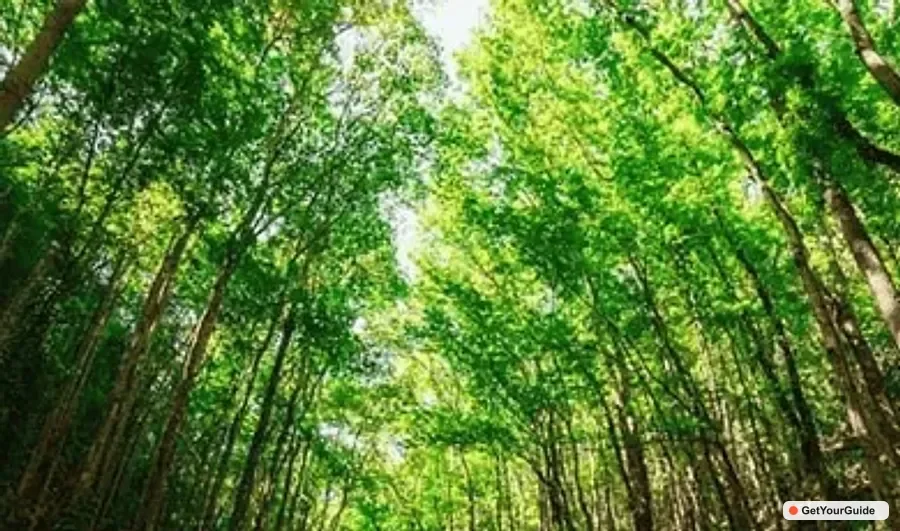
Between the Chocolate Hills and the tarsier sanctuary, the route passes through one of Bohol's most quietly impressive sights: a two-kilometre stretch of highway in Bilar town that runs through a dense, cathedral-arching grove of mahogany trees. Planted decades ago as a reforestation project, the trees have grown tall enough that their canopies lock overhead into a near-continuous tunnel of shade. Even on the warmest days, the air inside the grove drops noticeably. The road itself is narrow and the light filters through in shifting green columns, making this a favourite pull-over spot for photographs - particularly at midday when shafts of sunlight needle through the gaps in the leaves.
Philippine Tarsiers at the Tarsier Sanctuary
The Philippine tarsier - Carlito syrichta - is one of the world's smallest primates and one of Bohol's most emotionally resonant encounters. At the Tarsier Sanctuary in Corella, visitors walk a short trail through secondary forest where the animals rest in the branches at roughly eye level. Tarsiers are nocturnal, so during daytime visits they are completely still - gripping a thin trunk with oversized, padded fingers while their enormous amber eyes remain half-closed. Each eye is fixed in its socket and cannot rotate, which is why tarsiers must swivel their entire head to look around, a rotation that can reach 180 degrees.
The sanctuary operates under strict, visitor-friendly conservation rules: no flash photography, low voices, no touching. These rules are not merely courtesy - tarsiers are sensitive enough to stress that disturbance can cause them to harm themselves. A guide accompanies every group and points out individuals that might otherwise be invisible even at close range. The walk takes about thirty minutes and leaves most visitors with a lasting impression of something genuinely fragile being protected.
Baclayon Church and Bohol's Colonial Heritage
Standing near the waterfront in Baclayon town, the Church of Our Lady of the Immaculate Conception is one of the oldest stone churches in the Philippines. Franciscan missionaries began its construction around 1596, using coral stones cut from nearby reefs - a building technique common in the Visayas that gives the walls a rough, honeyed texture entirely different from the cut-limestone churches of Luzon. The church was badly damaged by the magnitude 7.2 earthquake that struck Bohol in October 2013, and restoration work has been ongoing since then, though the main structure and its adjacent convent-museum remain open.
The museum inside the convent holds a small but significant collection: vestments, religious statuary, antique bibles, and silver reliquaries dating back to the Spanish period. The church itself, even partially repaired, conveys the four-and-a-half centuries of continuous Catholic presence that defines Bohol's cultural identity.
Lunch on the Loboc River
The floating restaurant on the Loboc River is one of the most distinctively Filipino lunch experiences available anywhere in the country. Long, covered barges move slowly downstream past dense riverbank vegetation - nipa palms, bamboo groves, banana trees - while guests eat from a buffet of Filipino dishes including adobo, kare-kare, pancit, fresh rice, and tropical fruit. Local musicians often perform aboard, and at some points the boat docks briefly at a riverside village where children perform a traditional welcome dance.
The Loboc River itself is narrow and tannin-brown, lined so closely with greenery that the jungle seems to lean in from both sides. The current is barely perceptible. Herons stand in the shallows and kingfishers dart between the low branches. The whole meal takes roughly an hour - long enough to feel like a genuine rest after a full morning of sightseeing, short enough that energy remains for the ferry back to Cebu.
Best Time to Visit
The dry season between November and May produces the Chocolate Hills' signature brown colour and guarantees calm ferry crossings. December and January are the coolest and most comfortable months for sightseeing on foot. The wet season from June to October brings lush green hills - many people prefer the vivid colour - though ferry schedules occasionally shift during tropical storms. The tarsier sanctuary and Baclayon Church are rewarding at any time of year.
Practical Tips
Wear comfortable walking shoes - the Chocolate Hills staircase has more than 200 steps and the tarsier trail is unpaved.
Bring a light rain jacket between June and November; afternoon showers are common even during relatively dry periods.
Keep voices low and phones in silent mode at the tarsier sanctuary - these animals are genuinely stressed by noise.
Sun protection is essential at the Chocolate Hills viewpoint, which offers little shade at the summit.
The floating restaurant lunch is typically included; confirm with your operator whether the ferry fee is covered or paid separately.
Who This Tour Suits
This is an excellent choice for first-time visitors to the Philippines who are based in Cebu and want to see Bohol's landmarks without the logistics of planning an overnight trip. The pace is measured rather than rushed - a private vehicle means the group is not dependent on other travelers' schedules. Families with older children handle the day well; the tarsier sanctuary is a particular hit with younger visitors. The Chocolate Hills staircase and the uneven ground at Baclayon Church require reasonable mobility, but neither demands athletic ability. Anyone with a genuine interest in Philippine natural history, colonial architecture, or the sheer strangeness of a landscape that looks designed rather than geological will find this a thoroughly satisfying day out.
Good to know before you book
Duration: typically a full day (around 8 to 10 hours including transfers), though half-day and multi-day options exist - check the listing.
Best for: couples, families and first-time visitors.
What is included: transport, a guide and the main stops; entrance fees and lunch are sometimes extra.
Pickup: most tours offer hotel or central pickup; confirm your point and time when booking.
Book through: the GetYourGuide button on this page, which shows live availability and pricing.
Frequently asked questions
How long does the Bohol Day Tour from Cebu or Mactan (Private) take?
Most departures run as a full day - roughly 8 to 10 hours including pickup, travel and the activities themselves - so plan to set aside the whole day. Some operators offer shorter or private versions; the exact timing for your date is shown when you book through the GetYourGuide button on this page.
What is included in the Bohol Day Tour from Cebu or Mactan (Private)?
Typically the price covers transport, a guide and the main stops; entrance fees and lunch are sometimes extra. Inclusions vary by operator, so always read the specific listing - it spells out exactly what is provided and what you pay for separately, such as entrance or environmental fees.
What should I bring?
Pack comfortable shoes, sunscreen, a hat, water and small cash for entrance fees and souvenirs. It is also worth carrying some cash for local fees, drinks and tips, plus any personal medication, since card facilities can be limited outside the cities.
Is the Bohol Day Tour from Cebu or Mactan (Private) suitable for beginners or families?
It is gentle and family-friendly, suitable for all ages with only light walking involved - a comfortable way to see the highlights. If you have specific concerns about age, fitness or swimming ability, message the operator before booking - they can advise on the best option for your group.
When is the best time to do this tour?
The best conditions are usually the dry months of December to May, with calm seas for snorkelling and diving. That said, the Philippines is a year-round destination, and many of these experiences run in any season - just expect the occasional shower and check the forecast for the day.
How do I get to Cebu City?
To reach Cebu City, fly into Mactan-Cebu International Airport, then drive south (about 3 to 4 hours to the southwest coast). Many tours include transfers from nearby towns or hotels, so confirm your pickup arrangement when you book so the day runs smoothly from the start.
Do I need to book the Bohol Day Tour from Cebu or Mactan (Private) in advance?
Yes - booking ahead is strongly recommended, especially in the dry-season peak and on weekends, when popular tours and the best operators sell out. Reserving online also locks in your spot and lets you compare timings and inclusions easily.
How much does the Bohol Day Tour from Cebu or Mactan (Private) cost?
Prices vary with the season, group size and exactly what is included, so we do not list a fixed figure here. Tap the GetYourGuide button on this page to see the current, accurate price and availability for your chosen date.
Can I do the Bohol Day Tour from Cebu or Mactan (Private) as a private or customised tour?
Many operators offer a private version of this experience for couples, families or small groups who want a flexible pace and a guide to themselves, and some can tailor the route or add stops. If a private or custom option matters to you, check the listing or message the operator before booking, as availability and prices differ from the standard shared tour.
Ready to explore Cebu City?
From planning to the moment you arrive, the Bohol Day Tour from Cebu or Mactan (Private) is one of the most rewarding ways to experience this corner of the Philippines - and booking it is simple. Use the GetYourGuide button on this page to check live availability, compare timings and secure your spot, then turn up and let the local guides handle the rest while you focus on the views, the water and the memories.
The PANA.PH travel desk researches, books and re-checks Philippines travel logistics — fares, ferry schedules, government fees and permit rules — and publishes what it can verify.