Most travellers racing between Manila and Vigan never make it all the way to the top of Luzon. That's their loss — and your gain. Ilocos Norte, the province occupying the windswept northwest corner of the Philippines, is one of the most geographically dramatic and historically layered destinations in the entire archipelago. Nowhere else will you find towering sand dunes, a wind farm perched on sea cliffs, a UNESCO Baroque church, a presidential mausoleum, and one of the cleanest white-sand beaches in Southeast Asia — all within a single province smaller than a medium-sized American county.
Ilocos Norte Travel Guide: Sand Dunes, Windmills & Pagudpud White Sand Beach
Trip.com
Search on Trip.comHotels in Philippines
Compare live prices via Travelpayouts — targeted for this guide.
This guide covers everything you need to plan a proper Ilocos Norte trip: getting there, when to go, what to do, what it costs, and how to link it into the classic Ilocos route so you don't waste a single day.
Getting to Ilocos Norte
The easiest way in is by air. Laoag International Airport (LAO) is served by Philippine Airlines and Cebu Pacific from Manila Ninoy Aquino International Airport, with flight times of around one hour. Fares run roughly PHP 2,000–4,000 one-way booked in advance; last-minute fares can spike considerably. Philippine Airlines typically offers more schedule reliability on this route, while Cebu Pacific has seat sales worth watching if your dates are flexible.
Alternatively, several bus companies (Partas, Farinas, GV Florida) operate overnight coaches from Manila's Cubao or Sampaloc terminals to Laoag. The ride takes roughly 8–10 hours and costs PHP 700–1,100. Not glamorous, but a budget-conscious traveller who books an evening bus arrives in Laoag by early morning, ready to go — and saves both airfare and a night's accommodation.
Trip.com
See all tours in Philippines on Trip.comDiving in Philippines
Hand-picked experiences in Philippines — book on Trip.com with instant confirmation.

From Laoag City, tricycles and jeepneys serve the town centre, while private vans are the standard way to reach Pagudpud (1.5 hours north) and the other provincial highlights. Renting a van with driver for a full day typically costs PHP 2,500–3,500 and is absolutely worth it given the distances involved.
When to Go
Ilocos Norte sits in Climate Type 1 — essentially a dry season (November through April) and a wet season (May through October), with no prolonged dry spell mid-year. The ideal window is November through May. December through February brings the Amihan (northeast monsoon), which means cooler temperatures, light breezes, and clear skies across most of the province. March and April are hot but still dry — beach weather at Pagudpud is at its finest.
Avoid June through September if you can: Ilocos Norte is directly in the path of typhoons tracking westward across Luzon, and the northwest coast takes brutal hits. The Laoag Sand Dunes become impassable mud. Pagudpud beaches lose their charm in grey, choppy conditions. If you must travel during this period, October is the safest bet as typhoon frequency begins to drop.
Pagudpud and Saud Beach: The 'Maldives of the North'
Filipinos have taken to calling Pagudpud the "Maldives of the North," and while the comparison isn't strictly geographical, it captures the spirit of the place. Saud Beach — the main beach of Pagudpud — delivers a crescent of fine white sand, water that runs from turquoise at the shore to deep cobalt blue offshore, and a dramatic backdrop of green headlands. What it doesn't deliver is the Boracay-scale tourist infrastructure and the crowds that come with it.
Visitor numbers at Pagudpud are a fraction of those at Boracay or even El Nido. You can walk the full length of Saud Beach on a peak-season weekend and never feel crushed by sunbeds. There are no 7-Eleven franchises, no EDM beach bars pumping until 4 AM. What you get instead is a string of small family-run resorts and guesthouses, fresh seafood from the day's catch, and the kind of sunset that makes you forget your phone exists. Budget accommodation starts from PHP 600–1,200 per night for a clean fan room; better resorts with air-con and sea views run PHP 2,000–4,000.
Beyond Saud, explore Kapurpurawan Rock Formation — white limestone rocks sculpted by centuries of wind and wave into fantastical shapes — and Blue Lagoon Beach at Burgos, a smaller but equally stunning strip of sand less than an hour's drive away.
Laoag Sand Dunes: ATV, 4x4 and Sandboarding
The La Paz Sand Dunes sit just southwest of Laoag City and are among the largest active sand dune systems in Southeast Asia — an extraordinary landscape that seems genuinely out of place in a tropical archipelago. The dunes extend for roughly 2 kilometres along the coast and rise to heights of 30 metres in places, shaped by the relentless winds off the South China Sea.
The standard way to experience them is by ATV (PHP 500–800 for a guided 20-minute circuit) or 4x4 jeep (PHP 1,500–2,500 for a group of up to 10). The 4x4 option is the wilder ride — drivers deliberately power up steep dune faces and drop over the crests at speed, which is either thrilling or terrifying depending on your constitution. Sandboarding boards can be rented at the dune entry point for around PHP 150–200 and the technique is forgiving enough for beginners: sit, hold the board, slide, eat sand, repeat.
Sunset is the best time to visit — the low angle light turns the dunes golden and the shadows give the landscape a proper Saharan drama. Arrive by 4:30 PM in the dry season. A freshwater spring emerges at the base of the dunes near the beach, which makes for a surreal photo: white sand dunes on one side, crashing waves of the South China Sea on the other.
Burgos Windmills: The Most Dramatic View in Northern Luzon
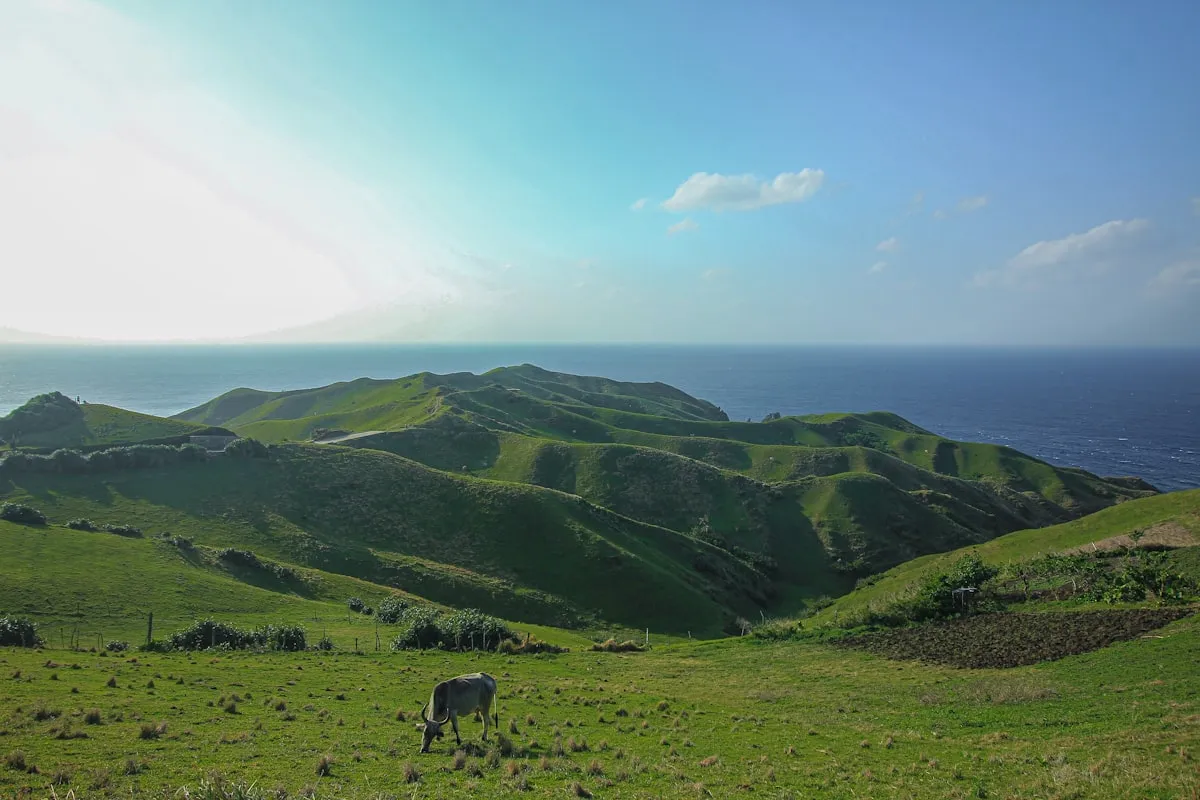
The Bangui and Burgos wind farms line the northern coast of Ilocos Norte along the South China Sea cliff edge, and the visual impact of giant white turbines spinning above a turquoise sea is genuinely remarkable. The Bangui Wind Farm, commissioned in 2005, was the first wind farm in Southeast Asia; the newer Burgos Wind Farm expanded the array significantly and now generates enough power to supply a substantial portion of Ilocos Norte's electricity needs.
From a traveller's perspective, the coastline here is one of the most photogenic in the Philippines — the combination of turbines, sea, and sky makes for images that look nothing like the tropical beaches most people associate with the country. There is no entry fee to walk along the shoreline near the turbines; just take a tricycle or jeepney heading north from Bangui town proper. Early morning light from the east backlights the turbines beautifully for photography.
Paoay Church: UNESCO Baroque Architecture
The Church of Saint Augustine in Paoay, built between 1694 and 1710, is one of four Philippine Baroque churches listed as a UNESCO World Heritage Site since 1993. What makes Paoay's church extraordinary is its "earthquake Baroque" style — the massive buttresses flanking the structure were added progressively by Augustinian friars who learned the hard way that the Ilocos coast sits on active fault lines. The result is a building that looks unlike any other church in the world: thick, stepped buttresses rising from the ground like flying fins, a coral-block facade worn to a warm amber-brown, a detached bell tower that served as a watchtower against Batanes pirates in the colonial era.
Paoay is 20 kilometres south of Laoag and easily visited on the way to or from the dunes. Entry to the church grounds is free; respectful dress (covered shoulders, no shorts for men) is expected inside. The surrounding Paoay Lake is a serene add-on — rent a bangka for PHP 150–200 for a 30-minute paddle.
Batac: The Marcos Mausoleum
History here is complicated. Ferdinand Marcos, President of the Philippines from 1965 to 1986, was born in the municipality of Sarrat in Ilocos Norte, and his body lies in a refrigerated mausoleum in Batac — a strange, time-stopped monument that draws a genuinely mixed crowd of fervent loyalists and curious observers. The body has been embalmed and preserved under glass since Marcos died in Hawaii in 1989, nine years after his family was forced into exile following the 1986 People Power Revolution.
Visiting is free and offers an unfiltered window into a deeply divided aspect of Philippine national identity. The museum adjacent to the mausoleum presents Marcos entirely in hagiographic terms — no mention of martial law, the 3,257 killings documented by human rights groups, or the roughly USD 10 billion looted from the national treasury according to the Philippine government's own Presidential Commission on Good Government. It is fascinating, troubling, and historically significant all at once. Whatever your politics, understanding this place helps you understand a great deal about the Philippines today.
Cape Bojeador Lighthouse
Standing on a promontory at Burgos, the Cape Bojeador Lighthouse was completed in 1892 and is considered the tallest and grandest lighthouse in the Philippines. The octagonal brick tower rises 20 metres and still functions as an active navigational aid. The views from the surrounding grounds out over the South China Sea are expansive — on a clear day you can see the mountains of the Cordillera to the east and the dark blue of the horizon to the west. There is a small entrance fee of around PHP 30. Combined with the nearby Burgos Wind Farm and Blue Lagoon Beach, this area makes an excellent half-day circuit from Laoag.
Budget and Planning
Ilocos Norte is genuinely affordable by Philippine standards. Budget travellers staying in fan-cooled guesthouses, eating at local carenderias (canteens), and travelling by jeepney and tricycle can manage on PHP 1,500–2,000 per day all in. Mid-range travellers with air-conditioned accommodation, a van hire for the sightseeing circuit, and sit-down restaurant meals can expect to spend PHP 2,500–3,500 per day. International resorts at Pagudpud push the ceiling higher.
Local dishes to try: bagnet (deep-fried pork belly, the Ilocano version of lechon kawali), pinakbet (vegetable stew with fermented fish paste), empanada Ilocana (fried pastry filled with egg, longganisa, and papaya), and dinengdeng (moringa and vegetable soup). All best eaten at a roadside eatery for PHP 60–120 per dish.
The Full Ilocos Route
Ilocos Norte connects seamlessly with Vigan to the south (the best-preserved Spanish colonial city in Asia, also a UNESCO World Heritage Site) and with Baguio via the mountain route through Abra province. A logical loop from Manila: fly Laoag, spend 3–4 days in Ilocos Norte (Pagudpud, sand dunes, Paoay Church, Burgos), take a bus south to Vigan for 2 days, then bus further south to Baguio for 2 days, then return to Manila by bus or domestic flight from Loakan Airport. This route covers one of the most culturally rich corridors in the Philippines in under 10 days.
Frequently Asked Questions
Is Pagudpud worth the trip from Manila?
Absolutely — if your goal is a genuinely unspoiled white-sand beach without the Boracay crowds. The total journey from Manila to Pagudpud takes roughly 1 hour by air to Laoag plus 1.5 hours by van north — under 3 hours total. That's comparable to or faster than reaching Palawan or Siargao, and Pagudpud costs significantly less once you arrive. The beach quality — white sand, clear water, minimal development — stands up to any comparison in the Philippines.
How many days do you need in Ilocos Norte?
Three full days is a comfortable minimum: one day for Pagudpud and the northern coast (Blue Lagoon, Kapurpurawan rocks, Burgos windmills and lighthouse); one day for Laoag itself and the sand dunes; one day for Paoay Church, Batac, and the Marcos sites. Four or five days allows you to slow down, take a boat off Pagudpud, and explore more of the back roads. Add two more days if you're continuing to Vigan.
What is the best way to get around Ilocos Norte?
For first-time visitors, hiring a private van with driver for PHP 2,500–3,500 per day is the most efficient option. Jeepneys and tricycles run between major towns but are slow and don't serve most tourist sites directly. If you're a confident rider, motorbike rental in Laoag costs around PHP 400–600 per day and gives you maximum flexibility — the roads are well-paved and traffic is light outside of Laoag City.
Can you combine Ilocos Norte with Vigan in one trip?
Yes, and this is highly recommended. Vigan is roughly 2.5 hours south of Laoag by bus or van, making the combination natural. Fly into Laoag, spend 3–4 days exploring Ilocos Norte, then take a bus south to Vigan for 2 nights. The contrast between the coastal drama of Ilocos Norte and the preserved colonial streets of Vigan is one of the most rewarding itinerary pairings in the Philippines. Flying out of Laoag works just as well on the return leg.
Is Ilocos Norte safe for tourists?
Yes, Ilocos Norte is one of the safest provinces in the Philippines for tourists. The Ilocano people are known throughout the country for being reserved, hardworking, and honest — petty crime targeting tourists is uncommon. The main practical hazard is the heat between March and May: carry water, use sunscreen, and take breaks during the midday hours. During ATV and 4x4 rides at the sand dunes, follow the guide's safety instructions and wear the helmet provided — the dunes are fun but the drops are steep.

PANA.PH Editorial Team
Philippines travel desk
The PANA.PH travel desk researches, books and re-checks Philippines travel logistics — fares, ferry schedules, government fees and permit rules — and publishes what it can verify.
🏡 Real local stays (book direct)
Hand-picked homestays and guesthouses — book direct, no markup.
Browse all local stays →
🌊 Popular activities (book instantly)
Island hopping, canyoneering, whale sharks — real Klook/GetYourGuide options.
View all activities →