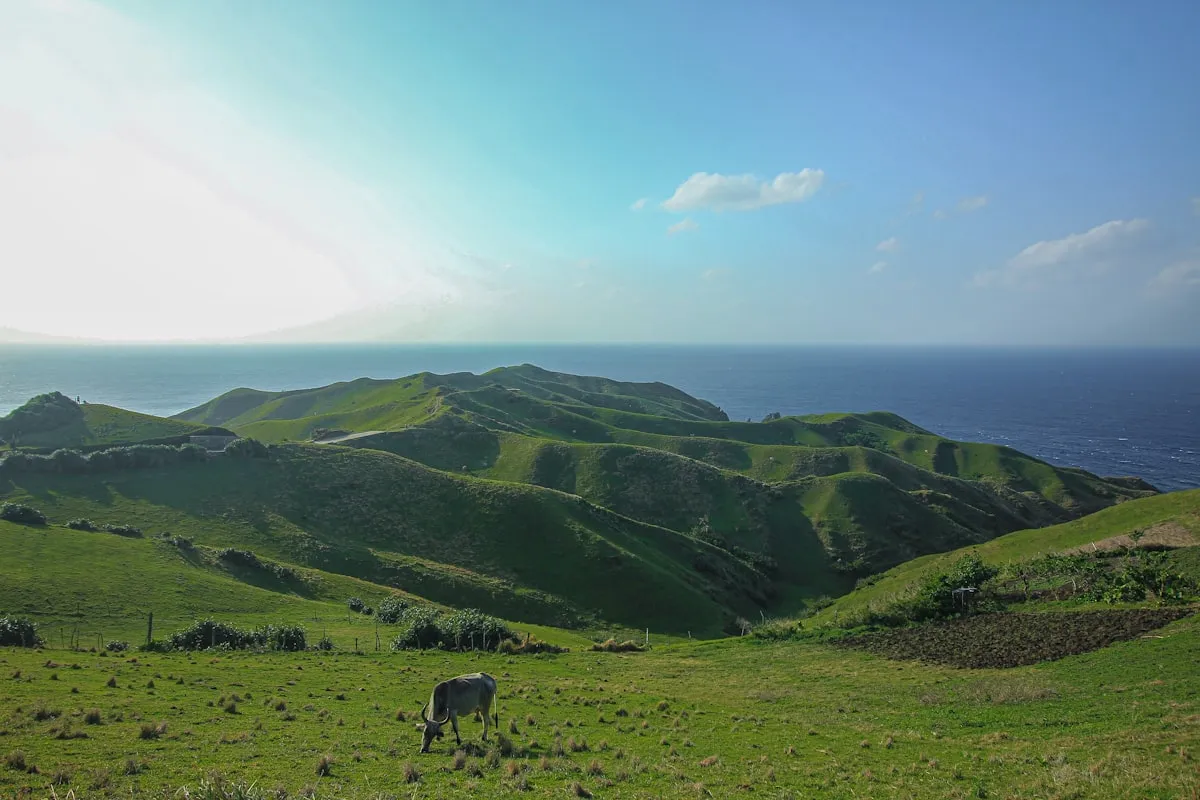
There is a moment, usually somewhere between the descent into Basco Airport and the first time you see a payag — the low-slung stone house the Ivatans have been building for four centuries — when you realize that Batanes is not a typical Philippine destination. The coconut palms thin out. The air turns cool and salted. Rolling hills of the deepest green tumble toward cliffs that drop straight into the Pacific, and somewhere north of you, just out of sight on a clear day, is Taiwan.
Batanes Travel Guide: The Philippines' Most Dramatic (and Remote) Province
Trip.com
Search on Trip.comHotels in Philippines
Compare live prices via Travelpayouts — targeted for this guide.
Batanes is the northernmost province of the Philippines. It sits at the collision point of two oceans and at least three civilizations, buffeted by typhoons for half the year and blanketed in extraordinary calm for the other half. Fewer than 20,000 people live here, spread across ten islands and three that are regularly visited. There are no malls, no fast-food chains, no traffic jams. There are, however, lighthouses, horses wandering untethered along coastal roads, and the kind of silence that makes you lower your voice out of instinct.
If you want to understand what the Philippines looked like before mass tourism arrived, come to Batanes before it changes.
Getting There: One Way In, One Way Out
Batanes is served by a single airport on Batan Island, and flights operate only from Manila. Philippine Airlines is the primary carrier, with Cebu Pacific occasionally operating seasonal routes. Expect to pay ₱4,000–₱8,000 roundtrip depending on how far ahead you book — and booking far ahead is not optional, it is mandatory.
Trip.com
See all tours in Philippines on Trip.comTours & activities in Philippines
Hand-picked experiences in Philippines — book on Trip.com with instant confirmation.


Seats on the twice-daily Manila–Basco route sell out weeks in advance, especially during peak season. If you turn up hoping to grab a last-minute fare, you will be disappointed. The rule of thumb: book flights at least two months ahead, ideally three or four if you are traveling in February, March, or April. The island has no contingency if you miss your flight window — the next available seat could be days away.
Flight time from Manila is approximately ninety minutes. No ferry from the main Luzon coast serves Batanes regularly. The plane is the only practical option.
When to Go: Choose Your Window Carefully
Batanes weather is not like weather anywhere else in the Philippines. Sitting in the path of typhoons that sweep up from the Pacific, the islands endure some of the most violent storms in the country. The typhoon season runs from June through November, and it is not a gentle one — several storms make direct landfall on Batanes each year, which is precisely why Ivatan architecture evolved to be so low, so thick-walled, and so indestructible.
The optimal travel window is February through May. February brings cool temperatures and the green hills at their most vivid. March and April are the driest months. By May, humidity climbs and the first hints of the approaching season appear on the horizon. Some travelers visit in January, which can be stunning but unpredictable. Avoid December through January if you want guaranteed flight stability.
The narrow season is part of what keeps Batanes uncrowded. Work with it, not against it.
The Three Islands Worth Knowing
Batan Island: The Hub
Batan is where you will land, sleep, and spend most of your time. The capital, Basco, is a quiet town of maybe a few thousand people — a main road, a church built in 1787, a handful of homestays, and a market that comes alive for a few hours in the morning and then quiets down again. Almost all accommodation on Batanes is on Batan, ranging from basic guesthouses to well-kept Ivatan stone house homestays where the family cooks your meals and you eat together at a long wooden table.
Sabtang Island: The Postcard
An hour by boat from Batan's Ivana Port (ferries cost around ₱400 each way), Sabtang is the island that ends up in every Batanes photograph. Its villages of ancient limestone and cogon-grass houses look like they belong to a different century entirely — because in many ways they do. Sabtang is compact enough to see in a full day, though an overnight here has a particular kind of magic to it.
Itbayat Island: For the Adventurous
The largest of the Batanes islands but the least visited, Itbayat requires a rough open-sea crossing that can take three hours or more and is frequently cancelled due to swells. There is no proper port — passengers are lowered into small boats by rope basket in rough conditions. If this sounds like your kind of thing, go. If not, Batan and Sabtang are more than enough.
What to Do on Batan Island
Marlboro Country
The name came from a cigarette advertisement filmed here in the 1980s, and the comparison is apt: rolling grasslands, wild horses, and views that stretch to the horizon. Marlboro Country, officially known as Racuh a Payaman, sits near Basco and is best visited at sunrise, when the light comes low from the east and turns the grass gold. A tricycle from town takes about ten minutes. Arrive early enough and you will have the hills entirely to yourself.
Vayang Rolling Hills
On the western coast of Batan, Vayang offers a different angle on the same dramatic landscape — here the green hills slope directly toward the South China Sea, and on clear afternoons the light on the water is something a photographer would not easily forget. The road there passes through small barangays where children wave from doorways and carabaos graze on the verge.
Naidi Hills Lighthouse and Cape Santiago
Two lighthouses bookend the Batan experience. The Naidi Hills Lighthouse sits above Basco, reached by a short walk up a hill that rewards you with the best panoramic view of the town, the bay, and the mountains to the south. The Cape Santiago Lighthouse on the southern tip of the island is more dramatic, perched on a cliff above rough water with nothing between it and the open Pacific.
Ivatan Stone Houses and Local Food
Wander Basco and the surrounding villages and you will find stone houses at every turn — many still lived in, some converted to homestays or small restaurants. The architecture is UNESCO-nominated for good reason: walls of volcanic limestone and cogon grass roofs engineered to survive Category 5 storms. Some of these houses have been standing since the Spanish period.
Eat what the Ivatans eat. Uvud — taro leaves slow-cooked with fatty pork — is the local staple, warming and rich. Dried flying fish is another specialty, smoked over coconut husks and served with rice. Tuba, the local coconut wine, is available at most homestays in the evening. It is sweeter than you expect and stronger than it looks. Drink it slowly.
Sabtang Island: A Closer Look
Cross from Ivana Port on Batan's southern tip and you arrive at Sabtang's small jetty. From there, a tricycle circuit covers the main sights in a morning. The village of Chavayan is the most photographed — its lanes are narrow, its stone walls thick, and the silence between them is absolute. Savidug is slightly less visited and slightly more beautiful, its houses stepped up a hillside with the South China Sea glittering below.
Morong Beach on Sabtang's northwest coast is not a tropical beach in the conventional sense — the water here is usually too rough for swimming — but the scenery is extraordinary: black volcanic sand, churning surf, and the limestone cliffs of the coastline stretching in both directions. The sunsets from this side of the island, over the South China Sea, are the kind that make you forget what you were thinking about.
Accommodation: Stone Houses and Family Meals
Batanes does not have hotels in the conventional sense. What it has are homestays inside Ivatan stone houses, where local families rent out a room or two and include three meals a day in the price. Budget ₱800–₱2,000 per person per night for this, depending on the property and the season. The quality is consistently good — Ivatans take genuine pride in hosting — and the meals are often the highlight of the day.
Book your accommodation at the same time you book your flights. The number of beds on Batan is finite, and they fill up fast during the February–April window. Email or message your preferred homestay directly; most communicate via Facebook Messenger.
Budgeting for Batanes
Be honest with yourself: Batanes is expensive by Philippine standards. The remoteness that makes it special also means that everything — food, fuel, building materials — has to be shipped or flown in. A realistic daily budget, including accommodation with meals, transport, and island-hopping boats, runs ₱4,000–₱6,000 per person per day. On top of that, add your flights from Manila, which are the biggest single expense.
That said, there is almost nothing to spend money on beyond these basics. There are no entrance fees to most viewpoints, no overpriced tour packages, no restaurants with international prices. The cost is simply the honest cost of being somewhere genuinely remote.
Practical Tips Before You Go
- Rent a scooter on Batan. At around ₱400 per day, a scooter is the best way to explore the island at your own pace. Roads are good, traffic is minimal, and the freedom to stop wherever the light looks right is worth it. An international driving permit is technically required; in practice, your Philippine or foreign license will do. Drive carefully — there are no hospitals here worth speaking of.
- Bring cash. There is an ATM in Basco, but it runs out of cash during peak season and is occasionally out of service. Bring enough pesos for your entire trip before you leave Manila. Most homestays and local vendors do not accept cards.
- Book flights 2–4 months ahead. This cannot be overstated. Batanes flights are the single most common reason people miss the trip they planned.
- Pack layers. Batanes in February and March can be genuinely cool by Philippine standards — think 18–22°C in the mornings. A light jacket is not optional.
- Download offline maps. Mobile signal exists in Basco but is unreliable in the hills. Download your maps before you leave the town center.
- Respect the culture. The Ivatans are among the most hospitable people in the Philippines, and they are also a community, not a theme park. Ask before photographing people, follow the rules at heritage sites, and leave nothing behind.
Why Batanes Is Worth Every Peso
The Philippines has extraordinary places. It has Palawan's lagoons and Boracay's sunsets and Siargao's barrels. But Batanes is different in a way that is hard to articulate until you have been there. It is a place where the landscape is genuinely dramatic, the culture is genuinely intact, and the experience is genuinely yours — not one shared simultaneously with ten thousand other travelers posting the same photograph.
The Ivatan stone villages are under consideration for UNESCO World Heritage status, and it is not hard to understand why. They represent an architectural tradition unique on Earth: buildings engineered by a people who had to survive, over centuries, among the most violent weather in the western Pacific. That these villages still stand, still inhabited, still beautiful, is a kind of miracle.
Mass tourism has not reached Batanes yet. It will, eventually. Go before it does — and go with the intention of leaving it exactly as you found it.
Frequently Asked Questions
Is Batanes safe to visit?
Yes, Batanes is one of the safest destinations in the Philippines. Crime is extremely low, the community is tight-knit, and visitors are genuinely welcomed. The main risks are weather-related: typhoons during the June–November season and rough seas that can cancel inter-island boats. Travel during February–May and you will have very few concerns.
How many days do I need for Batanes?
A minimum of four days, three nights allows you to explore Batan Island properly and take a day trip to Sabtang. Five to six days is better and gives you flexibility for weather delays or a second, slower look at places you loved. More than a week is possible but you will exhaust the main sights fairly quickly — the value of extra time is in slowing down, not in checking off more boxes.
Can I visit Batanes on a tight budget?
You can minimize costs, but there is a floor below which Batanes cannot be done. Flights alone are ₱4,000–₱8,000. Add ₱800–₱1,200 per night for the most basic homestay with meals and you are looking at a minimum of ₱15,000–₱20,000 for a four-night trip. By Philippine standards this is high; by the standards of what you get — a genuinely extraordinary and uncrowded destination — it is reasonable.
Do I need a guide in Batanes?
Not strictly, but a local guide adds context that you would otherwise miss entirely. Many homestay owners double as guides or can recommend one. For Sabtang Island in particular, a knowledgeable guide who can talk you through the history of Chavayan and Savidug villages transforms what might be a pleasant walk into something genuinely moving. Expect to pay ₱500–₱1,000 for a half-day guide service.
What is the best thing to do in Batanes?
There is no single best thing, but if forced to choose: watch the sunrise from Marlboro Country with a thermos of coffee and no particular agenda. The horses come and go. The light changes every few minutes. Taiwan is somewhere out there in the haze. It is the kind of morning that recalibrates something inside you — quiet in exactly the way that busy lives make you forget quiet can feel.

PANA.PH Editorial Team
Philippines travel desk
The PANA.PH travel desk researches, books and re-checks Philippines travel logistics — fares, ferry schedules, government fees and permit rules — and publishes what it can verify.
🏡 Real local stays (book direct)
Hand-picked homestays and guesthouses — book direct, no markup.
Browse all local stays →
🌊 Popular activities (book instantly)
Island hopping, canyoneering, whale sharks — real Klook/GetYourGuide options.
View all activities →