The Ivatan People of Batanes: Culture, Traditions & Way of Life
To understand Batanes, you must first understand its people. The Ivatan — the Indigenous inhabitants of the Batanes Islands, the northernmost province of the Philippines — are a community shaped by one of the most demanding environments on Earth: a group of small islands at the convergence of the Pacific Ocean and the South China Sea, directly in the path of typhoons that approach from the Philippine Sea, in near-total geographic isolation for most of their history.
The Ivatan response to this environment is not simply survival. It is a culture of extraordinary coherence and beauty — a set of material, social, and spiritual adaptations so specific to their place that they constitute something genuinely unique in the Philippine archipelago. Spending time in Batanes and paying attention to the Ivatan is one of the most culturally enriching experiences the Philippines offers.
Origins and Identity
The Ivatan are Austronesian people, part of the great maritime migration that populated island Southeast Asia and the Pacific over the past several thousand years. Their closest linguistic relatives are the indigenous peoples of Taiwan, a proximity that reflects the geography of Batanes — visible from Taiwan on clear days — and the ancient maritime routes that connected these islands.
The Ivatan language is distinct from Tagalog, Ilocano, and all other Philippine languages, though it shares structural similarities with Austronesian languages from Taiwan and the Batanes-Babuyan island chain. Most Ivatan today are trilingual: Ivatan at home and in the village, Filipino (Tagalog) for national communication, and English for education and tourism.
The Ivatan population numbers approximately 20,000–25,000, concentrated in the three inhabited islands of Batan, Sabtang, and Itbayat. They are a tight-knit community — the Batanes population has remained relatively small due to the limits of arable land and the practical challenges of island life — and family networks within the province are dense and multi-generational.
Traditional Architecture: Stone Houses Built for Survival
The most immediately visible expression of Ivatan culture is its architecture. Traditional Ivatan houses — still standing in remarkable numbers in the villages of Savidug and Chavayan on Sabtang Island, and in older sections of Basco — are built from two primary materials: limestone and coral stone for the walls, and cogon grass for the thick, steeply pitched roof.
The design is not aesthetic accident. The thick stone walls (typically 60–90 cm thick) provide mass and stability against typhoon winds. The low-pitched, densely thatched cogon roof — sometimes 60 cm thick — sheds water efficiently and resists being torn away by the extreme wind forces that accompany a major typhoon. Small windows, recessed and shuttered, minimise wind exposure. The overall profile is low and heavy — a house that hunkers down rather than stands up.
These architectural choices were tested repeatedly by storms that would have destroyed ordinary construction, and the Ivatan stone houses proved their value. In the villages where they stand today, centuries of typhoons have left them battered and weathered but fundamentally intact. Modern concrete construction has replaced stone houses for many Ivatan families, but preservation efforts and the heritage tourism economy have slowed the loss of the traditional built environment.
The Vakul: Functional Art in Woven Leaf
The vakul — a dome-shaped protective headgear woven from the dried leaves of the voyavoy palm — is the most widely recognised symbol of Ivatan culture. Worn traditionally by Ivatan women during fieldwork and rain, the vakul functions as a portable shelter: its dome shape and waterproof weave protect the head, face, and shoulders from rain and sun.
The vakul is made by weaving dried voyavoy leaves into a tight, overlapping pattern that becomes nearly waterproof when complete. The skill of vakul weaving is passed from generation to generation and represents a form of specialised knowledge that is both practical and artistic. A well-made vakul has a texture and geometric regularity that qualifies as genuine craft art.
Today the vakul is increasingly worn for festivals, cultural demonstrations, and when receiving tourists, rather than for daily fieldwork. The women who weave and sell vakul in Sabtang's villages are among Batanes' most important cultural practitioners, keeping a tradition alive through commerce as much as through sentiment.
Ivatan Agriculture: A Landscape of Terraced Fields
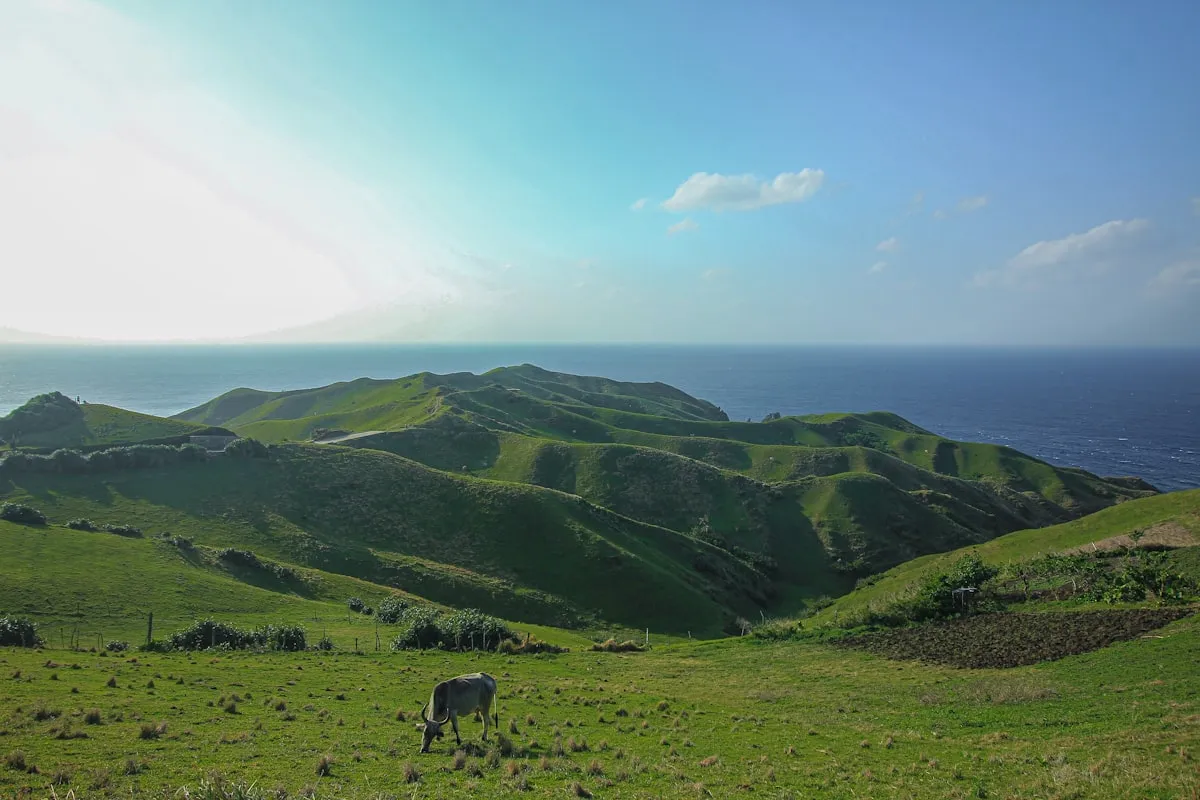
The traditional Ivatan agricultural landscape — visible throughout Batan and Sabtang — is characterised by small, stone-walled terrace fields carved from the hillsides, growing root crops (particularly camote, or sweet potato, a Batanes staple), vegetables, and some grain crops. The terracing controls water flow on the steep slopes and prevents erosion during the heavy rains that accompany typhoons.
Flying fish fishing — the Ivatan equivalent of the wet-season harvest — is a traditional seasonal occupation conducted in small wooden boats during the northeast monsoon. Flying fish (dorado) were historically dried and stored as protein reserves; today they remain a culinary speciality of the region, available fresh during the fishing season and dried year-round.
Social Structure and Community Values
Ivatan society is characterised by strong community solidarity — a value that makes practical sense in a small, isolated island community where collective action (building a house, hauling a boat, recovering from a typhoon) is essential for survival. The concept of ugnayan — mutual support and interdependence — is deeply embedded in Ivatan social practice.
The Catholic faith, introduced by Spanish missionaries in the 17th century, is central to Ivatan community life. Churches are the social as well as spiritual centres of each village; the local feast day (fiesta) is the most important annual community event, requiring preparation and participation from all families. The integration of Catholic practice with older Ivatan traditions has produced a religious culture with its own local character.
Ivatan Cuisine: What the Land and Sea Provide
Ivatan cuisine is determined by what the islands produce and preserve. Camote (sweet potato) in multiple forms appears at almost every meal. Flying fish — fresh, dried, or fermented — is the signature protein. Coconut and its derivatives (oil, vinegar, tuba or coconut wine) are central condiments and ingredients.
Luñiz (pork fat preserved in coconut vinegar) and uvud (banana blossom prepared in coconut milk) are distinctly Ivatan preparations with no equivalent elsewhere in the Philippines. The local bakeries in Basco produce a dense, slightly sweet bread called pandesal ivatan that is baked daily and consumed with coffee as the standard breakfast.
Visiting Ivatan Communities Respectfully
Batanes receives relatively few tourists — by Philippine destination standards, the numbers are tiny — and the communities in Sabtang and Batan remain genuinely unaccustomed to mass tourism. This means the experience of meeting Ivatan people is authentic rather than performed, but it also means that visitor behaviour matters more here than at established tourist centres.
- Ask permission before photographing individuals, especially in village contexts.
- Purchase crafts directly from makers — vakul, baskets, local food products — to ensure economic benefit reaches the community.
- Dress modestly in villages, particularly around churches and during community events.
- Greet locals in Ivatan: Namabaay kan (hello) goes a surprisingly long way.
Explore Batanes' cultural landscape properly with our Sabtang Island Cultural Immersion tour, which visits both Chavayan and Savidug with a local guide who provides cultural context. Our North Batan Island Tour covers the main viewpoints and heritage sites of the main island.
The Ivatan are proof that a small, isolated, storm-battered community can produce a culture of extraordinary richness — and that geography, rather than limiting human creativity, can inspire it to extraordinary heights.