MassKara Festival Bacolod: The City of Smiles Celebrates
Bacolod City is called the City of Smiles, and the MassKara Festival — held every October on the weekend closest to the city's founding anniversary on October 19th — is the annual proof that this nickname is earned. Thousands of dancers in elaborate masks and costumes fill the streets in a celebration that is simultaneously a political act of resilience, a cultural assertion of Negrense identity, and the most photogenic street festival in the Philippines. The name MassKara combines "mass" (crowd) and "kara" (face in Spanish), meaning "many faces" — a description of both the masked dancers and the multiple layers of meaning the festival carries.
MassKara was born from tragedy. In 1980, Bacolod was facing a confluence of crises: the global sugar crisis had devastated the Negros Occidental sugar industry that the city and its surrounding province depended on, causing widespread poverty and unemployment. And then, on April 22, 1980, the Don Juan ferry sank in the Tablas Strait, killing over 700 people — many of them Bacolod families who had been returning from Manila. The city was in mourning at the same moment it was in economic despair. Local government officials, working with artists and cultural workers, decided to respond by celebrating — to project optimism and resilience even in the face of genuine suffering. The MassKara Festival was created specifically to "wear a happy face" as an act of collective will.
The Masks: Art, Identity, and Transformation
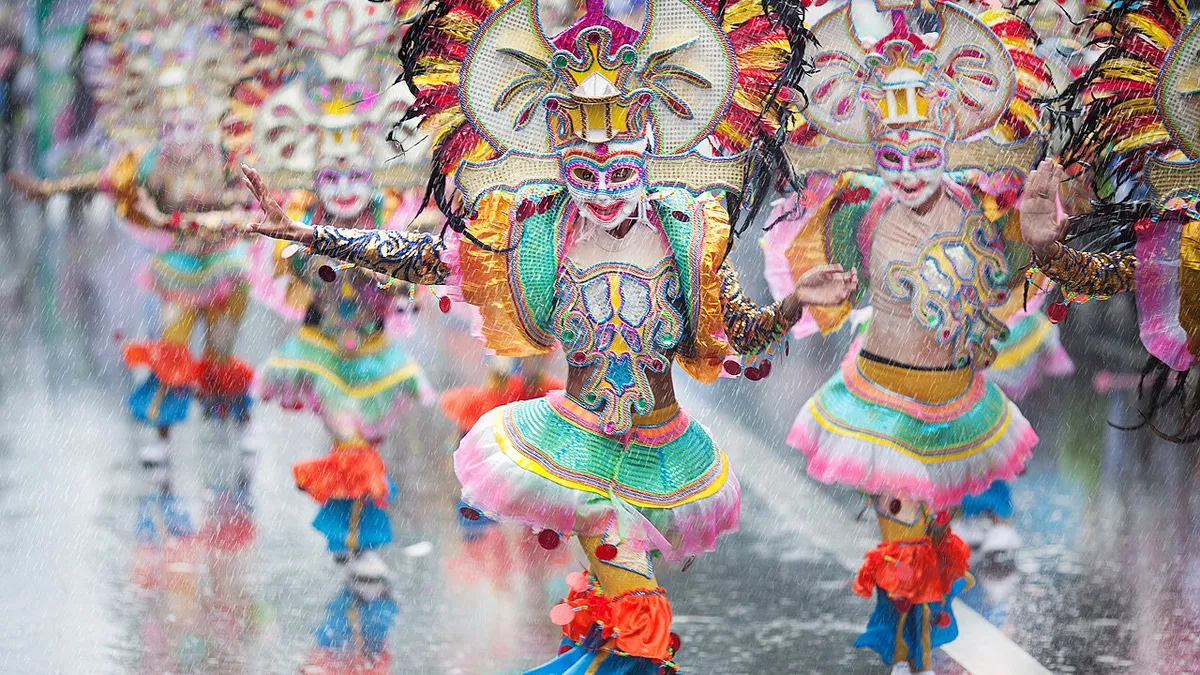
The central image of MassKara — the one that appears on every poster and photograph — is the mask: a stylized, wide-smiling face, elaborately decorated with sequins, feathers, and metalwork, worn by festival dancers over their own faces. The effect is striking and slightly surreal: hundreds of identical smiling faces processing through the streets in a choreographed display, the uniformity of the mask emphasizing rather than concealing the individuality of the bodies and movements beneath.
The masks are made by skilled craftsmen in Bacolod and throughout Negros Occidental, working year-round to produce masks that become increasingly elaborate each season. The base is typically papier-mache, shaped over a mold, then decorated with layers of paint, glass, rhinestones, sequins, feathers, and metalwork. The best masks sell for significant sums and are collected as works of art by Bacolod's sugar plantation families, who have historically been the patrons of the festival's most elaborate contingents.
The Street Dancing Competition
The centerpiece of MassKara is the street dancing competition, held on the Sunday closest to October 19th. Competing groups — each representing a barangay (neighborhood), school, or corporate sponsor — field hundreds of dancers in coordinated costumes, performing choreography they have rehearsed for months. The judging criteria cover costume creativity, choreography complexity, performance energy, and the maintenance of the characteristic MassKara smile even during the most demanding physical routines.
The dance style of MassKara is distinct from other Philippine festival dances: it incorporates elements of Spanish-influenced Philippine folk dance with contemporary performance movements, always filtered through the exuberant, crowd-engaging energy that the festival prizes. The best contingents perform with a physical intensity that makes clear how seriously they take the competition — these are not casual participants but dedicated performers who train for months specifically for this event.
The street dancing takes place along Lacson Street, Bacolod's main commercial thoroughfare, which is closed to traffic for the festival weekend and lined with temporary bleachers for spectators who have been holding their spots since early morning. The best viewing is from the elevated bleachers near the judging area, but the ground-level experience — being in the crowd as the contingents pass at close range — has an intensity that no bleacher seat can replicate.
The Electric MassKara: Nighttime and Carnival
MassKara does not end when the sun goes down. The festival spans an entire week, with events building in intensity toward the Sunday competition, and the nighttime activities are their own celebration. The Electric MassKara — held on select evenings during festival week — transforms Lacson Street into a lit spectacle: street dancers in illuminated costumes, LED-enhanced masks, neon lights on the floats. The overall effect is somewhere between a carnival and a music festival, with live performances, food stalls, and the kind of joyful, slightly chaotic energy that characterizes Bacolod at its most celebratory.
The Bacolod Convention Center and surrounding plazas host concerts during MassKara week featuring major Philippine artists alongside Negrense local performers. Tickets for the bigger concerts sell out weeks in advance. The free outdoor performances, held in the city's plazas, draw massive crowds who dance and eat through the Negros night.
MassKara Food: Bacolod at the Table
Any visit to Bacolod is incomplete without eating chicken inasal — the city's signature grilled chicken, marinated in vinegar, calamansi, lemongrass, and annatto oil, then grilled over charcoal until the skin turns deep orange and the meat stays miraculously juicy. MassKara week brings the city's inasal tradition into full public display: temporary grilling stations appear along the festival routes, filling the air with smoke and the smell of caramelizing annatto-marinated chicken. Manokan Country — the strip of open-air inasal restaurants near the provincial capitol — runs at full capacity for the entire festival week.
A Bacolod food tour during MassKara week covers both the festival food and the city's broader culinary identity: inasal, piaya (sweet muscovado-filled flatbread), napoleones (layered pastry with cream filling — a Bacolod specialty), and the rich food culture that has developed in the shadow of the sugar haciendas.
Practical Information: Attending MassKara Festival
MassKara Festival takes place in Bacolod City, the capital of Negros Occidental province, in October. The Grand Showdown (street dancing competition) happens on the Sunday closest to October 19th. Festival events run for approximately one week before and after this date.
Bacolod is served by the Bacolod-Silay International Airport, with multiple daily flights from Manila (approximately one hour) and connections from Cebu and other Philippine cities. Book flights and accommodation well in advance — the festival is one of the most popular in the Visayas and the city fills up completely during the peak weekend. Several Bacolod hotels offer festival-view rooms overlooking Lacson Street at premium prices that are, during MassKara, entirely worth it.
The festival is free to attend — the street dancing competition and the street party are open to the public. Grandstand seats for the competition are available for purchase and provide the best viewing angle. For the full MassKara experience, spend at least three days in Bacolod: arrive on Thursday or Friday to experience the buildup, attend the Saturday night events, and position yourself on Lacson Street on Sunday for the Grand Showdown. Then stay an extra day to recover and eat more inasal.