Camiguin Island: The Born of Fire Island with 7 Volcanoes
Somewhere in the Bohol Sea, a few hours north of Cagayan de Oro, there is an island that has more volcanoes per square kilometer than anywhere else on Earth. It is called Camiguin, it has a population of about 90,000 people, and it is the kind of place that makes experienced Philippine travelers go quiet when asked to describe it. Not because there are no words, but because the words feel insufficient.
Seven volcanoes on an island roughly 40 kilometers across. Hot springs that bubble out of the ground alongside cold waterfalls. A sunken cemetery visible from the surface. A white sandbar that appears from the sea like a mirage. One of the finest small-island experiences in Southeast Asia, and one of the least talked-about. This is Camiguin. It is waiting for you.
The Volcanoes: Understanding the Island's Character
Camiguin sits on one of the Pacific Ring of Fire's most active fault lines, and its geology reflects this with geological candor. The seven volcanoes, Hibok-Hibok, Mambajao, Guinsiliban, Uhog, Timpoong, Binangawan, and Mount Tres Marias, have shaped every aspect of the island, from its rich volcanic soil (which produces the sweetest lanzones fruit in the Philippines) to its hot spring resorts, its underwater topography, and the dramatic ridgelines that crown the interior.
Hibok-Hibok is the youngest and most active of the seven. It last erupted in 1953, killing 500 people. Today it is closely monitored by PHIVOLCS and is open to trekking with a guide. Most visitors experience Hibok-Hibok from the sea, its profile dominating the skyline as the ferry from Balingoan comes into port.
Getting to Camiguin
Most travelers reach Camiguin via the Balingoan-Benoni ferry. Balingoan is a port town about 3 hours from Cagayan de Oro by bus or van, and roughly 4 hours from Davao City. Ferries run regularly throughout the day and the crossing takes 45 minutes to 1.5 hours. Fare is about PHP 150 for regular passengers. There is also a direct flight connection from Cebu via Camiguin Airport (CGM), though schedules are limited.
Getting Around Camiguin
The circumferential road that loops the entire island is roughly 64 kilometers and can be driven in about two hours without stops. Most visitors rent a motorbike (PHP 400-600 per day) or hire a tricycle driver for the day (PHP 600-1,000 all-in, negotiable). Having your own wheels is strongly recommended since the island's attractions are spread around the circumference and public transport between them is infrequent.
The White Island: Camiguin's Defining Image
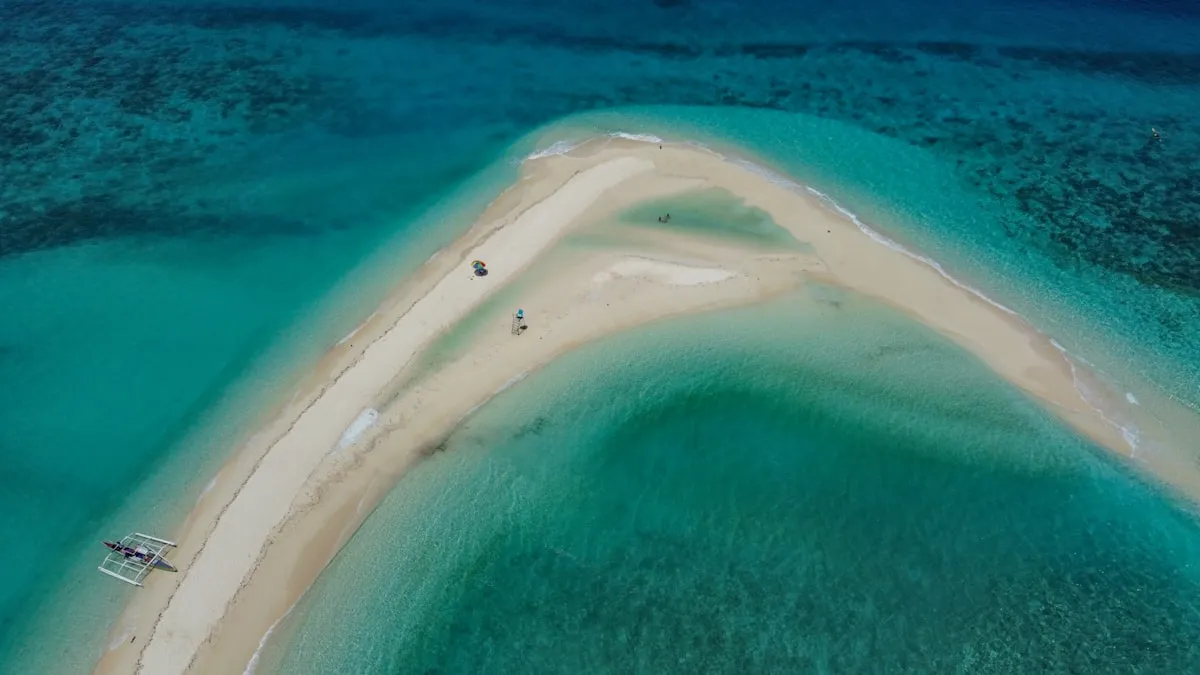
The image that defines Camiguin in every travel magazine is of a crescent of blinding white sand rising from turquoise water with a smoking volcano as backdrop. This is White Island, an uninhabited sandbar about 1 kilometer offshore from Agoho Beach that shifts shape with the tides and seasons. In the early morning, before other boats arrive, it is as close to a private paradise as the Philippines offers. A Camiguin island hopping tour typically combines White Island with the Sunken Cemetery Cross and Old Volcano snorkeling in a single half-day trip.
The Sunken Cemetery
In 1871, the volcano now known as Mount Vulcan Daan erupted so violently that it caused much of the local coastline to subsume beneath the sea, including the town of Catarman and its cemetery. Today, at about 5 meters depth, the tombstones and grave markers of Camiguin's 19th-century residents are still visible to snorkelers, festooned with coral and inhabited by schools of tropical fish. A large cross on a platform above the waterline marks the site.
Katibawasan Falls and Hot Springs
Katibawasan Falls drops 76 meters in a single plunge into a cold pool surrounded by mossy rock and dense rainforest, refreshing after the island's volcanic heat. The Katibawasan Falls and hot spring tour combines this cool plunge with a soak in one of Camiguin's volcanic hot springs. Ardent Hot Spring is the most developed and popular, open 24 hours and particularly magical after dark.
Lanzones Festival
If your schedule is flexible, time your Camiguin visit for the third week of October, when the island holds its Lanzones Festival. The festival features street dances in which performers wear lanzones-inspired costumes, cultural shows, and the opportunity to eat the sweetest, most perfectly balanced lanzones you will ever taste. Camiguin lanzones have a thin skin, minimal bitterness, and an almost honeyed sweetness that bears no comparison to mainland varieties.
Practical Information
- Best time to visit: April-June (driest months); October for Lanzones Festival
- Accommodation: Mostly small guesthouses and beachfront cottages in the Mambajao-Agoho area. Libro Beach Resort and Camiguin Action Geckos are popular with international travelers
- Money: ATMs in Mambajao town center; bring extra cash as they can run out on busy weekends
- Safety: Camiguin is one of the safest places in the Philippines. The local community is small, tight-knit, and genuinely welcoming
- How many days: Two nights, three days is the minimum. Four days is better. A week is not unusual for people who arrive planning to leave in three
Why Camiguin Stays With You
There is something about small volcanic islands that gets into the blood. The combination of geological drama and human warmth, of waterfalls and hot springs and sunken history, of mornings on a sandbar that appears to float between the sea and the smoking sky, Camiguin assembles these elements into an experience genuinely difficult to find elsewhere in the Philippines or anywhere in Southeast Asia. It is not flashy. It does not compete with Coron or El Nido for Instagram supremacy. It simply exists, beautiful and strange and alive, in the Bohol Sea, waiting for travelers who are paying attention. Pay attention. Come to Camiguin.