Camiguin is the second smallest province in the Philippines, a roughly oval island about 70 kilometers in circumference sitting in the Bohol Sea off the northern coast of Mindanao. It has more volcanoes per square kilometer than any other island on Earth - seven of them, including Hibok-Hibok, which last erupted in 1953. The combination of volcanic geology, colonial history, and extraordinary natural features makes Camiguin one of the Philippines' most rewarding destinations for travelers willing to venture beyond the standard Boracay-Palawan circuit.
Why Camiguin Is Called the Born of Fire Island
The island's very existence is volcanic. Camiguin rose from the sea through volcanic activity and continues to be shaped by geothermal forces - hot springs, gas vents, and the persistent dormancy (rather than true extinction) of its seven volcanic peaks. The most recent major eruption, from Mount Hibok-Hibok in 1953, killed over 3,000 people and buried the old town of Catarman, including its Spanish-era church. The ruins of that church now sit partially submerged underwater as part of the same sunken cemetery that has become one of Camiguin's most distinctive dive sites. Camiguin is a place where the violence of geological history is never entirely hidden from view.
White Island: The Perfect Sandbar
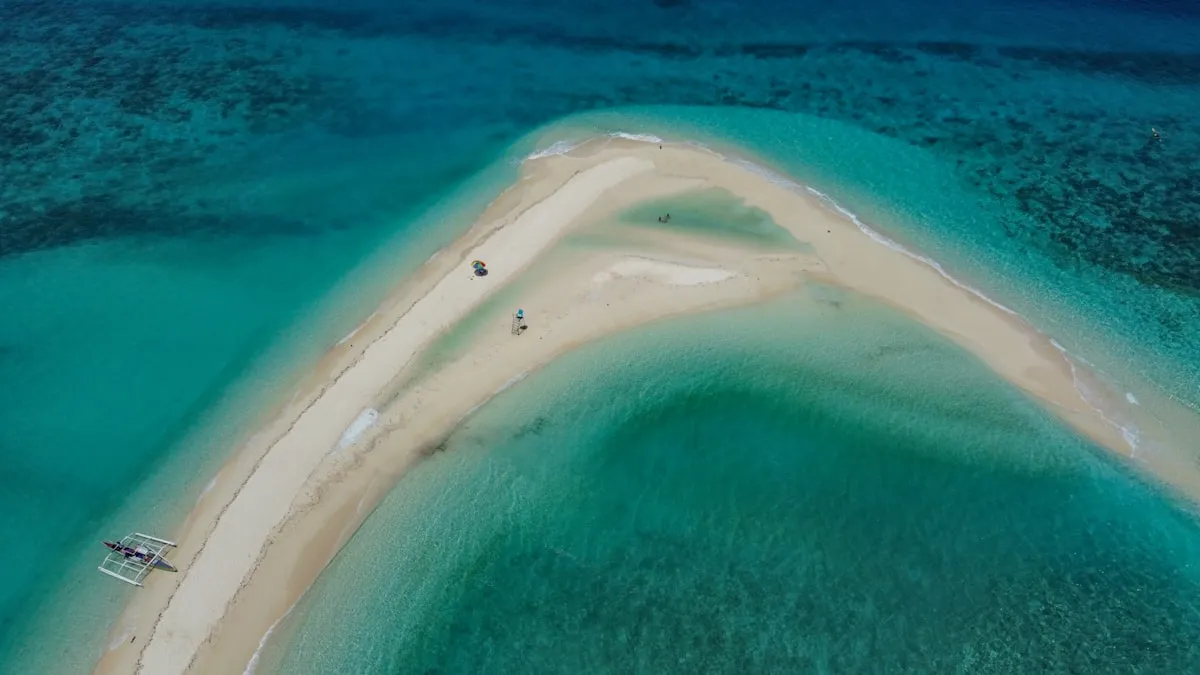
White Island is a crescent-shaped sandbar about 2 kilometers off the northern coast of Camiguin. It has no vegetation, no facilities, and no permanent structure - just brilliant white coral sand and the turquoise water of the Bohol Sea, with Hibok-Hibok volcano rising in the background. It is one of the most photographed images in Philippine tourism, and one of the few destinations where the photographs actually undersell the reality. Read our full Camiguin White Island guide for practical details on getting there.
The Sunken Cemetery
In 1871 a volcanic eruption submerged a section of the coast of Camiguin, taking with it a cemetery that has remained underwater ever since. A large cross has been erected on the surface above the site as a marker, and it is visible from shore. Scuba divers can explore the cemetery itself, which sits at 6 to 8 meters and contains coral-encrusted tombstones and grave markers still legible despite 150 years of submersion. The experience is haunting and extraordinary - a genuine memorial that the sea has claimed. Read our Sunken Cemetery diving guide for details.
Getting to Camiguin
The most common route is by ferry from Balingoan on the northern coast of Mindanao, about 90 minutes by bus from Cagayan de Oro (CDO). The ferry crossing to Camiguin takes about 1.5 hours and costs 150 to 200 pesos. Alternatively, Camiguin Airport (CGM) receives occasional flights from Manila on some small carriers - check availability when planning. Most travelers combine Camiguin with a visit to CDO, which has the nearest major airport and is the white-water rafting capital of the Philippines.
Getting Around Camiguin
The island has a circumferential road roughly 70 kilometers long that connects all the main attractions. The most flexible option is to rent a motorbike for 350 to 500 pesos per day and ride the entire loop at your own pace - a half-day for the highlights, a full day if you want to explore properly. Tricycles are available for shorter trips, and organized island-hopping tours cover the marine attractions (White Island, Sunken Cemetery, and nearby islets). Book our Camiguin island hopping tour for the full marine experience.
Other Camiguin Attractions
Ardent Hot Springs
Volcanic hot springs in the foothills of Hibok-Hibok, where heated mineral water fills a series of pools. The contrast between the heat of the springs and the cool mountain air around them is deeply restorative. Busy on weekends; quieter on weekday mornings.
Katibawasan Falls
A 76-meter waterfall that drops into a natural pool suitable for swimming. One of the tallest and most impressive waterfalls in the region. A short hike from the road through secondary forest.
Santo Nino Cold Spring
A natural freshwater spring with cool water maintained at a consistent temperature by the underlying geology. Popular with families. The water is so clear it appears turquoise in certain light.
Where to Stay in Camiguin
Mambajao is the island's main town and the most convenient base. Accommodation ranges from simple guesthouses at 500 to 800 pesos per night to mid-range resorts at 2,000 to 4,000 pesos. Several beach resorts along the northern coast offer comfortable accommodation with direct access to the water. Book well ahead during Holy Week (Easter) and December, when the island fills with domestic tourists.
How Long to Spend on Camiguin
Two days is the minimum to cover the highlights: White Island, the Sunken Cemetery, Ardent Hot Springs, and the main waterfalls. Three days is comfortable, allowing a full loop of the island and time to simply relax. If you are diving, budget an extra day for multiple dives at the marine sites. See our Mindanao 7-day itinerary for a suggested schedule that combines Camiguin with CDO and Davao.