Sisig, Lechon and Adobo: The Holy Trinity of Filipino Cuisine
Every cuisine has its icons — the dishes that define it, represent it abroad, and form the emotional bedrock of a nation's food identity. France has its croissant, boeuf bourguignon, and soupe a l'oignon. Japan has ramen, sushi, and tonkatsu. The Philippines has three dishes that stand above all others: sisig, lechon, and adobo. These are the meals Filipinos miss when they are overseas, the ones they cook to impress foreign visitors, the ones that spark the most passionate debates about whose version is best. Together, they tell the full story of Filipino cooking — its Spanish influences, its Chinese roots, its indigenous ingenuity, and its stubborn commitment to flavor above all else.
Adobo: The Dish That Built a Nation
Long before the Spanish arrived in 1565 and gave it a name, Filipinos were already cooking meat in vinegar and salt as a preservation method. The tropical heat made fermentation and acidic preservation essential. When the Spanish colonizers tasted this technique and applied their word "adobar" (to marinate), adobo was born — a Filipino creation with a Spanish name, which is as good a summary of Philippine history as any.
The basic formula is deceptively simple: meat marinated in vinegar, soy sauce, garlic, bay leaves, and black peppercorns, then braised until tender. But within that simplicity lies infinite variation. In the Visayas, some cooks add coconut milk toward the end, creating a richer, creamier version. In Batangas, they make it yellow-white with minimal soy sauce, letting the vinegar and turmeric carry the flavor. In Mindanao, coconut vinegar gives it a sweeter, more tropical acidity. The Ilocano version of the north adds the fermented shrimp paste binagoongan. In Pampanga — the culinary heartland — the definitive version is cooked low and slow until the liquid almost entirely evaporates and the meat fries in its own fat, emerging crispy, dark, and intensely flavored.
No two lolas (grandmothers) make adobo the same way. This is not a bug; it is the entire point. Adobo is the dish every Filipino cook personalizes, the dish that carries family memory. When Filipinos debate whose adobo is the best, they are also debating whose childhood was the most delicious.
The practical genius of adobo is that it gets better the longer it sits. Make it on Sunday, eat the best of it on Tuesday. The vinegar continues to work on the meat, deepening the flavor and extending shelf life. In a pre-refrigeration archipelago, this was culinary survival. Today, it is simply the best argument for cooking a large batch and eating it across the week.
You will find adobo everywhere in the Philippines: in home kitchens, in carinderias (neighborhood eateries), in fine-dining restaurants charging five times the usual price for a dish that costs almost nothing to make. The best adobo is rarely the most expensive. It is usually the one made by the person who has been perfecting it for forty years.
Lechon: The Festival on a Platter
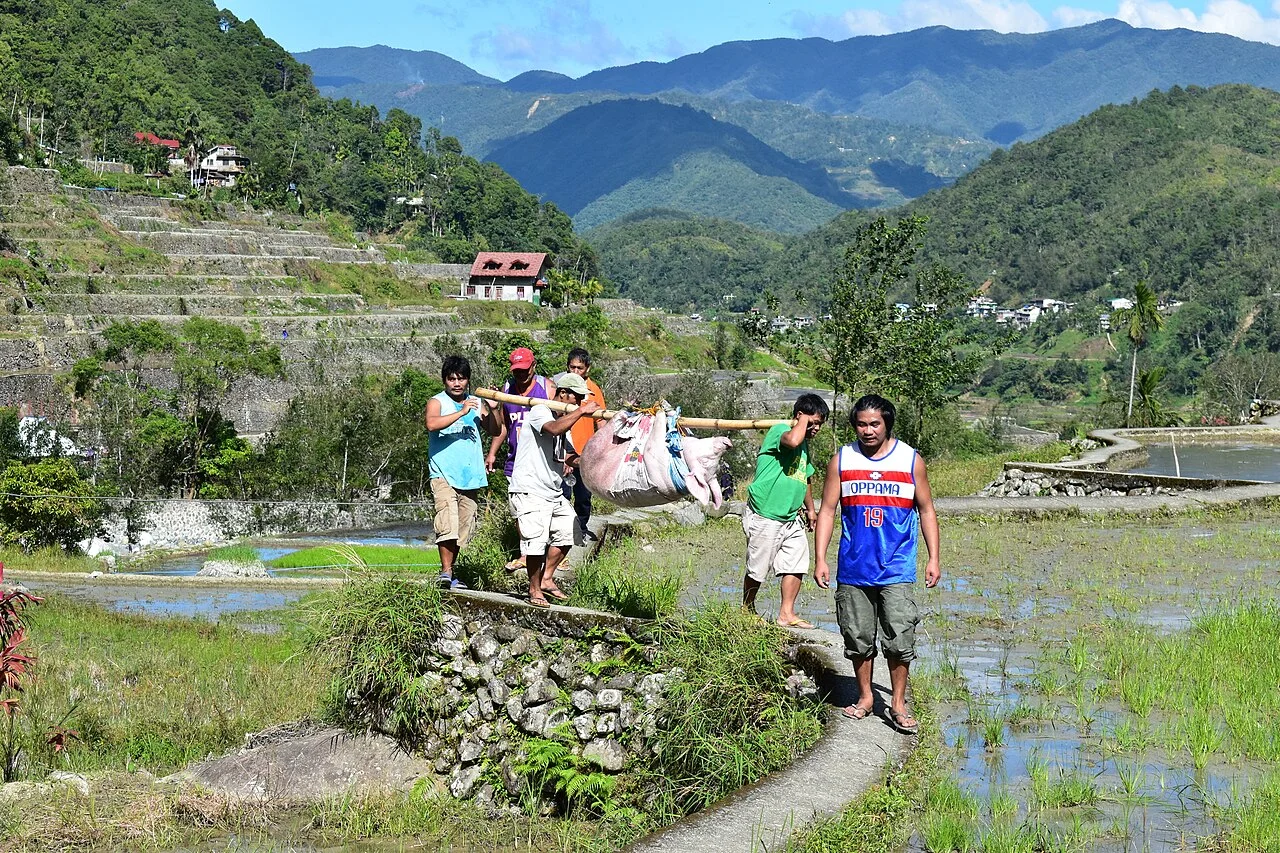
If adobo is the everyday, lechon is the extraordinary. A whole pig — sometimes weighing 50 kilograms — stuffed with lemongrass, garlic, spring onions, and bay leaves, skewered on a bamboo pole, and slow-roasted over a charcoal fire for four to six hours while workers rotate it by hand. The result is a dish of theatrical excess: amber skin so crisp it shatters at the lightest touch, meat so tender it falls from the bone, pork fat rendered to the consistency of silk. No fiesta in the Philippines is complete without one. No wedding, no birthday, no major celebration passes without a lechon at the center of the table, its glazed skin catching the light, surrounded by guests who are already planning their second plate.
The two great traditions of Philippine lechon are Cebu and Manila, and Filipinos have strong opinions about which is superior. Cebu lechon — particularly the version made famous by CNT Lechon and Rico's Lechon — is stuffed with tanglad (lemongrass) and salt-rubbed inside for a more assertive, aromatic flavor. The skin is brushed with water or beer during roasting until it achieves a mahogany color and glass-like crispness. Cebu lechon is eaten plain, without any sauce, because the flavors are complete without intervention. Celebrity chef Anthony Bourdain called Cebu lechon "the best pig, ever" on his television program, and the city has not stopped mentioning it since.
Manila lechon, meanwhile, comes with a companion: Mang Tomas, the iconic sweet liver sauce that counterbalances the pork's richness with sweetness and a faint offal note. The La Loma district of Manila is the traditional lechon country of the capital, with rows of lechoneros roasting pigs on their bamboo poles since the early 1900s.
Beyond the Cebu-versus-Manila debate, individual provinces have their own lechon traditions. Balayan in Batangas roasts its lechon for longer and serves it with native coconut vinegar. Some Visayan towns stuff the pig with indigenous herbs. The Pampanga version — naturally — involves a more complex internal seasoning with additional pork stuffing.
Ordering a whole lechon requires advance planning: most lechoneros require 24-48 hours notice. The cost depends on the size of the pig but is typically shared among a large group. For the solo traveler or small group wanting to experience lechon without ordering a whole pig, lechon manok (roasted chicken done in the same style) is widely available, as is chopped lechon sold by the kilo at Cebu's numerous lechon restaurants. A Cebu food tour will take you to the best lechon spots in the city, including the legendary stalls that have been roasting since before the internet existed.
Sisig: The Accidental Icon
Of the three members of this holy trinity, sisig has the most improbable origin story. It was not a traditional dish passed down through generations. It was invented in the 1970s by a cook named Lucia Cunanan, who ran a restaurant called Aling Lucing's in Angeles City, Pampanga. She took the pork face, ears, and cheeks that the American soldiers at the nearby Clark Air Base were discarding after using only the prime cuts, boiled and grilled them, then chopped the meat fine and served it sizzling on a heated clay pot with onions, calamansi (Filipino lime), and chili. She called it sisig, borrowing an old Kapampangan word for eating something sour.
The dish was a revelation. The combination of textures — crispy bits from the grill marks, soft inner meat, crunchy onion, the acid punch of calamansi, the heat of chili — made it immediately irresistible. Angeles City adopted it as its signature dish. From there, it spread across the Philippines with the speed and force of something the country had been waiting for without knowing it.
Today, sisig comes in dozens of variations. The original pork version is still considered the definitive form, but you will find bangus (milkfish) sisig, squid sisig, tuna sisig, tofu sisig, even ostrich sisig at ambitious restaurants. The arrival of a raw egg cracked on top — which cooks on the sizzling plate and gets stirred into the chopped meat — came later, added by later cooks, and is now standard at most restaurants. A cold San Miguel Pale Pilsen alongside sisig is one of the great food-and-drink pairings in Philippine cuisine.
The spiritual home of sisig is still Pampanga, specifically the open-air restaurants along MacArthur Highway in Angeles City where vendors have been serving it since Aling Lucing was alive. A Pampanga food tour will take you through the culinary heartland that produced sisig, tocino, longanisa, and the most sophisticated fermented condiments in the Philippine culinary canon.
Why These Three Define Filipino Food
Adobo, lechon, and sisig represent different facets of Philippine culinary genius. Adobo is adaptation and preservation — the indigenous technique transformed by colonial contact into something uniquely Filipino. Lechon is abundance and celebration — the whole animal sacrificed for the feast, the visible expression of generosity that Filipinos call pakikisama (togetherness). Sisig is ingenuity and improvisation — the use of discarded parts to create something more delicious than the prime cuts they came from, a metaphor for what Filipino cooks have always done with whatever ingredients history handed them.
Together, these three dishes sketch the emotional map of Filipino food: the everyday richness of adobo, the festive excess of lechon, and the brilliant resourcefulness of sisig. Eat all three and you will understand something essential about the Philippines — about a culture that has survived colonization, typhoons, and poverty through an unbreakable belief that a good meal, shared with people you love, is always worth making.
Start your exploration of Philippine cuisine with a food tour through Manila, where all three of these dishes are available within a short walk of each other. Or head directly to Pampanga — the province that arguably perfected all three — for the most concentrated Filipino food experience in the country. A Kapampangan cooking class will teach you to make adobo and sisig from scratch, under the guidance of cooks whose families have been perfecting these recipes for generations.
The holy trinity of Filipino cuisine is waiting. All you have to do is arrive hungry.