PHPANA.PH Team · Philippines travel teamPublished June 4, 2026 · 5 min read
Ilocos Norte Grand Tour: Windmills, Pink Sand & Spanish Churches
Ilocos Norte sits at the very top of Luzon, where the land tapers to a narrow, wind-battered coastline before the South China Sea takes over. It is the kind of place where the landscape feels almost operatic — volcanic mountains to the east, churning seas to the west, and in between a strip of coast packed with an extraordinary variety of sights: giant wind turbines, a pink-sand lake, baroque churches that have outlasted earthquakes and colonisers, and beaches so blue they seem photoshopped.
Most travellers rush through Ilocos Norte on a day trip from Laoag, ticking off the windmills and heading back before sunset. That is a mistake. This province deserves at least two full days — ideally three — to be properly understood and enjoyed.
Laoag: Your Base and Gateway
The provincial capital, Laoag City, has a small but functional airport served by Cebu Pacific and Philippine Airlines from Manila. Most travellers fly in, spend a night, and use Laoag as a base for day trips north to Bangui and Pagudpud, east to Paoay, and south towards Vigan.
Book Philippines tours & activities
Island hopping, whale shark watching, canyoneering and more. Best prices on GetYourGuide & Klook.
Downtown Laoag is worth a morning stroll. The Sinking Bell Tower — a 16th-century campanile that has sunk several metres into the soft alluvial ground over the centuries — is one of the most photographed monuments in northern Luzon. The adjacent St. William Cathedral and the Tobacco Monopoly Monument complete a compact colonial heritage circuit that takes less than two hours on foot.
Paoay Church: Earthquake Baroque at Its Finest
Twenty-three kilometres south of Laoag, Paoay Church (officially St. Augustine Church) stands in the lakeside municipality of Paoay as one of the supreme achievements of Philippine colonial architecture. Built by Augustinian friars over several decades from the late 17th century, the church is the defining example of what historians call Earthquake Baroque — a distinctly Philippine architectural adaptation in which massive buttresses are added to reinforce structures against the seismic activity that periodically rocks the archipelago.
The buttresses of Paoay Church are not mere structural additions — they are dramatic, sculptural elements that give the church an almost fortress-like solidity. The facade blends Baroque ornamentation with Chinese decorative motifs brought by immigrant craftsmen, a fusion that resulted in a style found nowhere else on earth. A UNESCO World Heritage Site since 1993, it remains an active parish church serving the community.
Nearby, the shores of Paoay Lake offer a serene landscape of still water framed by the volcanic cone of Mount Ilocos. The infamous Marcos Museum (built on the grounds of the former Malacañang of the North, the Marcos family vacation palace) sits here — a deeply contested historical site that visitors can explore with complicated feelings but genuine historical interest.
Bangui Windmills: The Iconic Image of the North
Drive north from Laoag along the coastal highway and after about an hour you will see them: a row of white wind turbines, each standing 70 metres tall, lined along a dark-sand beach with the South China Sea churning behind them. The Bangui Wind Farm — the first wind energy facility in Southeast Asia — has become the defining visual symbol of Ilocos Norte.
The turbines are best seen in the late afternoon when the setting sun turns the sea golden and the mountains inland go purple. Getting there at sunrise is even more dramatic — the turbines emerge slowly from mist, and you may have the beach almost entirely to yourself.
The dark volcanic sand of Bangui Beach itself is worth lingering on. It has a wild, elemental quality — powerful waves, driftwood, the constant sound of turning blades above. Swim carefully; currents can be strong.
Kapurpurawan Rock Formation
A short drive from Bangui, the Kapurpurawan Rock Formation is one of those Philippine sights that seems almost artificially beautiful: pure-white coral rock formations sculpted by centuries of wind and waves into abstract shapes, rising from a pristine coastline. The name means "whitened by the waves" in Ilocano, and the description is accurate — the rocks gleam so brilliantly in sunlight that photographs look like they have been over-edited.
Visit at low tide when you can walk between the formations. Wear shoes with grip — the rocks are jagged. Sunrise and golden hour produce the best light.
Pagudpud: The Emerald Shore at the End of the Road
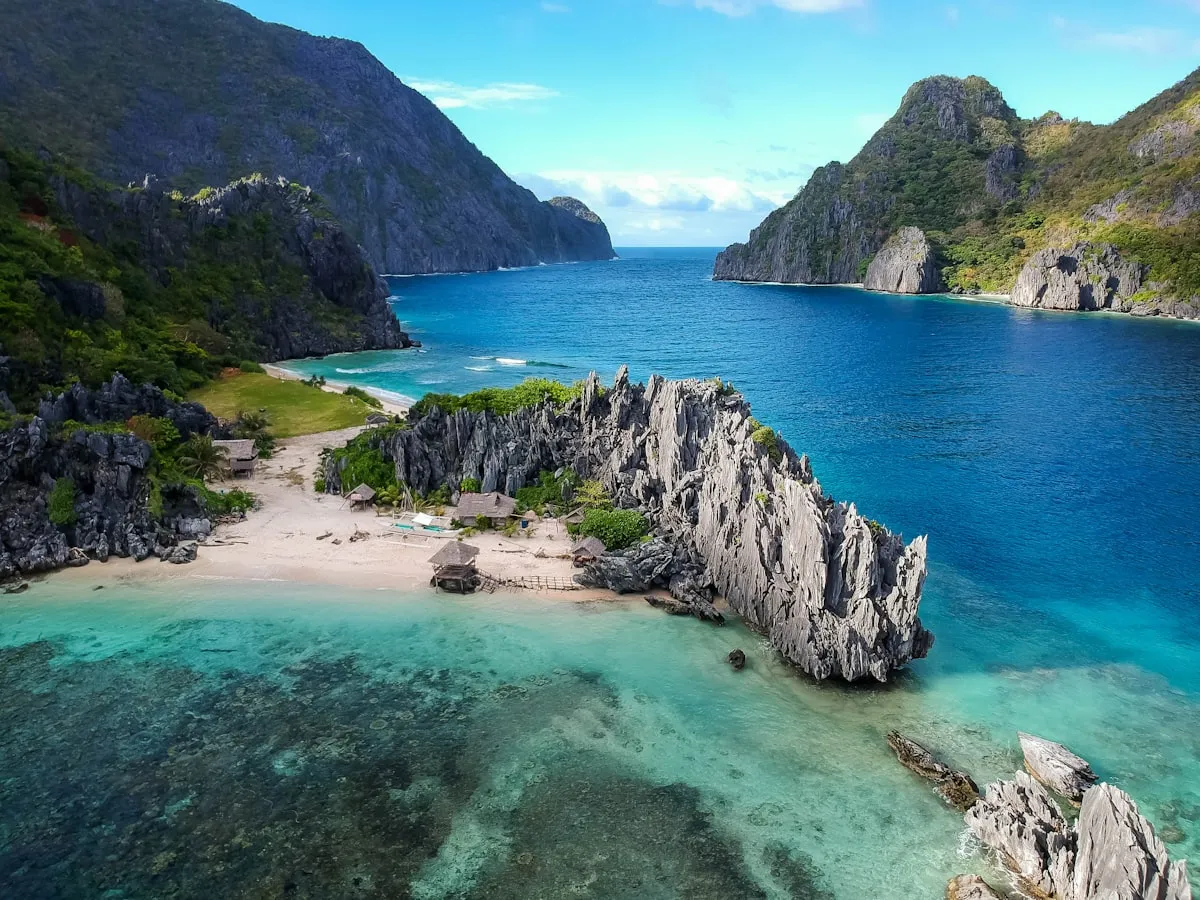
Pagudpud is as far north as the road goes in Ilocos Norte. The town sits on a bay of startlingly blue water — Blue Lagoon Beach — that consistently shocks first-time visitors. The water is the kind of impossible turquoise that belongs in Bohol or Palawan, not this far north. Saud Beach, just west of Blue Lagoon, offers calmer water and a broader stretch of sand.
Both beaches are dramatically less crowded than comparable spots in the Visayas. Infrastructure is simpler — a handful of resorts, local eateries, no beach clubs playing techno. That is entirely the point. Pagudpud rewards travellers who arrive expecting nature, not amenities.
The coastline around Pagudpud also features the Patapat Viaduct — a bridge perched on cliffs above the sea that is one of the most scenic drives in the Philippines — and several waterfalls accessible by short hikes inland.
Planning Your Ilocos Norte Grand Tour
The ideal itinerary moves north from Laoag: morning at Paoay Church, afternoon at Bangui windmills and Kapurpurawan, overnight at Pagudpud, full beach day on Blue Lagoon, then loop back via the interior or south to Vigan. A rental car or hired van is the most practical way to do this; tricycle and bus combinations work but consume significant time.
Book our Ilocos Norte Grand Tour for a fully guided circuit covering Paoay, Bangui, and Pagudpud in one sweeping day. For dedicated beach time, the Pagudpud Saud Beach & Blue Lagoon tour lets you linger where it matters most. And for the windmill experience in depth, try our Bangui Wind Farm & Kapurpurawan half-day tour.
Practical Information
- Getting there: Fly Manila–Laoag (1 hour, Cebu Pacific/PAL) or take an overnight bus (9–11 hours).
- Best time: November–April (dry season). The Ilocos region is one of the driest in Luzon during the northeast monsoon.
- Transport: Rent a car or hire a local driver-guide from Laoag (PHP 2,500–4,000/day including fuel).
- Budget: Mid-range at PHP 1,500–3,000/day excluding accommodation. Budget guesthouses from PHP 800/night.
Ilocos Norte is the Philippines at its most dramatic and most historically layered. Come for the windmills, stay for the churches, and leave wondering why it took you this long to get here.